


The anti-lock braking system (ABS) consists of an electronic control unit (ECU), wheel speed sensors, a hydraulic unit 1 (Fig. 1) with hydraulic solenoid valves, an electrically driven return pump, and a warning lamp 4 in the instrument cluster.
ABS is used to regulate the pressure in the brake mechanisms of all wheels when braking in difficult road conditions, preventing wheel locking.
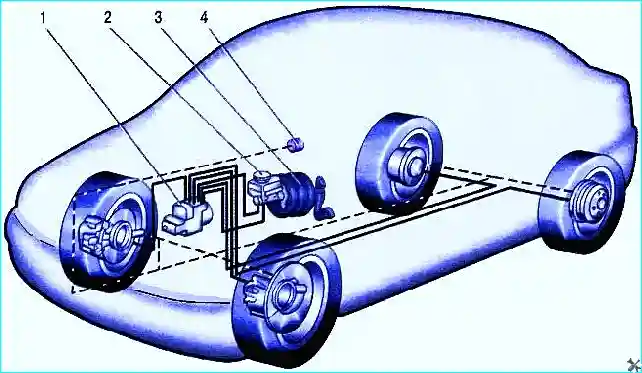
The system provides the following advantages:
- - avoiding obstacles with a higher degree of safety, including in emergency situations braking;
- - reducing the braking distance during emergency braking while maintaining directional stability and control of the vehicle, including when turning.
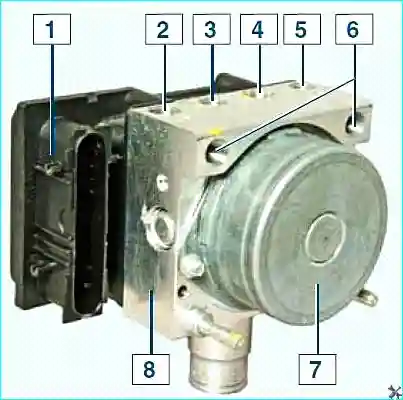
In the event of a system malfunction, a function is provided to maintain operation during system failures.
The electronic control unit (ECU) receives information about the vehicle speed, direction of travel, and road conditions from the wheel speed sensors.
Based on this information, the control unit determines the optimal wheel braking mode by changing the flow cross-sections of the circuits using the electromagnetic valves of the hydraulic unit, anticipating the moment of locking of the wheel that slows rotation, thereby preventing it from locking.
If the system suspects that a wheel is locking, it commands the corresponding valve to isolate the fluid supply to the slave cylinder of that wheel from the master cylinder.
If the wheel speed continues to decrease compared to the other wheels, the ABS system returns brake fluid back to the master cylinder, weakening the braking effect.
If all four wheels slow down equally, the return pump will disengage and all electromagnetic valves will reactivate. open, allowing the master cylinder to act on the wheel cylinders in the normal mode.
This cycle can repeat up to ten times per second.
Activation of the solenoids and the return pump creates pulsations in the hydraulic drive of the brake system, which are transmitted to the brake pedal, thereby signaling to the driver that the ABS is operating.
The solenoids in the front brake circuits act on their wheel cylinders independently, each separately, while the solenoid valve in the rear brake circuits acts on both wheel cylinders simultaneously.
Since the braking system is diagonally divided, a separate mechanical plunger valve in the hydraulic block divides the hydraulic output of the rear solenoid valve into two separate circuits.
To prevent false signals from affecting the system, a built-in safety circuit monitors all signals coming into ECU.
If a false signal is received or the on-board electrical system voltage is insufficient, the system automatically switches off, and the ABS deactivation indicator light in the instrument cluster illuminates.
In this case, normal braking operation remains. However, extreme caution is required when driving on slippery roads, as the system's distribution function (the function of equalizing the pressure in the front and rear brake mechanisms) is impaired, increasing the risk of skidding during braking.
If a malfunction occurs in the ABS system, contact a service station, as diagnosis and repair require specialized equipment.
The hydraulic brake system is integrated into a single unit by metal tubes and hoses.
The system is filled with a special brake fluid of at least DOT-4 grade, which must be replaced periodically.


