


According to the manufacturer's recommendation, the coolant should be changed after 6 years of operation or 90,000 km, whichever comes first.
Fill the cooling system with GLACE0L RX antifreeze (type D).
You will need: coolant, a clean rag, a container with a minimum capacity of 10 liters for draining the coolant, and pliers.
Change the coolant only when the engine is cold. Coolant is toxic, so be careful when handling it.
The expansion tank cap must be closed when starting the engine.
Tighten the expansion tank cap securely.
The cooling system is under pressure when the engine is running, so coolant may leak from a loose cap.
Place the vehicle on a level surface.
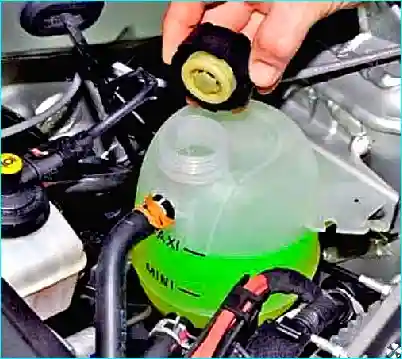
Remove the expansion tank cap.
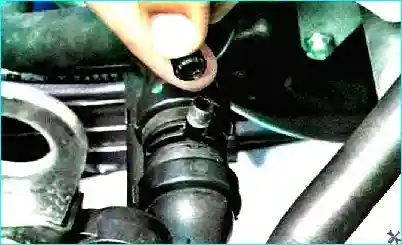
Unscrew the air bleeder plug.
Remove the engine sump guard.
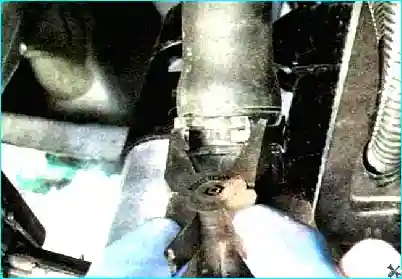
Using pliers, squeeze the clamp on the lower radiator hose and slide the clamp down the hose...
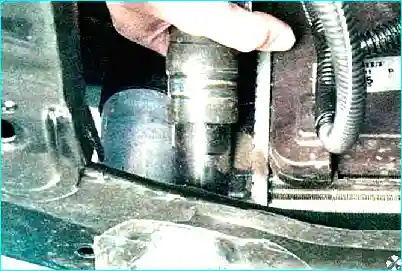
Remove the hose from the radiator hose and drain the coolant into a suitable container.
Antifreeze is deadly to all living things. To avoid polluting the environment, drain it through a funnel (for example, made from a plastic soda bottle).
After draining the coolant, tighten the bleeder valve cap.
Fill the expansion tank with water to flush the system.
Pump compressed air into the expansion tank to blow out as much water as possible from the cooling system.
Connect the lower hose radiator.
Install the engine crankcase guard.
Fill with coolant (the bleeder valve plug must be removed).
After air stops escaping from the valve and liquid appears, tighten the bleeder valve plug and the expansion tank cap.
Start the engine, increase the crankshaft speed to 2500 min¹ and let it run until the fan turns on.
After this, turn off the engine, check the coolant level and, if necessary, add coolant to the expansion tank up to the "MAX" mark.
While the engine is running, monitor the coolant temperature on the gauge.
If the gauge scale is completely shaded and the radiator fan does not turn on, turn on the heater and check the air flow through it.
If the heater delivers warm air.
Most likely, the fan is faulty, and if it's blowing cold air, an airlock has formed in the engine cooling system.
To remove this airlock, turn off the engine, let it cool, and then remove the expansion tank cap.
Start the engine, let it run for 3-5 minutes, and then replace the expansion tank cap.
To ensure the system is properly filled, periodically press on the radiator hoses by hand.
Check the coolant level after a few days of operation. Top up the level if necessary.
If the fresh coolant turns brown after a very short time, you've purchased a counterfeit coolant, to which the manufacturer "forgot" to add corrosion inhibitors.
Furthermore, one sign of a counterfeit is a sudden, complete discoloration of the coolant.
The dye in high-quality coolant is very stable and only darkens over time.
Fluid tinted with laundry blue will also become discolored. This "antifreeze" should be replaced promptly.


