


Renault Logan vehicles are equipped with transversely mounted four-cylinder, four-stroke, gasoline-fueled, 8-valve, 1.6-liter K7M (SOHC) and 16-valve K4M (DONC) engines.
The K7M engine, with a single overhead camshaft and five bearings, has two valves per cylinder.
The engine camshaft is driven by a toothed belt.
The valves are driven from the camshaft by rocker arms, one of which rests on the camshaft lobes and the other has bolts for adjusting valve clearances with locknuts acting on the ends of the valve stems.
Engines with an overhead camshaft with five bearings have two valves per cylinder.
The camshafts of both engines are driven by reinforced toothed belts, the engine valves are actuated from the camshafts by rocker arms, one arm of which rests on the camshaft lobes and the other arm of which has valve clearance adjustment bolts with locknuts acting on the ends of the valve stems.
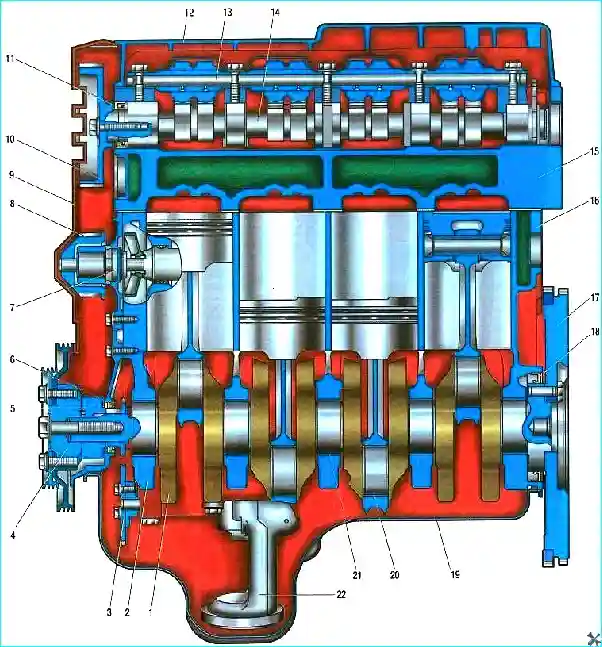
The cylinder heads of 15 cylinders (see Fig. 1) of both engines are made of aluminum alloy with a transverse scavenging scheme (the intake and exhaust ports are located on opposite sides of the head).
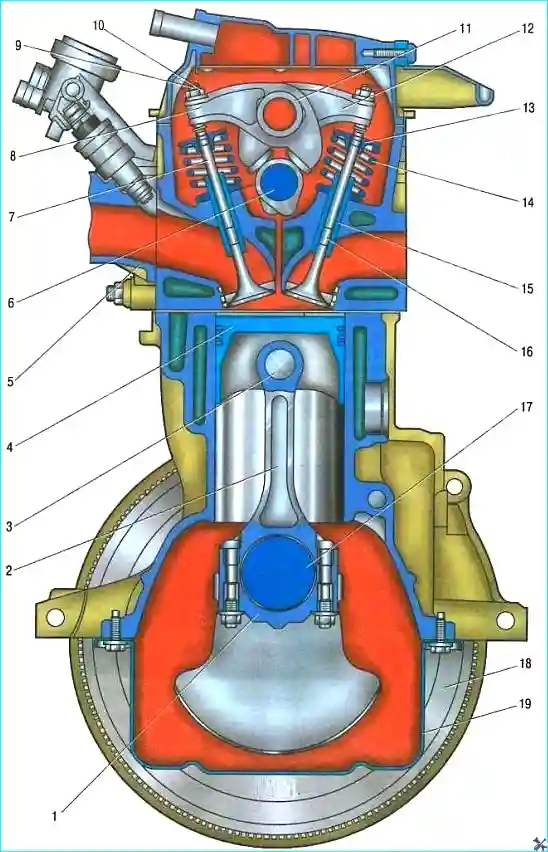
The valve seats and guide bushings 13 (see Fig. 2) are pressed into the heads. The intake and exhaust valves 16 each have one spring 14, secured through a plate 13 by two crackers.
The axle 11 of the rocker arms 8 and 12 of the intake and exhaust valves, respectively, is bolted to the upper surface of the cylinder head.
In the holes in; The rocker arms are fitted with bolts 9, secured with locknuts 10, for adjusting clearances in the valve drive mechanism, resting on the ends of the valve stems.
The camshaft 14 is mounted in bearing beds made in the body of the head and is secured from axial movement by a thrust flange.
The plane of separation of the head and cylinder block is sealed with a gasket, which is a plate molded from thin sheet metal.
The cylinder blocks 16 (see Fig. 1) of both engines are a single casting that forms the cylinders, the cooling jacket, the upper part of the crankcase, and five crankshaft bearings made in the form of crankcase partitions.
The blocks are made of special high-strength cast iron with cylinders bored directly in the block body.
The 2 main bearing caps are machined in assembled with the blocks and are not interchangeable.
The cylinder blocks have special bosses, flanges, and holes for mounting parts, assemblies, and units, as well as channels for the main oil line.
Crankshaft 1 rotates in main bearings with thin-walled steel liners 20 and 21 with an antifriction layer.
Axial movement The crankshaft rotation is limited by two half rings installed in the grooves of the center main bearing bed.
Flywheel 17, cast from cast iron, is mounted on the rear end of the crankshaft and secured with six bolts. A toothed rim for starting the engine is pressed onto the flywheel.
In addition, a toothed ring gear is machined on the flywheel to ensure operation of the top dead center (TDC) sensor of the engine management system.
The pistons (Fig. 3) are made of aluminum alloy. The cylindrical surface of the piston crown is provided with annular grooves for the oil scraper ring and two compression rings.
Piston pins 3 (see Fig. 2) are installed in the piston bosses with a clearance and are pressed with interference fit into the upper heads of the connecting rods, which are connected by their lower heads to the crankshaft journals through thin-walled liners, similar in design to the main bearings.
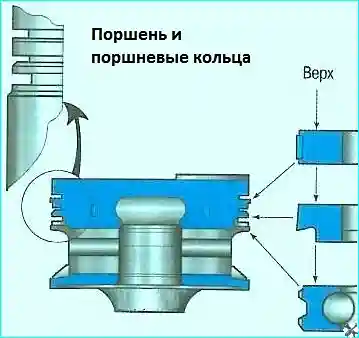
Fig. 3. Piston and piston rings
Two forged steel connecting rods with an I-section rod.
Combined lubrication system
The closed-type crankcase ventilation system does not communicate directly with the atmosphere. Therefore, a vacuum is generated in the crankcase at all engine operating modes, simultaneously with the exhaust gases, which increases the reliability of various engine seals and reduces toxic emissions into the atmosphere.
The system consists of two branches, a large and a small one.
When the engine is idling and under low load conditions, when the vacuum in the intake manifold is high, crankcase gases are sucked into the intake manifold through the small branch of the system.
At full load conditions, when the throttle valve is wide open, the vacuum in the intake manifold decreases, and in the air supply hose it increases. and crankcase gases, through a large branch hose connected to a fitting on the cylinder head cover, primarily enter the air supply sleeve, and then through the throttle assembly into the intake manifold and engine cylinders.
The engine cooling system is sealed, with an expansion tank, consisting of a cooling jacket made of casting and surrounding the cylinders in the block, the combustion chambers, and the gas passages in the cylinder head.
Forced circulation of the coolant is provided by a centrifugal water pump 7 (see Fig. 1) driven from the crankshaft by a toothed timing belt.
To maintain normal operating coolant temperature, a thermostat is installed in the cooling system, closing the large circuit of the system when the engine is cold and the coolant temperature is low.
The fuel system of both engines consists of an electric fuel pump installed in the fuel tank, throttle assembly, fine fuel filter installed on the fuel tank, fuel pressure regulator installed in the fuel pump module, injectors and fuel lines, and also includes an air filter.
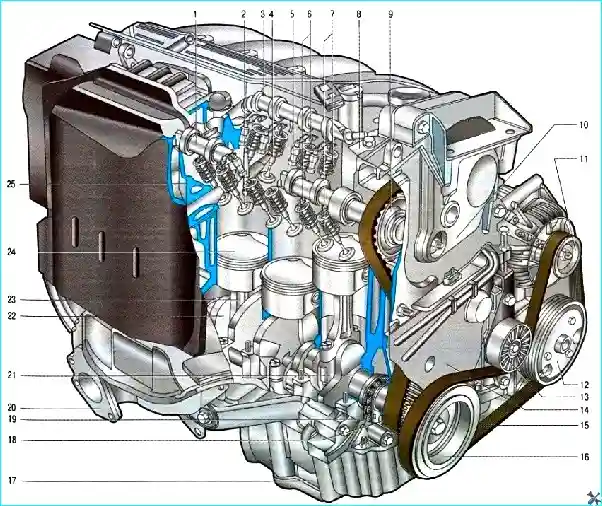
The main difference between the K4M engine and the K7J and K7M engines is the presence of a cylinder head with two camshafts (separate intake and exhaust valves).
The camshafts are driven by a reinforced toothed belt.
The sixteen valves of the K4M engine are actuated by camshafts using roller rocker arms and hydraulic tappets.
The hydraulic tappets automatically ensure clearance-free contact between the camshaft lobe and the valve.
The cylinder block, crankshaft, flywheel, pistons, piston pins, and connecting rods of the K4M and K7M engines are identical.
The lubrication, cooling, and fuel systems are also similar in design.
Each cylinder of the K4M engine is equipped with four ignition coils, which are directly controlled by the engine's electronic control unit (ECU).
Moreover, the high-voltage There are no ignition wires, and the ignition coils are mounted directly to the spark plugs.
The powertrain (engine with gearbox, clutch, and final drive) is mounted on three mounts with elastic rubber elements: two upper side mounts (right and left), which support the main weight of the powertrain, and a rear mount, which compensates for torque from the transmission and loads that occur when starting the car, accelerating, and braking.


