


Regardless of the lifting equipment used, never use the rear suspension beam as a support.
When replacing one shock absorber, the shock absorber on the opposite side must also be replaced.
Removal
Place the vehicle on a two-post lift or inspection pit.
Place wheel chocks under the front wheels.
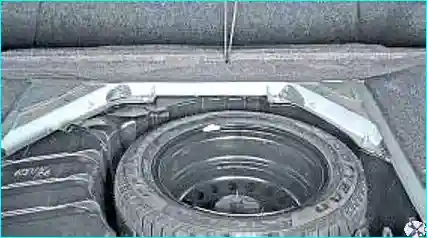
Open the trunk and the rear section of the spare tire compartment cover.
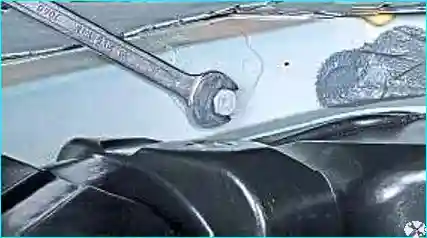
Remove the upper shock absorber mount bolt.
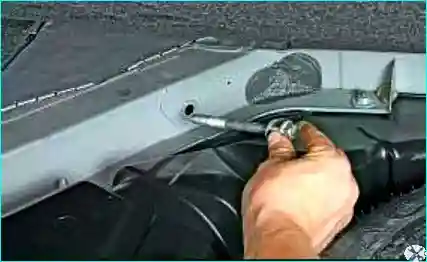
Remove the upper shock absorber mount bolt.
Raise the rear of the car and place it on supports.
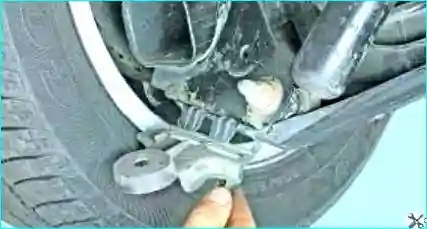
Removing the mudguard of the rear suspension beam
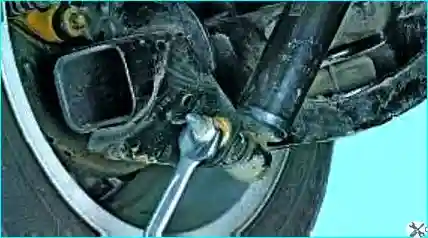
Unscrew the nut securing the shock absorber to the rear suspension trailing arm bracket
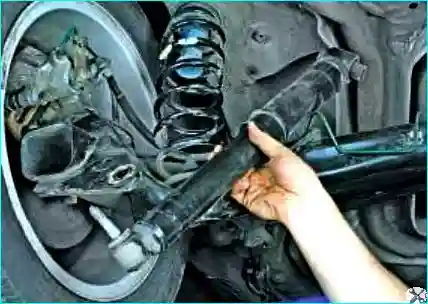
Removing the shock absorber from the car
Shock absorbers should be replaced in pairs.
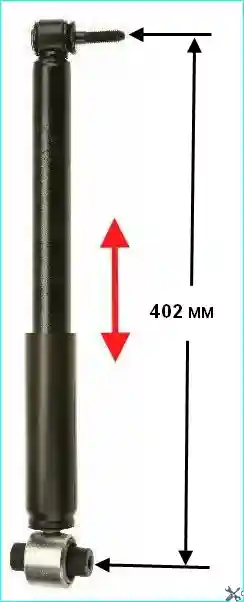
Install the shock absorber vertically and lower and raise the upper part of the shock absorber several times.
If the shock absorber moves jerkily and dips, and you feel sticking or knocking, it needs to be replaced.
Check the shock absorber piston stroke and measure its free length at the points shown in the figure 7.
Shock absorber length: 402 mm.
If the length is less than specified, replace the shock absorber.
Installation is the reverse of removal.
Pre-tighten the lower shock absorber mounting bolt.
Final tightening of the shock absorber mounting bolts is performed with the vehicle on its wheels.
Install the shock absorber head into the socket.
Lower the lift and support the vehicle.
Align the shock absorber head with the opening in the luggage compartment.
Install the upper shock absorber mounting nut.
Pre-tighten the upper shock absorber mounting nut.
Repeat the operation on the other side vehicle.
Tighten to the specified torque:
- – upper shock absorber mounting nuts (140 Nm), holding the bolt heads;
- – lower shock absorber mounting bolts (105 Nm);
- – wheel bolts (105 Nm).
Install the wheel arch liner.


