


The fuel system includes elements of the following subsystems:
- - fuel supply, which includes the fuel tank, electric fuel pump, fuel filter, fuel pressure regulator, lines, and fuel rail with injectors;
- - air supply, which includes the air supply pipe, air filter, throttle body, and idle speed control valve;
- - fuel vapor recovery, which includes the adsorber and connecting lines.
The functional purpose of the supply system is to ensure the supply of the required amount of fuel to the engine in all operating modes.
The engines are equipped with an electronic engine management system with distributed fuel injection.
In the distributed injection system, the functions of mixture formation and The metering of the air-fuel mixture supplied to the engine cylinders is separated;
- - air is supplied by the air supply system, consisting of a throttle body and an idle speed control valve, and the required amount of fuel at any given moment of engine operation is injected into the intake manifold by injectors.
This control method ensures the optimal composition of the combustible mixture at each specific moment of engine operation, which allows for maximum power with the lowest possible fuel consumption and low toxicity of exhaust gases.
The fuel injection system (as well as the ignition system) is controlled by an electronic unit that continuously monitors engine load, vehicle speed, engine thermal state, and the optimal combustion process in the engine cylinders using appropriate sensors.
The fuel vapor recovery system prevents fuel vapors from escaping from the fuel system into the atmosphere, which adversely affect the environment.
The system uses a carbon vapor absorption method The canister.
It is installed in the right front fender well and is connected by pipes to the fuel tank and intake manifold.
The canister purge solenoid valve is located on the canister cover, which switches the system operating modes based on signals from the engine control unit.
Fuel vapors from the fuel tank are continuously removed through the pipe and accumulate in the canister, which is filled with activated carbon (the canister).
When the engine is running, the canister is regenerated (restored) by purging the canister with fresh air, which enters the system under the action of the vacuum transferred through the pipe from the intake manifold into the canister cavity when the valve opens.
The opening angle of the valve, and therefore the intensity of the canister purge, depend on the throttle angle and are determined by the vacuum. which occurs in the cavity of the intake manifold of a running engine.
Fuel vapor from the adsorber enters the engine intake manifold through the pipeline and burns in the cylinders.
Faults in the fuel vapor recovery system lead to unstable idle speed, engine stalling, increased toxicity of exhaust gases and deterioration of the vehicle's driving performance.
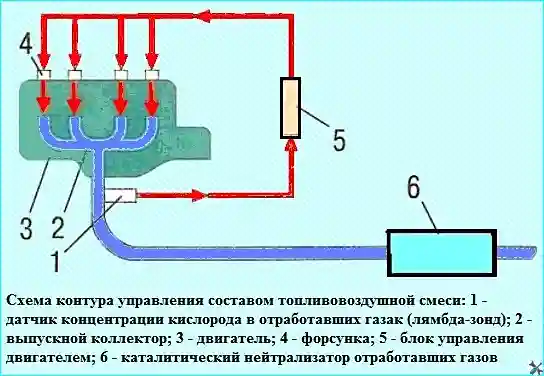
The main sensor for ensuring optimal combustion is the exhaust gas oxygen concentration sensor (lambda probe).
It is installed in the engine exhaust manifold and, together with the electronic control unit and injectors, forms a circuit for adjusting the composition of the air-fuel mixture supplied to the engine (Fig. 1.)
Based on the sensor signals, the engine control unit determines the amount of unburned oxygen in the exhaust gases and, accordingly, evaluates the optimal composition of the air-fuel mixture entering the engine cylinders at any given time.
Having detected a deviation in the composition from the optimal 1:14 (fuel and air, respectively), which ensures the most efficient operation of the catalytic converter, the control unit changes the composition of the mixture using the injectors.
As a result, the air-fuel mixture control circuit is closed,
Some vehicles are equipped with two oxygen concentration sensors: one in the exhaust manifold, the other behind the catalytic converter.
The first sensor is a control sensor (based on its signal, the ECU adjusts fuel delivery), and the second is a diagnostic sensor (based on its signal, the ECU evaluates the efficiency of the catalytic converter).


