


The rear suspension is semi-independent, lever-and-spring, with longitudinal arms pivoted to the car body and connected by a U-shaped cross beam.
The longitudinal arms are connected to the car body by silent blocks.
The suspension springs are cylindrical.
The upper and lower ends of the springs rest on elastic rubber pads.
A torsion-type anti-roll bar can be installed in the suspension beam.
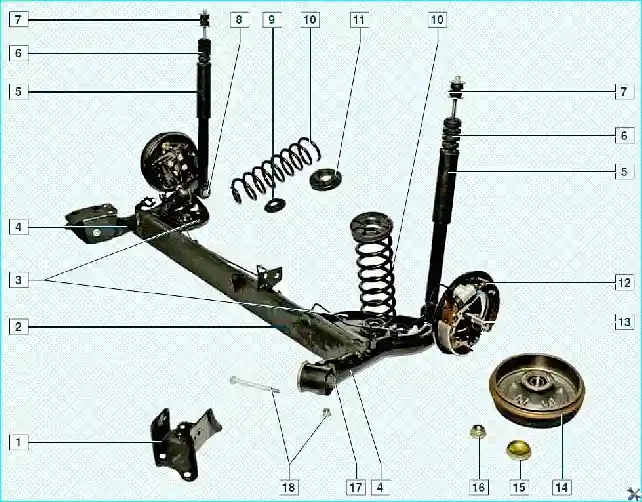
The lower ends of the double-acting telescopic hydraulic shock absorbers are bolted to the suspension arms (Fig. 1).
The upper ends of the shock absorbers are attached to the body via rubber mounts.
Rear suspension springs are divided into classes based on stiffness. The spring class is marked with paint.
Springs of the same class must be installed on the right and left sides of the vehicle.
When replacing springs, it is recommended to install springs of the same class as those installed on the vehicle.
A rubber-metal hinge is pressed into the lower eye of the shock absorber, through the central bushing of which a bolt passes, securing the shock absorber to the suspension arm.
The shock absorber rod is attached to the body via two rubber pads (one at the bottom of the support, the other at the top) and two metal washers.
A spacer sleeve is installed between the pads on the shock absorber rod, preventing excessive deformation of the pads when tightening the rod nut.
A compression buffer is installed on the shock absorber rod, to which the boot is attached.
Each rear wheel hub is mounted on two Tapered roller bearings.
The rear wheel alignment angles are determined by the beam geometry and cannot be adjusted during operation.
The angles can only be checked on a special stand and compared with the reference values.
If the rear wheel alignment angles do not correspond to the reference values, the condition of the rear suspension components must be checked.
Possible rear suspension malfunctions and troubleshooting methods
Cause of malfunction - Remedy
Noise and knocking in the suspension when the vehicle is moving
Faulty shock absorber - Replace the shock absorber
Loose shock absorber mount or worn shock absorber lug bushing - Tighten the lower shock absorber mount bolt and nut or replace the bushings
Worn trailing arm bushings - Replace the silent blocks
Settling or broken spring - Replace the spring
Failure of the wheel bearing - Replace the bearing
Vehicle pulls away from a straight line
Uneven tire pressure - Set the tire pressure to normal
Tires have different wear or tread patterns - Replace the tires
Camber angle is incorrect - Correct the cause of the incorrect camber angle
Settling or broken spring - Replace the spring
Distorted trailing arms - Replace the silent blocks
Increased or excessive tire tread wear
Incorrect tire pressure - Set the correct pressure
Wheel alignment is incorrect - Eliminate the causes of wheel alignment problems.
Overloading the vehicle - Avoid overloading the vehicle.
Imbalanced wheels - Balance the wheels.


