


Synchronisation of the pulse wheels of the crankshaft and of the reduction gear shaft of the injection pump drive
The need to install (re-install) the pulse wheels of the crankshaft and of the reduction gear shaft of the high-pressure fuel pump (HPFP) drive for their synchronisation may be caused by the replacement of the HPFP drive reduction gear during a current repair of the diesel engine.
The installation of the pulse wheels according to the proposed scheme is carried out to synchronise the signals of the crankshaft speed sensors and of the primary shaft of the HPFP drive, and is ensured by tying the sensor signals to a common reference point of the shaft position at the moment when the piston of the first cylinder passes through top dead centre (TDC).
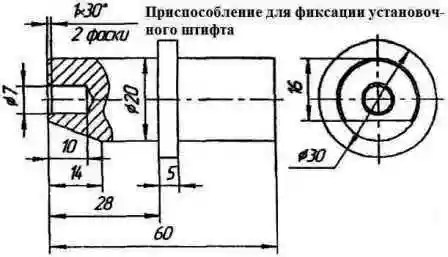
To ensure the correct installation of the pulse wheels, it is necessary to manufacture a device for securing the setting pin in accordance with the sketch (Fig. 1).
Remove the cap of the cylinder head cover.
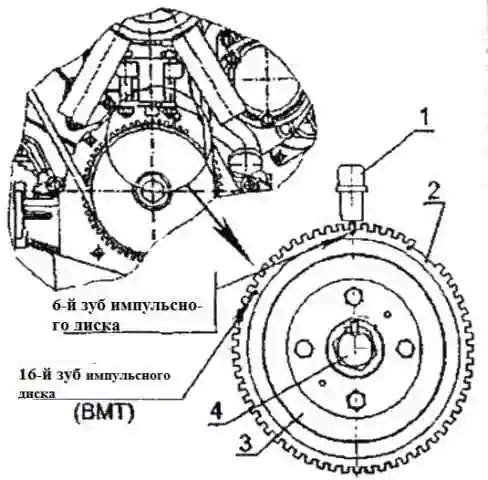
Set the piston of the first cylinder to the TDC position by turning the crankshaft clockwise using bolt 4 (Fig. 2) until the axis of the 16th tooth of the "crown" of the pulse wheel (counting anticlockwise from the break segment in the "crown" of the pulse wheel) coincides with the axis of sensor 1.
Make sure that the inlet and exhaust valves of the 1st cylinder are closed.
If the exhaust valve is open, turn the crankshaft through one complete revolution and re-check the condition of the valves.
Set the piston of the first cylinder to the compression stroke (approximately 60° of crankshaft rotation before TDC), for which:
turn the crankshaft clockwise using bolt 4 (Fig. 3) by approximately two revolutions.
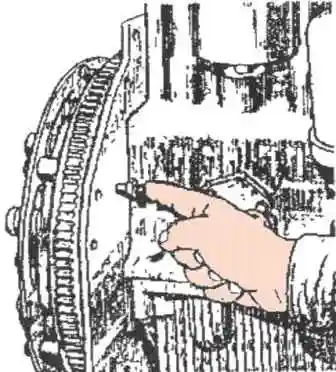
At this, on the second revolution, unscrew in accordance with Fig. 3 the locking tool from the threaded hole of the rear plate, insert it with its reverse side into the same hole until it stops against the flywheel (for ZIL diesel engines, press the spring-loaded locking tool until it stops against the flywheel) and turn the crankshaft until the locking tool coincides with the hole in the flywheel.
At this, the pulse wheel 2 (Fig. 2), secured on the crankshaft pulley 3, will be positioned in such a way that the axis of sensor 1 passes along the axis of the sixth tooth of the "crown" of the pulse wheel (counting anticlockwise from the break segment in the "crown" of the pulse wheel).

In case of non-coaxiality of the sensor and the sixth tooth, it is necessary to slacken the sensor mounting, achieve coincidence of the axes of the sensor and the tooth, and secure the sensor.
On the removed reduction gear, by turning the drive half-coupling 5 clockwise (Fig. 4; in Fig. 4 the reduction gear is shown with the reduction gear drive gear mounted on the drive half-coupling), achieve the position in the sensor installation window of two consecutively arranged pulse pins.
By a slight turn of the drive in the opposite direction, position the setting pin (the first in the direction of shaft rotation) in the centre of the window.
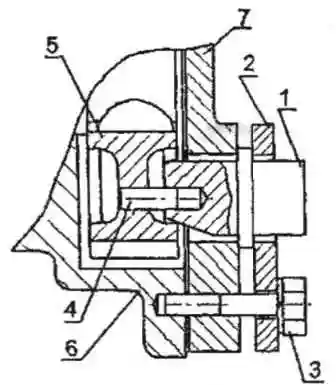
Install into the window the device for securing the position of the setting pin 1 (Fig. 5) and secure the device with the mounting flange 2 and bolts 3.
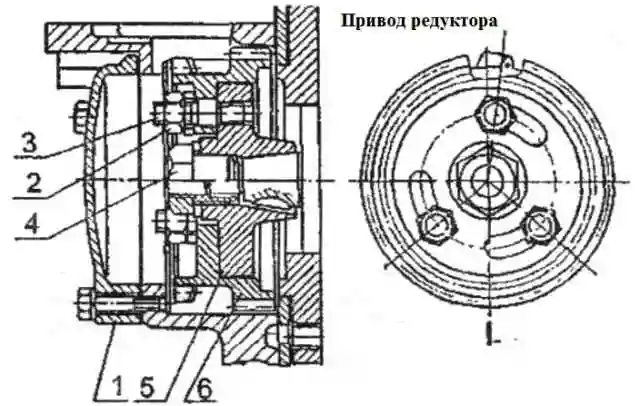
Remove the hatch cover 1 (Fig. 6) and, supporting the drive gear 6 through the hatch window, insert into the slots of the drive gear the studs 3 of the drive half-coupling 5, thus installing the reduction gear.
Secure the reduction gear in the distribution panel.
Install and tighten the nuts 2 to a torque of 35–50 N·m.
Remove the mounting flange and withdraw the setting device.
Re-install the mounting flange and secure it.
Install the hatch cover, the speed sensor and secure them.
Withdraw the flywheel locking tool and screw it by its threaded part into the rear plate.
Install the cap of the cylinder head cover.


