


The correct position of the brake pedal when released and fully depressed (pedal travel) is one of the criteria for checking the brake system's performance.
At the same time, the pedal position largely ensures the proper operation of the system.
If the pedal is located further from the floor than specified, the wheels may not fully release when the pedal is released (usually, there is no free pedal travel).
If the pedal is too low, braking effectiveness may decrease due to a decrease in pedal travel.
You will need: a ruler, a 13 mm wrench, and pliers.
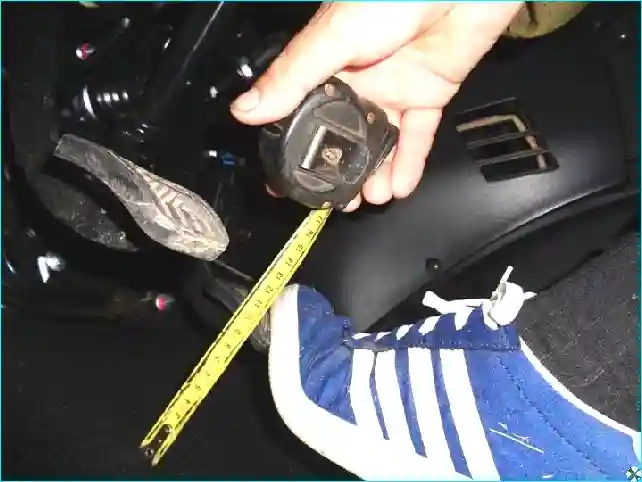
Depress the brake pedal fully and measure the distance from the pedal pad to the floor.
The ruler should be perpendicular to the floor.
Release the pedal and re-measure the distance from the pedal pad to the floor when free.
This distance should be 100-105 mm.
The difference between the two measurements is the "full" pedal travel, which should be 60 ~ 65 mm.
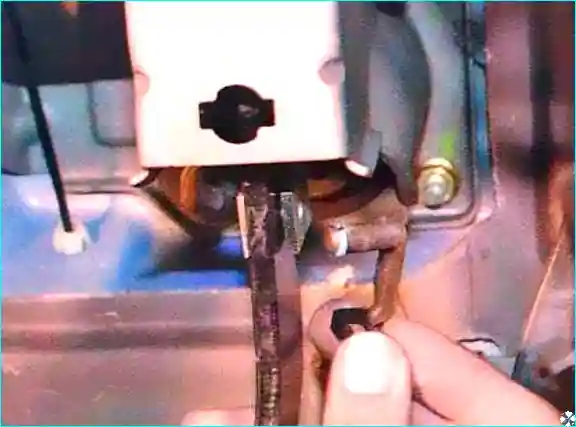
If the distance from the pedal pad to the floor is not as specified, adjust it by changing the length of the brake booster pushrod.
Disconnect the pushrod fork from the brake pedal (see "Replacing the Renault Logan vacuum booster").
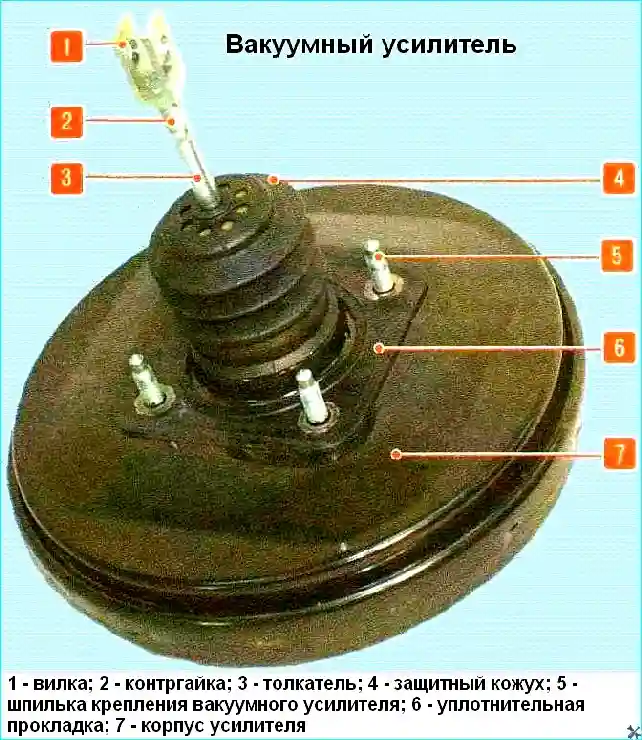
Loosen fork locknut 2 and, holding pusher 3 from turning, rotate fork 1 in the desired direction.
One fork turn changes the brake pedal position by approximately 5 mm.
For clarity, the operation is shown with the brake booster removed.
The manufacturer recommends removing the booster from the vehicle to adjust the pedal position; however, with sufficient skill, the adjustment can also be performed directly on the vehicle.
Check the brake pedal free play by moving the pedal by hand until it stops moving without resistance.
Using a ruler, determine the free play; it should be 8-10 mm.
A discrepancy between the free play and the specified value may be caused by the following:
- - increased play in the connection between the brake booster pushrod fork and the pedal. This may be due to wear on the fork pin and holes in the fork and pedal;
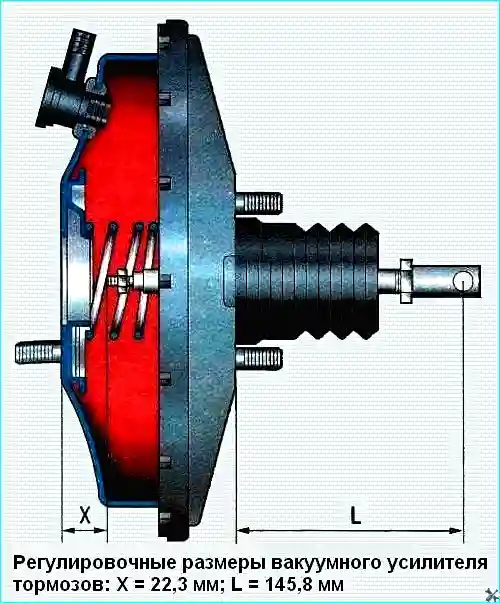
- - the distance from the pedal pad to the floor in the free state is incorrectly adjusted (see point 2, as well as dimension L in Fig. 1);
- - dimension X (see Fig. 1) between the end of the brake booster adjusting bolt and the flange of its housing for connecting the master cylinder is incorrectly adjusted.
If the pedal travel is greater than the value. If the condition listed in point 2 is not met, this indicates air in the hydraulic brake system or extreme wear of the brake shoe linings, brake discs, or drums.
Bleed the hydraulic system.
If the pedal, when pressed all the way and held in this position, gradually moves toward the floor, this indicates a fluid leak in the hydraulic system or a faulty master cylinder.
These problems are very serious, so immediately locate the leak and repair it or replace the master cylinder.


