


The Renault Logan is equipped with two independent braking systems: service and parking.
The first, equipped with a hydraulic drive with a vacuum booster and an anti-lock braking system (installed optionally), provides braking when the car is moving, the second brakes the car when parked.
The service system is dual-circuit with a diagonal connection of the front and rear brake mechanisms.
One hydraulic circuit operates the right front and left rear brake mechanisms, the other - the left front and right rear.
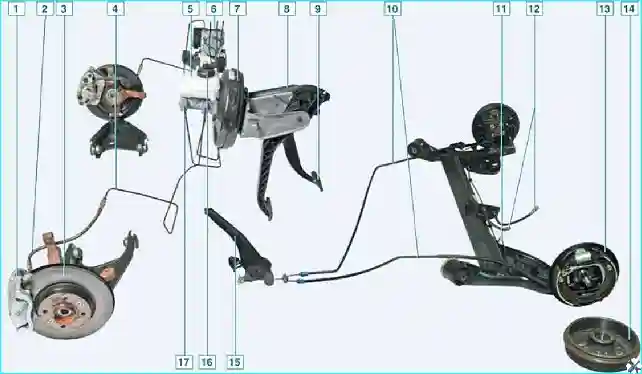
If one of the circuits of the service brake system fails, the second circuit is used, ensuring that the vehicle stops with sufficient efficiency.
The hydraulic drive includes a vacuum booster and a dual-circuit pressure regulator for the rear brakes.
The parking brake system has a cable drive to the rear wheel brake mechanisms.
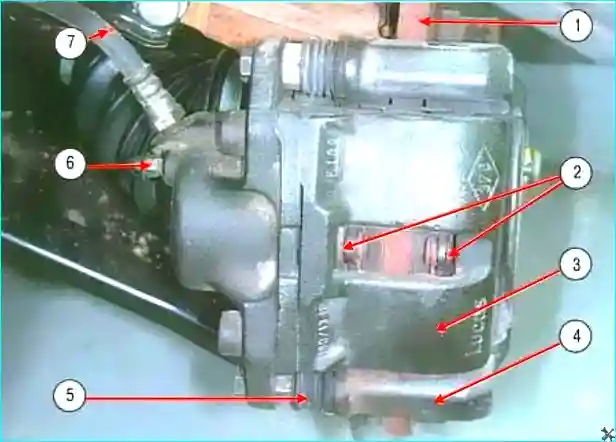
Front wheel brake mechanism, disc, with automatic adjustment of the gap between pads 2 (Fig. 1) and disc 1, with floating bracket.
The sliding bracket is formed by a caliper 3 with a single-piston working cylinder.
The pad guide 4 is bolted to the steering knuckle.
The sliding bracket is bolted to guide pins 5, installed in the holes in the pad guide.
The guide pins are lubricated with grease and protected by rubber boots.
A piston with a sealing ring is installed in the cavity of the wheel cylinder.
Due to the elasticity of this ring, an optimal gap is maintained between the pads and the disc, the surface of which is protected by a brake shield.
During braking, the piston, under the influence of fluid pressure, presses the inner pad against the disc. As a result of the reaction force, the caliper moves on the pins and the outer pad is also pressed against the disc, while the pressing force of the pads is identical.
When releasing the brakes, the piston is moved away from the pad due to the elasticity of the sealing ring, creating a small gap between the pads and the disc.
The rear wheel brake mechanism is a drum brake with a two-piston wheel cylinder and two brake shoes, with automatic adjustment of the gap between the pads and the drum.
The brake drum also serves as the rear wheel hub and contains a pressed-in bearing.
The pressure regulator changes the pressure in the hydraulic drive of the rear wheel brake mechanisms depending on the load on the rear axle of the vehicle.
It is included in both circuits of the braking system, through which brake fluid is supplied to both rear brake mechanisms.
The regulator is bolted to the vehicle body.
Its piston rod is supplied via a spring-loaded load cell The rod, lever 4, and the shackle are connected to the rear suspension beam.
Depending on the distance between the beam and the body, which depends on the vehicle load, the regulator rod moves, which, in turn, uses a valve system to change the cross-sectional area of the circuit passages inside the regulator, thereby limiting the pressure in the rear brake circuits.
The degree of regulator limitation, and therefore the pressure in the circuits, is adjusted by changing the length of the regulator rod using a nut.
The wheel cylinders of the rear brake mechanisms are identical.
The front brake shoes of the rear wheels are identical, but the rear ones differ - non-removable parking brake levers are mounted on them in a mirror-symmetrical manner.
The spacer bar and ratchet nut of the brake mechanisms of the left and right wheels differ.
On the ratchet nut and on the end of the spacer The left wheel spacer bar has a left-hand thread, and the ratchet nut and the end of the right wheel spacer bar have a right-hand thread.
The brake adjuster levers for the left and right wheels are mirror images O-symmetrical.
An anti-lock braking system (ABS) consists of a hydro-electronic unit with hydraulic electromagnetic valves, wheel speed sensors, an electric pump, and a warning lamp in the instrument cluster.
The anti-lock braking system regulates the pressure in the brake mechanisms of all wheels during braking in difficult road conditions, preventing wheel locking.
ABS provides the following benefits:
- — avoiding obstacles with a higher degree of safety, including during emergency braking;
- — reducing the braking distance during emergency braking while maintaining directional stability and control of the vehicle, including when turning.
In the event of a system malfunction, a function is provided to maintain operation during system failures.
The hydro-electronic control unit receives information about the vehicle speed, direction of travel, and road conditions from the wheel speed sensors. wheel rotation
Based on this information, the control unit determines the optimal braking mode for the wheels by changing the flow cross-section of the circuits using the solenoid valves, anticipating the moment the wheel slowing down will lock, thereby preventing it from locking.
If the system anticipates that a wheel will lock, it commands the corresponding valve to isolate the fluid supply to the wheel's slave cylinder from the master cylinder.
If the wheel's rotation speed continues to decrease compared to the other wheels, the ABS system returns brake fluid back to the master cylinder, weakening braking.
If all four wheels slow down equally, the return pump will switch off, and all the solenoid valves will reopen, allowing the master cylinder to act on the slave cylinders in the normal mode.
This cycle can repeat up to ten times per second.
Activation of the solenoid valves and the return pump creates pulsations in the hydraulic drive of the brake system, which are transmitted The brake pedal is pressed, signaling the driver that the ABS is operating.
The solenoid valves in the front brake circuits act on each wheel's wheel cylinder independently, while the solenoid valve in the rear brake circuits acts on both wheel cylinders simultaneously.
Since the braking system is diagonally split, a separate mechanical plunger valve in the hydraulic block divides the hydraulic output of the rear solenoid valve into two separate circuits.
To prevent false signals from affecting the system, a built-in safety circuit monitors all signals sent to the control unit.
If a false signal is received or the voltage in the on-board electrical system is insufficient, the system automatically switches off, and the ABS deactivation warning light in the instrument cluster lights up.
In this case, the normal braking system remains in operation; however, extreme caution is required when driving on slippery roads, as the system's distribution function will be impaired. (the function of equalizing the pressure in the brake mechanisms of the front and rear wheels) and there is a risk of skidding when braking.
Parking brake drive - manual, mechanical, cable, on the rear wheels.
It consists of a lever, a front cable with an adjusting nut on its end, an equalizer, two rear cables, and levers in the brake mechanisms of the rear wheels.
The parking brake lever, fixed between the front seats on the floor tunnel, is connected to the front cable.
An equalizer is attached to the rear end of the front cable, into the holes of which the front ends of the rear cables are inserted.
The rear ends of the cables are connected to the parking brake drive levers fixed to the rear brake pads.
During operation (until the brake pads are completely worn out) (rear brake mechanisms) parking brake drive adjustment is not required, since the extension of the brake mechanism spacer bar compensates for pad wear.
The parking brake drive only needs to be adjusted if the parking brake cables or lever are replaced.
The working stroke of the brake pedal with the engine running should be approximately 60-65 mm.
Too little working stroke indicates an incorrect initial brake pedal setting, a malfunctioning brake booster, or a sticking slave cylinder, which leads to increased fuel consumption and accelerated brake pad wear.
Too much working stroke indicates excessive clearances in the pedal mechanism or a leak in the hydraulic brake system.
If the working stroke decreases with repeated pedal presses, i.e. It becomes "harder" and there is air in the system.
If the pedal's full travel is not If the brake pedal vibration increases, the system is leaking.
If the brake pedal constantly vibrates when braking, the brake discs are likely warped. In this case, both discs need to be replaced.
Pedal vibration that appears and disappears intermittently during hard braking is a symptom of the anti-lock braking system and is not a sign of a malfunction.
If the car begins to pull to one side when braking, check the wheel cylinders; They may need to be replaced.
If a knocking noise appears in the front suspension that disappears when braking, check the tightness of the caliper mounting bolts.
Before driving after replacing the brake pads, be sure to press the brake pedal several times to ensure the pistons in the wheel cylinders are seated.
Possible Brake System Malfunctions and Corrective Actions
Cause of Malfunction - Corrective Action
Extended Brake Pedal Travel
Brake fluid leaking from the wheel cylinders - Replace the faulty wheel cylinders.
Flush and dry the pads, discs, and drums.
Air in the brake system. Damaged rubber O-rings in the master cylinder - Bleed the air by bleeding the system. Replace the master cylinder.
The rubber brake hydraulic hoses are damaged. Increased brake disc runout (more than 0.03 mm) - Replace the hoses and bleed the system. Grind or replace the disc if the thickness of the brake disc front is less than 19.8 mm.
Insufficient braking performance
Oily contaminated brake pad linings - Wash and dry the pads
Pistons seized in the working cylinders - Eliminate the cause of seizure, replace damaged parts
Completely worn brake pad linings - Stop immediately and allow the brakes to cool
Brake overheating - Replace the brake pads
Use of low-quality pads - Use original pads or products from companies specializing in the production of brake system components
Lack of tightness in one of the circuits (accompanied by a failure of the brake pedal) - Replace damaged parts, bleed the system
Violation Brake pedal position - Determine the cause of the increased full travel and replace damaged components.
Brake booster rod protrusion adjustment is incorrect - Contact a service center to adjust the booster.
Anti-lock braking system (ABS) malfunction - Contact a service center to check the anti-lock braking system.
Incomplete release of all wheels.
No free travel of the brake pedal - Replace the brake master cylinder.
Increased protrusion of the brake booster rod - Contact a service center to adjust the booster.
Swelling of the rubber seals of the master cylinder due to gasoline, mineral oils, etc. getting into the fluid.
- Flush and bleed the entire hydraulic drive system, replace the rubber components.
Jammed master cylinder pistons - Check and, if necessary, replace the master cylinder. cylinder
Braking of one wheel when the pedal is released
Broken or weakened return springs of the parking brake shoes - Replace the spring
Piston sticking in the working cylinder due to contamination or corrosion of the housing - Replace the working cylinder and bleed the brake hydraulic system
Swelling of the working cylinder sealing rings due to foreign impurities entering the fluid - Replace the working cylinder and bleed the brake hydraulic system
Wrong position of the caliper relative to the brake disc when the mounting bolts are loose - Tighten the mounting bolts, replace damaged parts if necessary
Incorrect adjustment of the parking brake system - Adjust the parking brake system
Malfunction of the anti-lock braking system - Contact a service center to have the anti-lock braking system checked
Skidding or The vehicle pulls to one side when braking.
The slave cylinder piston is seized - Check and correct the piston seizure in the cylinder.
Any tube is blocked due to a dent or clog - Replace or clean the tube.
Brake discs, drums, and linings are dirty or oily - Clean the brake components.
Wheel alignment is incorrect - Adjust the wheel alignment.
Tire pressure is uneven - Set the correct tire pressure.
One of the brake system circuits is not working (accompanied by a decrease in braking efficiency). Replace the damaged components and bleed the system. If this does not produce the desired result, contact a service center to have the anti-lock braking system (if equipped) checked.
Increased brake pedal effort when braking
Fault Avene vacuum booster - Replace the booster.
The hose connecting the vacuum booster to the engine intake manifold is damaged or loose. - Replace the hose.
The rubber cylinder seals are swollen due to gasoline, mineral oil, etc. getting into the fluid. - Replace the cylinders, flush, and bleed the system.
Brake squealing or vibration.
Oily contaminated friction linings. - Clean the linings with a wire brush using warm water and detergent. Eliminate the causes of fluid or grease getting on the brake pads.
Worn brake pads or foreign particles in them - Replace the pads.
Excessive runout or uneven wear (noticeable by vibration in the brake pedal) of the brake disc - Resurface or replace the disc if the thickness of the front brake discs on vehicles with K7J and K7M engines is less than 10.6 mm, or less than 17.7 mm on vehicles with K4M engines.
Checking the Brake System
It is advisable to check the operation of the brake system on special brake test stands.
A rough assessment of the brake system's operation can be performed on a level, horizontal surface (preferably covered with a thin layer of sand), covered for traffic.
This check can be performed on vehicles without ABS. With ABS, testing is performed at a service station using diagnostics.
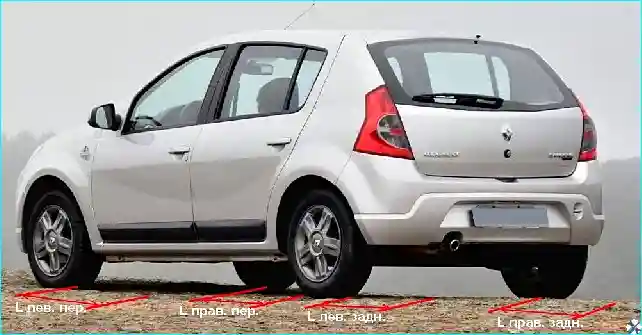
After braking the car, exit the vehicle and inspect the brake marks left by the wheels.
If the front brake marks are slightly longer than the rear ones, and the left and right marks are the same length, the brake system is functioning properly. Otherwise, repair the system.
The following ratios must be observed:
- - L left front = L right front
- - L left rear = L right Rear
- - Front L > Rear L
If, during the same test on a vehicle equipped with ABS, the brake marks are just as clearly visible as when testing a vehicle without ABS, the anti-lock braking system is faulty.
In this case, you should contact a service station to have the ABS repaired.


