


The camshaft is replaced in the following cases:
- - the pressure in the engine lubrication system has dropped. This malfunction is often caused by increased wear of the camshaft journals and camshaft bearing seats in the cylinder head;
- - If the bearing seats are worn, the entire cylinder head is replaced, as the bearing seats are machined directly into the cylinder head;
- - valve knocking that cannot be corrected by adjusting the valve clearances. This may be caused by increased wear on the camshaft lobes due to the use of low-quality engine oil or a damaged oil filter.
If the camshaft lobes are severely worn, replacing the valve rocker arms often requires replacing the camshaft.
Due to the layout of the Renault Logan engine compartment, it is not possible to remove the camshaft directly from the vehicle.
To do this, remove the cylinder head.
Remove the cylinder head (see "Replacing the Cylinder Head Gasket").
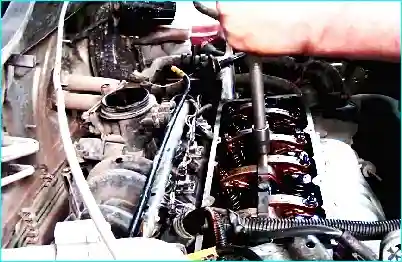
Evenly loosen the bolts and remove the five rocker arm shaft mounting bolts...
Note that the bolts have different head shapes.
Reinstall the bolts in their original locations during reassembly.
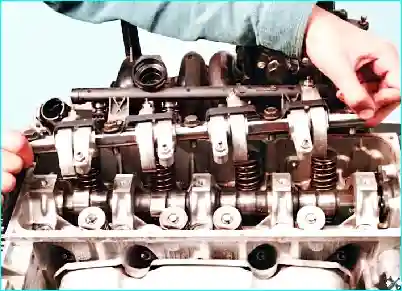
Remove the shaft assembly with the rocker arms.
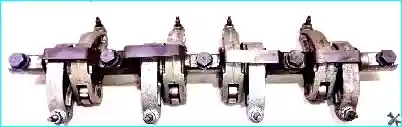
If you do not plan to replace the valve rocker arms and their shaft, do not remove the rocker arms so that they can be installed in their original locations during assembly.
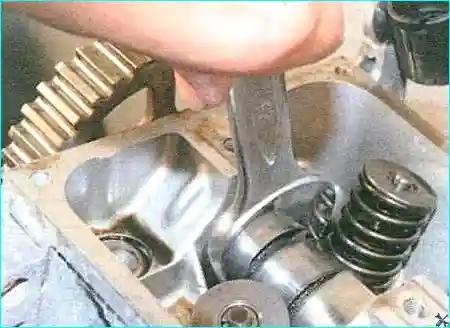
Hold the camshaft from turning with a hex key.
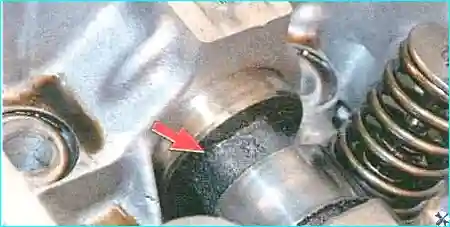
The hexagon retaining bolt is cast in the front journal of the camshaft bearing.
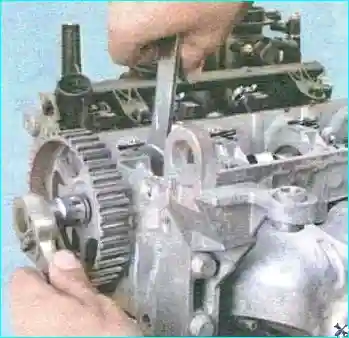
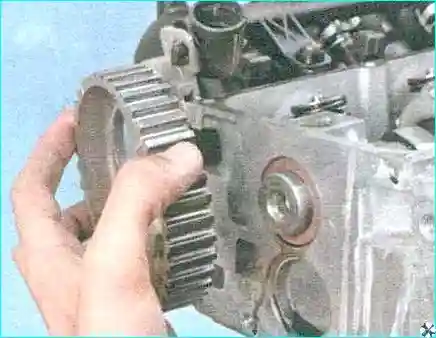
Remove the camshaft timing pulley bolt.
Remove the pulley.
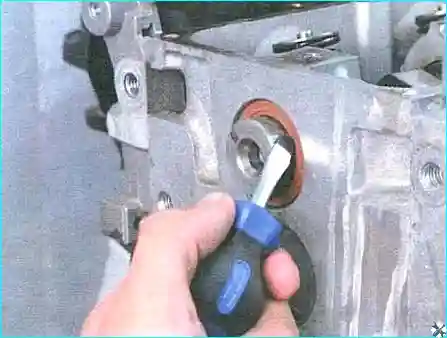
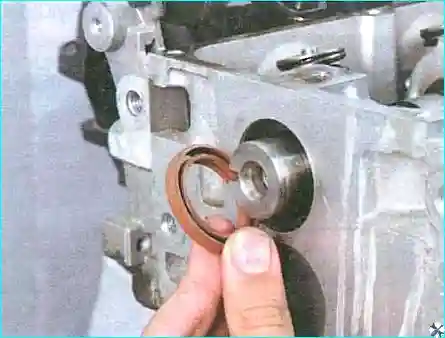
Pry with a screwdriver to remove the oil seal from its socket in the cylinder head shaft.
Replace the camshaft oil seal with a new one each time it is removed.
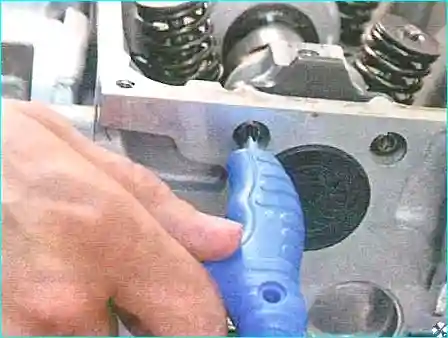
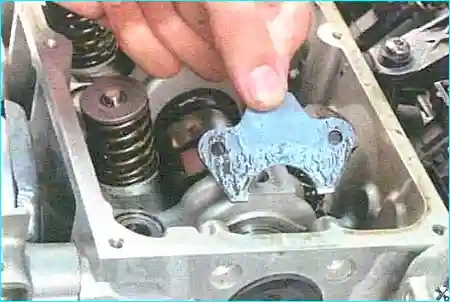
At the rear end of the cylinder head, remove the two screws securing the camshaft thrust flange and remove the flange.
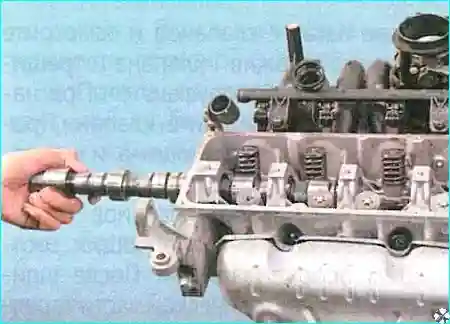
Carefully, being careful not to damage the bearing surfaces with the sharp edges of the cams, remove the camshaft from the cylinder head.
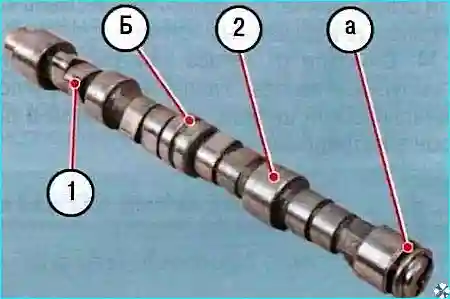
Inspect the camshaft. The surfaces of bearing journals 2 and cams 1 should be well polished and free of damage, and the groove for the thrust flange should be free of excessive wear and nicks.
The working surfaces of journals 2 should not have any scoring, nicks, scratches, or aluminum galling from the bearing seats in the cylinder head.
If the working surfaces of cams 1 show signs of seizure, overheating, deep scratches, or faceted wear, or uniform wear exceeding 0.5 mm, replace Shaft.
Thoroughly clean oil supply channel 6 in the center bearing journal of any deposits.
Grinding the camshaft lobes to eliminate stepped wear is prohibited, as changing the cam profile dimensions will disrupt the valve timing.
Workshops equipped with special tools and fixtures can check the radial runout of the camshaft journals.
If its value is greater than 0.02 mm or the journals are misaligned, replace the shaft, as straightening it is not permitted:
When installing a new camshaft, we recommend replacing the valve rocker arms with new ones.
Before starting the engine for the first time and to improve running-in conditions, we recommend adding an extreme pressure anti-friction additive to the engine oil.
After installing the camshaft, check its axial clearance. If it is greater than 0.15 mm, replace the thrust flange,
Install the camshaft into the cylinder head and all removed parts in the reverse order of removal.
Install the cylinder head on the engine (see Replacing the Cylinder Head Gasket).


