


If the engine cylinder head installed on the vehicle requires repair, remove it ("Cylinder Head Gasket Replacement")
In most cases, cylinder head repair involves lapping or replacing the valves and their guides, and replacing or grinding the valve seats.
Moreover, repairing valve guides and seats requires specialized tools and equipment, so this work should be performed at a specialized service center.
In case of malfunctions such as a leak in the cooling system channels and warping of the mating surface to the cylinder block, the cylinder head is replaced.
You will need: 10, 12, and 17 mm wrenches, a spark plug wrench, a magnetized screwdriver (or tweezers) for removing the valve keepers. springs, valve spring compressor.
Remove all spark plugs.
Loosen the three mounting nuts and remove the exhaust manifold heat shield.
Loosen the remaining exhaust manifold mounting nuts and remove the manifold and the gasket installed underneath.
Loosen the four upper bolts securing the intake manifold to the cylinder head, loosen the three lower nuts and remove the intake manifold together with the throttle body and fuel rail (see "Replacing the intake manifold seal").
Remove the intake manifold gaskets.
Replace the intake manifold sealing gaskets with new ones each time the connection is disassembled.
Loosen the three mounting bolts and remove the thermostat.
Remove the rocker arm shaft assembly with the rocker arms and Camshaft
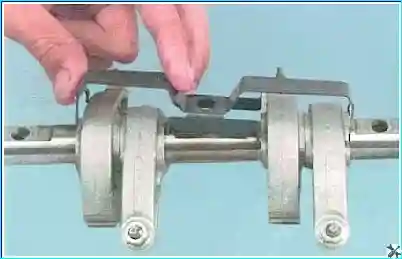
If necessary, remove the rocker arm retainers and valve rocker arms from the axle.
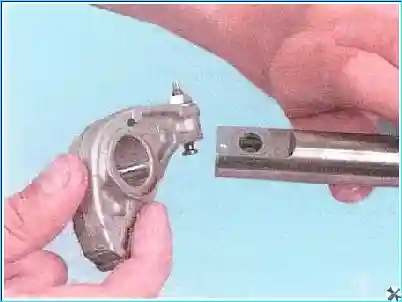
If you do not plan to replace the valve rocker arms, their shaft, and camshaft, do not remove the rocker arms from the shaft so that they can be installed in their original positions during assembly.
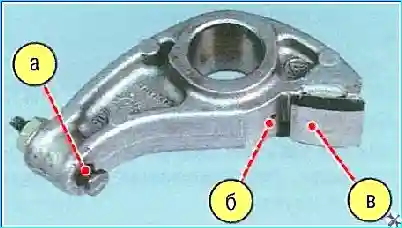
Inspect the valve rocker arms.
Replace the rocker arm if there is severe, clearly visible wear on the surface. contacting the camshaft lobe.
Check the cleanliness of the oil supply hole to the camshaft lobe.
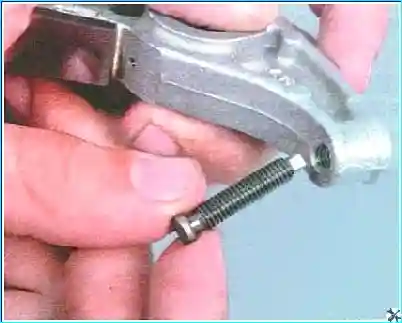
Check the condition of the adjusting bolt head and, if there are any obvious signs of wear, check it.
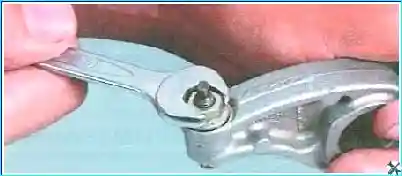
Loosen the bolt locknut and remove the bolt from the rocker arm.
Install a valve spring compressor, compress the springs, remove the keepers, spring retainers, and springs (see "Replacing Valve Stem Caps"), and remove the valves from the guide bushings.
After prolonged use, a mushroom-shaped burr may form on the upper end of the valve.
Before removing the valve from the guide bushing, remove this burr with a file.
Never knock the valve out of the guide bushing with a hammer through a mandrel without removing the burr, as this will inevitably damage the valve. The inner surface of the bushing is damaged.
Remove resinous deposits from the top surface of the head and from the intake ports.
These deposits can be softened and washed away with kerosene or diesel fuel.
Clean carbon deposits from the combustion chambers and exhaust ports. Remove carbon deposits with a round wire brush installed in the chuck of an electric drill.
Pre-soak the carbon deposits with kerosene.
Be careful not to inhale dust generated during cleaning of the combustion chambers. To prevent dust formation, periodically wet the carbon deposits with kerosene.
Clean the inner surfaces of the valve guide bushings Brush the cylinder head with a thin cylindrical brush made of copper wire clamped in the chuck of an electric drill.
Remove any burnt-on gasket residue from the mating surface of the cylinder head to the block.
Do not clean the mating surface of the cylinder head with wire brushes or emery cloth.
Use a spatula made of hard wood or plastic, after softening the gasket residue with solvent.
After cleaning, inspect the cylinder head to prevent it from being used with damaged threaded holes, cracks (especially between the valve seats and in the exhaust ports), corrosion, foreign material inclusions, voids, and fistulas.
Do not weld cracks, voids, or fistulas. Replace a defective cylinder head.
Using a metal ruler placed on its edge and a feeler gauge, check the flatness of the cylinder head mating surface to the block in the longitudinal and transverse directions, as well as diagonally.
If the gap between the ruler's edge and the cylinder head surface exceeds 0.05 mm, replace the cylinder head.
Clean the surfaces of the cylinder head flanges for installing the intake pipe and exhaust manifold from gasket residue and carbon deposits.
Check for deformation of the flanges for the intake pipe and exhaust manifold; replace any deformed cylinder head.
Repair damaged threaded holes by tapping or installing a repair bushing (insert).
Determine valve guide wear by measuring the inner diameter of the bushing bore and the diameter of the valve stem, and Using the difference in these dimensions to determine the clearance,
The maximum permissible clearance for intake valves during wear is 0.10 mm, and for exhaust valves, 0.15 mm.
If the clearance remains greater than the maximum permissible even when installing new valves, replace the valve guides.
Replace the valve guides in a specialized workshop with the appropriate tools.
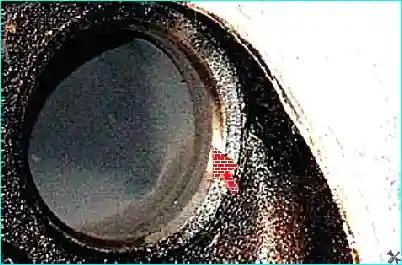
Check the condition of the valve seats. The valve seat chamfers should be free of wear, pitting, corrosion, or other defects.
Valve seats can be replaced in a specialized workshop.
Minor damage (small nicks, scratches, etc.) can be removed by lapping the valves.
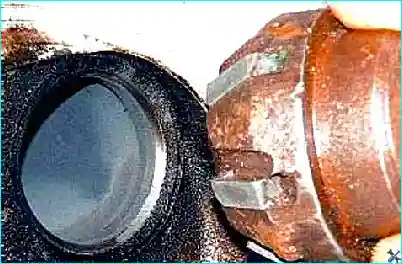
More significant valve seat defects are corrected by grinding.
The seats must be ground in a specialized workshop, as this requires specialized tools and equipment.
If significant defects cannot be corrected Grind the valve seats and replace them. Remove any carbon deposits from the valves and inspect them.
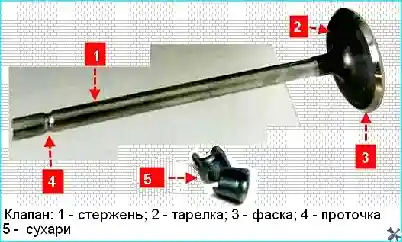
Brain deformation of the valve stem 1 and cracks in its head 2 are not permitted.
If damaged, replace the valve. Check that the working chamfer 3 is not excessively worn or damaged.
Grinding the working chamfer of the valves is permitted (in repair shops with the appropriate equipment).
After grinding, the thickness of the cylindrical portion of the valve head should be at least 0.5 mm for intake valves and at least 1.0 mm for exhaust valves.
Minor nicks and scratches on the chamfer can be removed by lapping the valve to the seat.
Check the concentricity of the valve head and seat; Apply a thin coat of paint (such as Prussian blue) to the valve head chamfer, insert it into the guide bushing, press it lightly against the seat, and rotate it.
Paint marks on the seat chamfer indicate the concentricity of the valve and seat.
Check the condition of the grooves 4 on the valve stem for the cotters.
If you find signs of chipping on the groove edges or wear on the cylinder section, replace the valve.
Replace the valve stem seals.
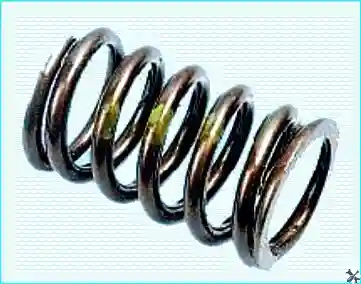
Inspect the valve springs. Cracks and loss of spring elasticity are not allowed.
Springs can be installed in one of two types.
The nominal length of the first type of spring in the free state is 46.5 ± 2 mm, and the second type is 46,64±2) mm.
The length with fully compressed coils is 26.0 and 23.63 mm, respectively.
Replace springs with a free length shorter than the permissible limit, or if they are warped (the spring axis deviation from the vertical in the free state is more than 4°), or if they have cracks.
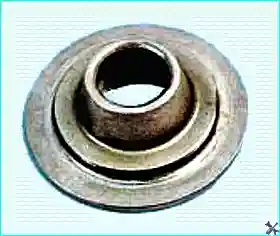
Check the condition of the spring retainers. Replace any retainers with significant wear on the spring grooves.
Reinstall all removed cylinder head components in the reverse order of removal.
Always replace the cylinder head, intake manifold, and exhaust manifold gaskets with new ones, as even apparently undamaged gaskets removed from the engine may be severely compressed and will not provide a tight seal.


