


The flywheel is removed to replace the rear crankshaft oil seal, to replace it if the toothed rim used to start the engine with the starter is damaged, and to grind the surface under the clutch disc.
You will need the tools necessary for removing the gearbox and clutch, as well as a 17 mm socket head and a screwdriver.
Remove the gearbox (see "Removing and installing the gearbox") and the clutch (see "Removing and installing the clutch").

Mark the relative positions of the flywheel and crankshaft in any way.
The flywheel can only be installed on the crankshaft in one position, since one of the holes in the flywheel and crankshaft is located asymmetrically (has an angular offset).
To facilitate flywheel installation, we recommend marking the relative positions of the parts.
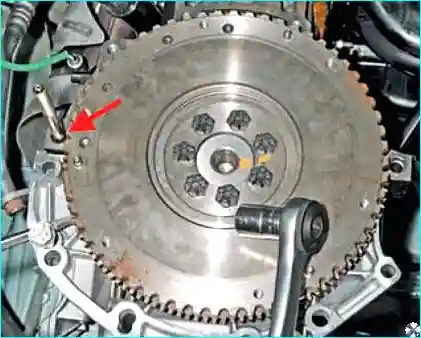
Remove the six flywheel mounting bolts, holding the flywheel from turning with Screwdrivers.
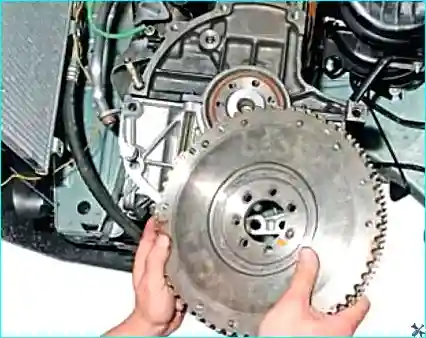
Remove the flywheel.
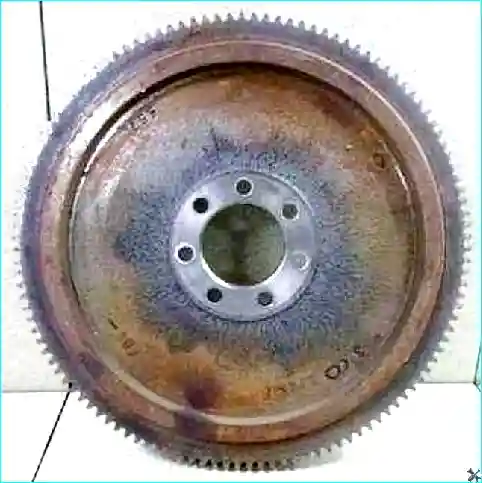
Check the condition of the flywheel rim teeth and replace them if damaged Flywheel.
Replace or repair the flywheel if there are nicks or scoring on the mating surfaces of the driven disc or crankshaft flange.
The flywheel can be inspected and repaired in a workshop with the necessary equipment.
Flywheel runout, measured along the toothed rim, should not exceed 0.5 mm.
To remove deep nicks and scoring, the mating surface of the driven disc can be ground, while the metal removal layer should not exceed 0.3 mm.
Install the flywheel according to the marks applied, and all removed components in the reverse order of removal.
Lubricate the threads of the flywheel mounting bolts with an anaerobic thread locker, such as Loctite Frenetanch or similar.
Tighten Tighten the bolts evenly, crosswise, to a torque of 65 Nm (6.5 kgf/m).
Replace the flywheel mounting bolts with new ones. Reusing them is not permitted.


