


An external sign of worn valve stem seals is the brief appearance of blue smoke from the exhaust pipe after starting the engine, as well as during engine braking after prolonged driving under load.
Constant smoke is usually not observed. Indirect signs include increased oil consumption without any external leaks and oily spark plug electrodes.
You can replace the valve stem seals without removing the cylinder head from the engine.
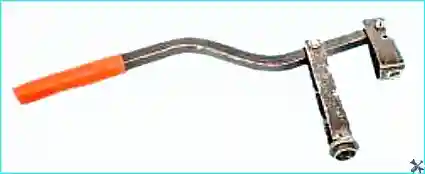
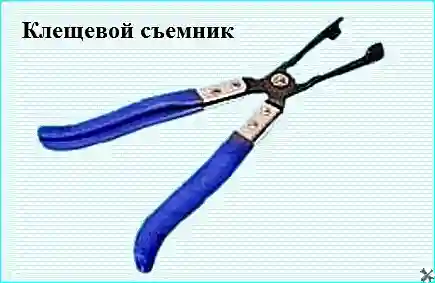
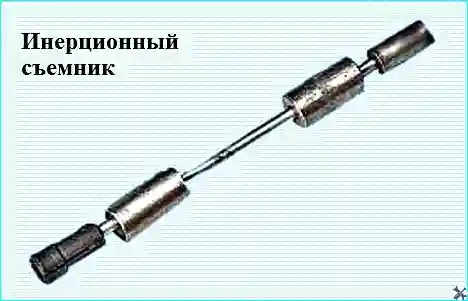
You will need: all the tools necessary for removing the cylinder head cover (see "Replacing the Renault Logan valve cover gasket"), as well as a 12 mm wrench, tweezers (or a magnetized screwdriver) for removing the valve spring retainers, a valve spring compressor, A pliers or inertial valve stem seal puller.
The puller shown has a mandrel on the other end for pressing the stem seals on.
If you don't have such a puller, you will need pliers to remove the stem seals and a mandrel of the appropriate diameter to press them onto the valve guides.
Disconnect the negative battery cable.
Remove all spark plugs.
Remove the cylinder head cover (see "Replacing the Cylinder Head Cover Gasket").
Set piston No. 1 to TDC on the compression stroke.
With the crankshaft in this position, pistons No. 1 and No. 4 are at TDC. This makes it possible to "de-jam" the valves of these cylinders without the risk of dropping them into the cylinder.
To set the piston of cylinder 1 to the TDC position of the compression stroke, it is necessary to remove the upper cover of the timing belt (to gain access to the timing marks on the camshaft pulley and on the cylinder head), which entails labor-intensive preliminary operations to remove the right support of the powertrain mount.
With sufficient accuracy to set the pistons of cylinders 1 and 4 to the TDC position when replacing the valve stem seals, the camshaft can be set in the required position, checking it visually.
When turning the crankshaft, the camshaft must be set so that the heels of the rocker arms of both valves of cylinders 1 or 4 rest on the back of the camshaft lobes, and the rocker arms can be It was moved by "rocking" within the gap.
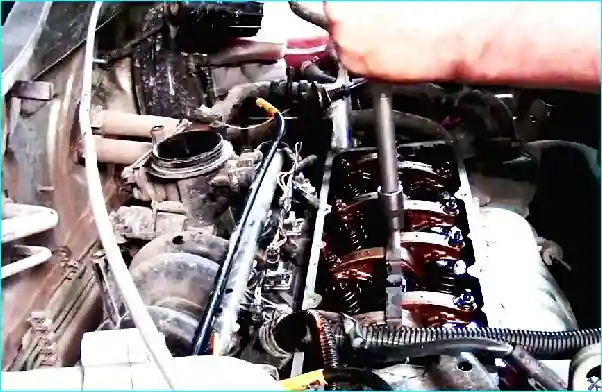
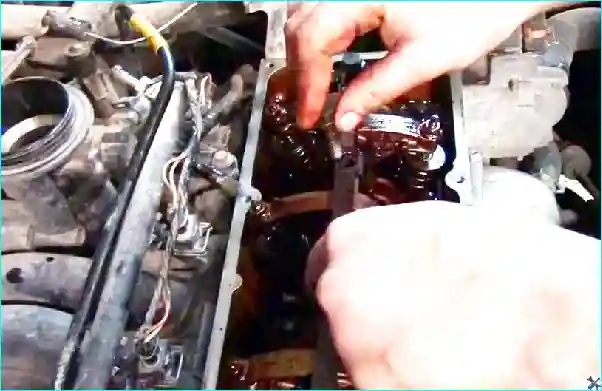
Evenly loosen the five bolts securing the rocker arm shaft of the valve drive Remove the bolts from the cylinder head and axle holes.
Note that the bolt heads are different shapes.
Reinstall the bolts in their original locations during reassembly.
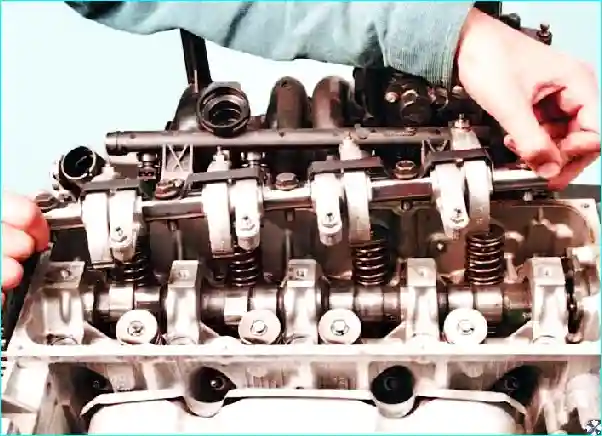
Remove the axle assembly with the rocker arms.
If you do not plan to replace the rocker arms, their axle, or the camshaft, do not remove the rocker arms from the axle so that they can be installed in their original locations during reassembly.
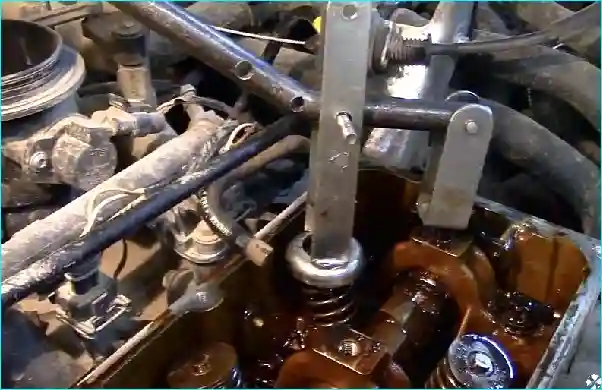
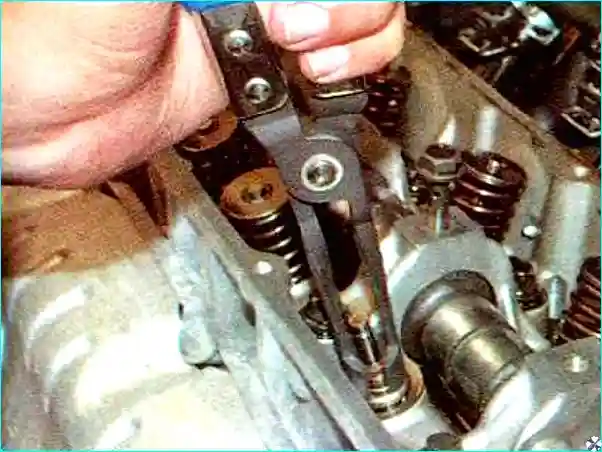
Install the valve spring compressor by screwing the valve rocker shaft mounting bolt into one of the cylinder head holes and hooking the compressor onto this bolt.
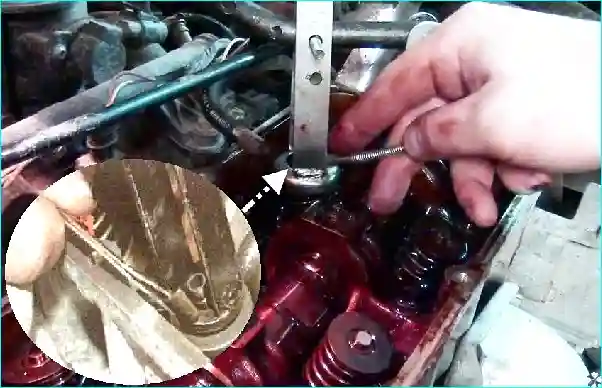
Compress the valve spring with the tool and remove the two crackers from the spring retainer using tweezers or a magnetized screwdriver.
Then remove the tool.
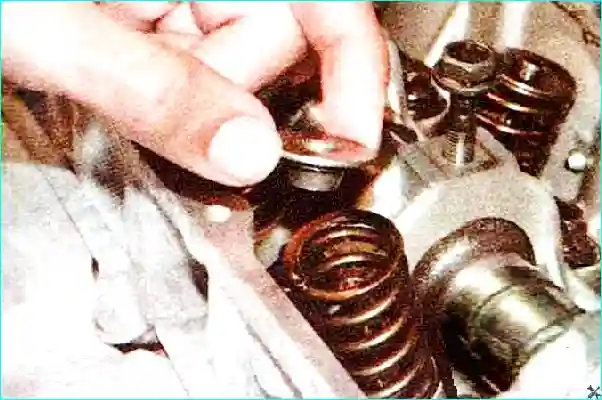
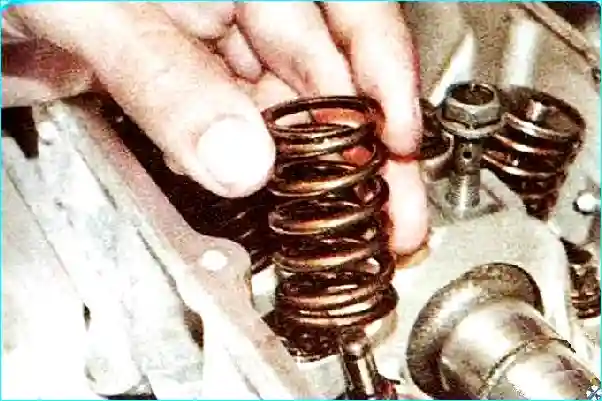
Remove the spring retainer and valve spring.
The valve spring support washer does not interfere with replacing the valve stem seal.
Press the valve stem seal off the valve guide.
To do this, place the collet of the inertial valve stem seal puller on the seal and sharply strike the collet sleeve with the striker.
Then, sharply strike the handle of the tool with the striker. thereby pressing the cap off the sleeve.
If you don't have an inertial valve stem seal puller, remove the cap with a special pliers-type puller or pliers, applying force straight up and without turning the cap to avoid damaging the valve guide.
Do not remove the cap by prying it from both sides with screwdrivers.
The guide sleeve on which the cap is placed is made of metal-ceramic, and its edge is easily It breaks off.
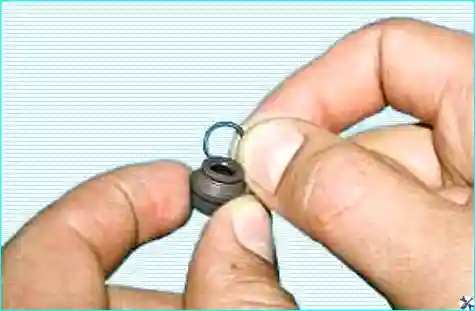
Before installing new valve stem seals, we recommend removing the springs from them, otherwise the seals can be damaged when they pass through the grooves for the valve keepers.
If the new seals come with a plastic installation sleeve, you can leave the springs in place.
In this case, place the sleeve on the valve stem.
Lubricate the inside surface of the valve stem seal with engine oil and slide the seal along the stem. valve to the guide sleeve
Install a mandrel to press the cap in.
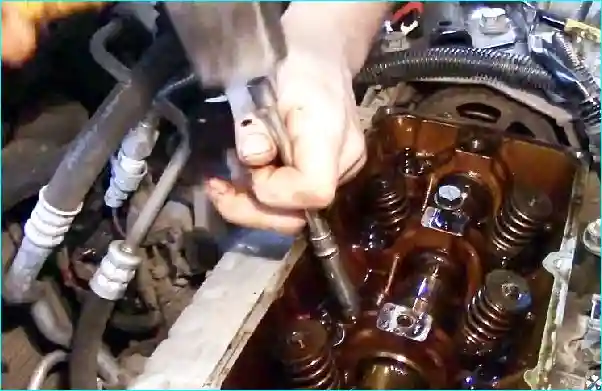
Press the cap in until it stops by lightly tapping the mandrel with a hammer.
If you don't have a special tool, you can select a cylindrical mandrel of a suitable diameter and press the cap in using it by lightly tapping it with a hammer.
You can use a long socket from a tool kit as a mandrel.
Choose a socket with 12 faces and chamfer inside the hole so that the head contacts the cap along a continuous circle.
Remove the guide sleeve from the valve stem or place the spring on the cap, if it was removed.
Install the spring and valve retainer in the reverse order of removal.
Install the keepers using a tool so that they fit into the grooves of the valve stem.
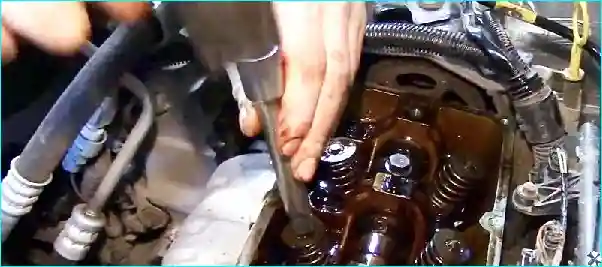
After installing the keepers, strike them with a hammer through a metal rod valve end to ensure the cotters are seated.
If the cotters are installed crookedly and remain loose, the "uncranked" valve will fall into the cylinder when the engine is started, causing serious engine failure.
Similarly, replace the valve stem seals for the second valve of cylinder 1 and two valves of cylinder 4.
Turn the crankshaft half a turn until the pistons of cylinders 2 and 3 are at TDC, and replace the valve stem seals for the remaining valves.
After installing the rocker arm shaft assembly onto the engine, check and, if necessary, adjust the valve clearances (see "Adjusting Valve Clearances").
Reinstall all removed parts in the reverse order of removal.


