


Renault Logan vehicles are equipped with a dry, single-plate clutch with a central diaphragm spring.
The clutch pressure plate is connected to the engine flywheel with six bolts.
Three pins are pressed into the flywheel to center the pressure plate.
A diaphragm spring made of spring steel is installed in the clutch housing.
The diaphragm spring consists of eighteen petals, which act as elastic release levers.
Due to the elasticity of the levers, the diaphragm spring creates uniform pressure on the clutch pressure plate and facilitates smooth engagement and disengagement of the clutch.
The pressure plate must be replaced if the diaphragm spring petals wear more than 0.8 mm, or if pedal effort decreases when disengaging the clutch, indicating significant wear. pressure plate surface or diaphragm spring settlement.
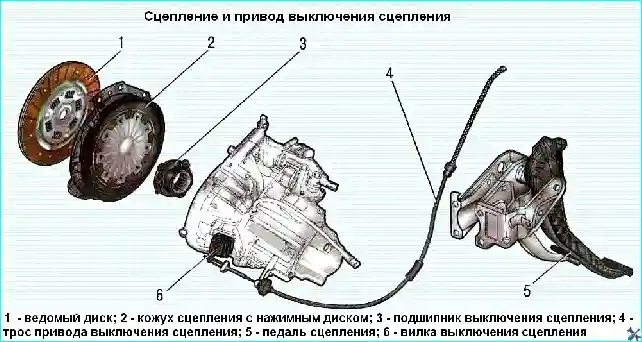
The clutch actuator on these vehicles is cable-operated and gap-free.
The front end of the cable is secured in the clutch release fork, and the rear end is secured in the clutch pedal bracket.
The front end is threaded and is used to adjust the clutch release mechanism.
The clutch pedal is mounted on a shaft in the pedal assembly bracket. The pedal return spring is also mounted on this axis.
The fork pivots on a ball joint installed in the clutch housing.
A clutch release bearing is mounted between the clutch release fork and the diaphragm spring petals.
The bearing sleeve has two hooks with which it engages the fork tabs.
The clutch drive design uses a design in which the bearing is constantly pressed against the diaphragm spring petals.
The bearing moves freely along a guide sleeve pressed into the clutch housing.
The clutch is released as follows.
When the clutch pedal is pressed, the cable rotates the clutch release fork, which moves the bearing along the guide sleeve.
The bearing presses on the diaphragm spring petals. springs.
The spring, deforming, stops pressing the pressure plate against the flywheel, and the pressure plate moves away from the flywheel, allowing the engine crankshaft and gearbox input shaft to rotate independently of each other.
When the clutch pedal is released, the bearing returns to its original position, causing the diaphragm spring to again press on the pressure plate, which, in turn, presses the driven plate against the flywheel—resulting in renewed torque transmission.
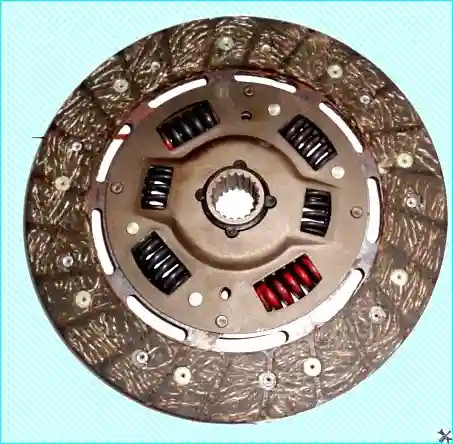
Driving disk 1 is mounted on the splines of the gearbox input shaft gears and is clamped by a diaphragm spring between the flywheel and the pressure plate.
Clutch release bearing 3 is a sealed type that does not require lubrication during operation. It is mounted on a guide sleeve pressed into the bore of the clutch housing.
The guide sleeve is a one-piece unit that includes an oil seal and the front bearing of the input shaft.
The bearing is moved by fork 6, mounted on a ball joint screwed into the clutch housing.
The fork is inserted into the grooves of the bearing sleeve without additional fastening.
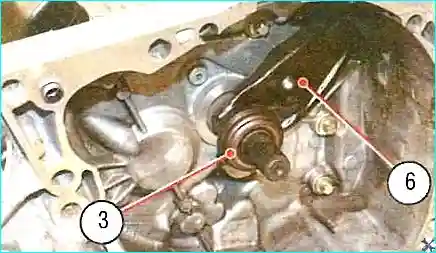
The free arm of the clutch release fork, sealed in the clutch housing with a rubber boot, is acted upon by clutch release cable 4, the other end of which is secured to clutch pedal sector 5.
The pedal travel is adjusted during operation as the driven disc linings wear using an adjusting nut mounted on the threaded end of the cable.
The clutches of 1.4- and 1.6-liter engines are identical in design and differ only in the diameters of the driven and pressure plates.
For the 1.4-liter engine, the diameter is 180 mm, for the 1.6-liter engine, it is 200 mm.
The working stroke of the outer arm of the clutch release fork also varies slightly: for the 1.4-liter engine, it is 28-33 mm, for the 1.6-liter engine, it is 30-35 mm.
Possible malfunctions with Clutch problems and troubleshooting methods
Jerking when starting
Stuck clutch cable - Apply engine oil to the cable. If the cable is damaged, replace it.
The driven disk hub is jammed on the gearbox input shaft splines - Clean the splines of dirt, and repair minor damage with a file.
If the splines are significantly worn or damaged, replace the disc or the gearbox input shaft.
Apply SHRUS-4 grease to the splines before assembly.
Drawn disk deformation - Replace the driven disk.
Looseness of the driven disk friction linings, severe wear or cracks on the linings - Replace the driven disk.
Loss of elasticity of the driven disk spring plates - Replace the driven disk.
Significant settling or breakage of the torsional vibration damper springs, wear of the spring windows - Replace the driven disk.
Scuffing on the working surfaces of the flywheel or pressure plate - Replace the flywheel or clutch housing with the pressure plate assembly (clutch basket).
Oily contaminated working surfaces of the driven disc friction linings - Thoroughly wash the oily surfaces with white spirit or gasoline and wipe them dry.
Replace a heavily oiled driven disc. Eliminate the cause of the oil contamination.
Rattling, knocking, or noise when engaging the clutch
Significant settling or breakage of the torsional vibration damper springs, wear of the spring windows - Replace the driven disc
Distortion of the driven disc - Replace the driven disc
Looseness of the friction linings of the driven disc, severe wear or cracks on the linings - Replace the driven disc
Increased noise when disengaging the clutch
Worn, damaged, or leaking grease from the clutch release bearing - Replace the bearing
The clutch slips (does not fully engage) when the gas pedal is pressed sharply, the engine picks up speed, but the car does not accelerate
Oil contamination of the flywheel, Clutch pressure plate and driven disc friction linings - Wash the oily surfaces with gasoline and wipe them dry.
Replace a heavily oiled disc. Eliminate the cause of the oiling.
Loss of diaphragm spring force - Replace the driven disc (basket)
Severe wear or burning of the driven disc friction linings - Replace the driven disc
Damaged or sticking clutch drive - Eliminate any sticking. Replace the drive components if necessary.
The clutch drags (does not fully disengage), forward gear shifting is difficult, and reverse gear shifts noisily even though the transmission is in good working order.
Incorrect clutch adjustment (insufficient pedal travel) - Adjust the clutch.
The clutch cable is sticking - Apply engine oil to the cable. If the cable is damaged, replace it.
Loose rivets or broken friction linings, warped driven disk (axial runout greater than 0.5 mm) - Replace the driven disk.
Severe and uneven wear, scoring on the working surfaces of the flywheel or clutch pressure plate - Replace the flywheel.
If the surface of the pressure plate is damaged, replace the housing with the pressure plate assembly (clutch basket).
Distortion or warping of the pressure plate. - Replace the pressure plate housing assembly (clutch basket)
The driven disk hub is seized on the gearbox input shaft splines. - Clean the splines of dirt and repair minor damage with a file.
If the splines are significantly worn or damaged, replace the driven disk or the gearbox input shaft.


