


The front wheel drives consist of outer and inner constant velocity joints (CV joints) connected by shafts.
The outer joint allows only angular movement of the connected shafts.
The inner joint, in addition to angular movement, also allows axial movement of the shafts when the front wheels turn and the suspension operates.
All joints of both drives are tripod-type, with the outer joints of both drives being identical in design, while the inner joints are different.
Therefore, the right and left drives are not interchangeable.
To reduce vibration in the transmission, a dynamic damper is installed with an interference fit on the right drive shaft.
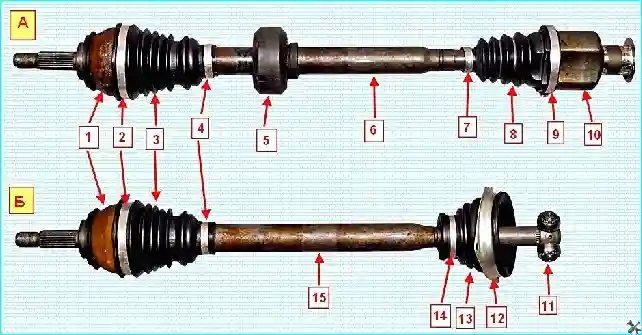
The Renault Logan uses outer constant velocity joints of the GE 86 type and inner joints of the GL 69 (left) and RC 462 (right) types.
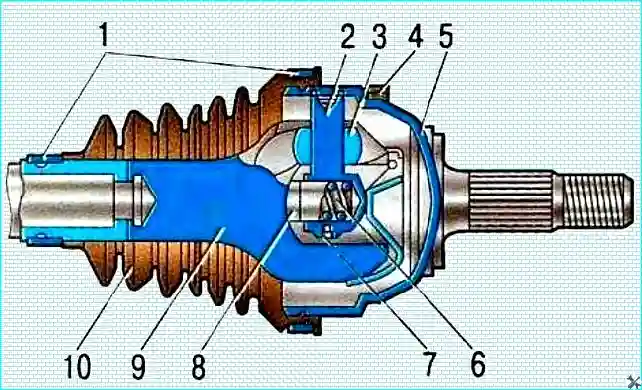
Outer Hinge 2 consists of Housing 5 (Fig. 2) and three rollers 3 mounted on the journals of a three-spoke hub 2. The latter is made integral with the Hinge Boot.
The rollers fit into grooves in the Hinge Sleeve, which is made integral with Drive Shaft 9.
This design allows the Hinge to rotate to the required angle.
The splined tailpiece of the outer Hinge Boot is secured to the front wheel hub with a nut.
Hinge sealing is ensured by Boot 10, secured with clamps 1 to the Hinge Boot and Drive Shaft.
For repairs of the outer Hinge, only its Boot and Boot Fastening Clamps are supplied as spare parts.
In the event of failure The joint must be replaced as an assembly with the drive shaft, since the joint sleeve and the shaft form a non-separable unit.
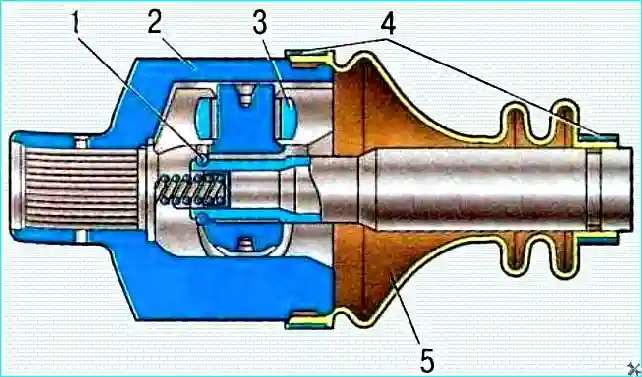
The right inner hinge consists of a housing 2 (Fig. 3) and three rollers 3 on needle bearings mounted on the journals of a three-pin hub.
The hinge housing contains grooves for the rollers.
The three-pin hub is secured to the drive shaft with a retaining ring 1. The rollers allow the hub to move axially in the grooves of the hinge housing, allowing the drive to be lengthened or shortened to compensate for relative movements of the suspension and the power unit.
The end of the inner hinge housing with internal splines is mounted on the splined shank of the right axle gear.
The hinge housing is secured from axial movement on the shank of the gear during suspension operation by an expansion spring 6 installed inside Joint
The joint is sealed by boot 5, secured with clamps 4 to the joint housing and to the drive shaft.
In the gearbox housing, the tip of the joint housing is sealed with a toroidal rubber ring and a self-tightening oil seal.
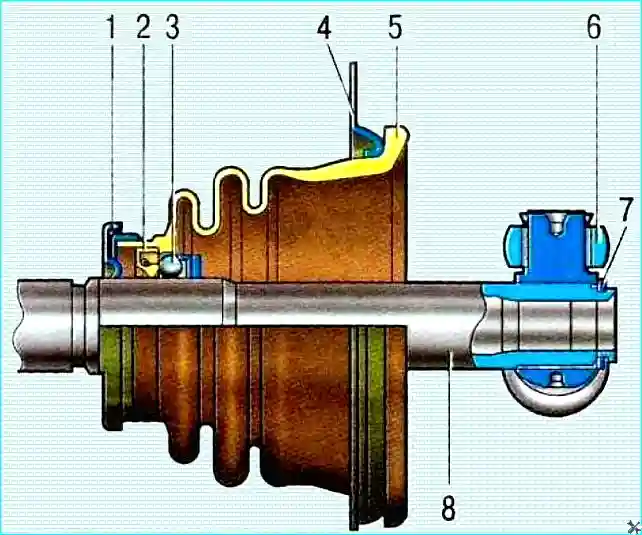
The left inner joint consists of three rollers 6 (Fig. 4) on needle bearings mounted on the journals of a three-pin hub.
The left half-axle gear of the gearbox, which has a complex shape, serves as the joint housing.
Its internal grooves for the rollers are made similar to The three-pin hub is secured to the drive shaft 8 (see Fig. 4) by retaining ring 7. The rollers allow the hub to move axially in the half-axle gear grooves, allowing the drive to be lengthened or shortened to compensate for relative movements of the suspension and powertrain. The joint is sealed by boot 5, securely fastened to the gearbox housing using holder 4. The drive shaft, rotating inside the boot in bearing 3, is sealed by oil seal 2, installed under the boot in a removable unit shared with the bearing. Two repair kits are supplied as spare parts for repairing the right inner joint: a large one, which includes all the parts. Joint, and a small one, similar to the outer joint repair kit.
For repairing the left inner joint, two repair kits are supplied as spare parts: a large one, which includes all joint components except the axle gear, and a small one, which includes the joint boot and the bearing assembly with the oil seal.
For lubricating the outer joints and the right inner joint, use a special grease with molybdenum disulfide "MOBIL CVJ 825 BLACK STAR" (supplied with the joint repair kit; the domestic equivalent is the SHRUS-4).
The splines of the inner joint shaft are lubricated with "MOLYKOTE BR2" grease, and the left inner joint is lubricated with transmission fluid.
The drive joints are very durable; their estimated service life is almost equal to the service life of car.
They are often replaced or repaired during operation due to the lack of attention to the condition of the protective covers.
Such work is quite expensive and labor-intensive. To save money, regularly check the condition of the ball joint boots and replace them immediately if they show any damage.
If water or dust gets into the ball joint through a damaged boot, it will fail within a few hundred kilometers.
Possible Drive Malfunctions and Troubleshooting
Cause of Malfunction - Troubleshooting
Vibration when driving
Severe wear on the outer drive joint - Replace the drive shaft assembly with the outer joint
Distortion of the drive shaft - Same thing
Worn rollers on the inner drive joint - Replace the inner joint
Loose hub nut - Tighten or replace the nut
Vehicle pulls to one side
Worn or damaged inner drive race Joint - Replace the drive shaft assembly with the outer joint.
Worn or damaged outer joint - Same thing.
Damaged or deformed wheel drive shaft - Replace the shaft.
Loose hub nut - Tighten or replace the nut.
Grease leaking from joints.
Worn or torn outer or inner joint protective boot - Inspect the joint; replace if there is any play. Replace the damaged boot and grease.
Loose clamps - Replace and tighten clamps securely.
Damaged left inner joint shaft oil seal - Replace the left inner joint bearing assembly with oil seal.
Noise, knocking from the front wheel when driving.
Damaged or deformed wheel drive shaft - Replace the drive shaft and outer joint assembly.
Runout of the front wheel drive shaft - Same.
Loosened hub nut - Replace or tighten the nut.
Knocking noise when turning the vehicle.
Severe wear of the outer joint of the wheel drive - Replace the drive shaft and outer joint assembly.


