


To compensate for thermal expansion of the valve, a gap is specified between the end of the valve stem and the adjusting bolt screwed into one of the arms of the valve drive rocker arm.
With an increased clearance, the valve will not open fully; with a decreased clearance, it will not close fully.
The need to adjust the valve drive clearances is indicated by a distinct, loud knocking sound, audible from the driver's seat when the engine is idling and the hood is closed.
Increased clearances do not lead to engine failure, but they do cause increased wear of valve train components.
In addition, with increased intake valve clearances, the filling of the cylinders with the combustible mixture is impaired, and, as a result, engine power is reduced.
With a complete lack of clearances in the exhaust valves, in addition to rough operation and reduced engine power, Due to reduced compression in the cylinders, the valve heads and seats of these valves may burn due to overheating, since a valve that does not fit tightly into its seat is poorly cooled.
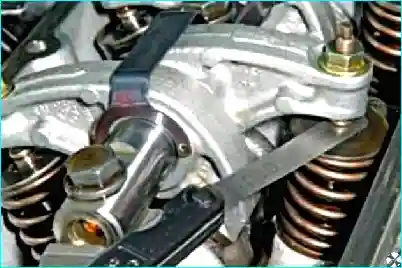
The clearance is measured on a cold engine (at +20 °C) between the ends of the valve stem and the adjusting bolt with the valve fully closed.
The nominal clearance for intake valves is 0.10 ~ 0.15 mm, for exhaust valves - 0.25 0.30 mm.
After replacing the valves, during the initial adjustment, the exhaust valve clearance should be set to a slightly reduced value of 0.20-0.25 mm.
Before starting the adjustment, be sure to check and, if necessary, adjust the timing belt tension (see "Replacing the timing belt and pulley on a Renault Logan engine").
You will need: all the tools necessary for removing the cylinder head cover, as well as a 10 mm spanner, pliers, and a set of flat feeler gauges.
Remove the cylinder head cover (see "Replacing the valve cover gasket on a Renault Logan").
Set the piston of cylinder No. 1 to the TDC position of the compression stroke (see "Setting the TDC of the Renault Logan engine").
In this position, both valves of cylinder No. 1 will be closed, and The clearances between the valve faces and the adjusting screws will be maximum.
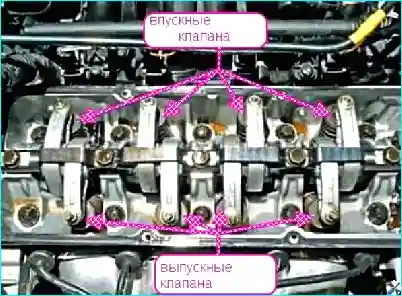
!!! The cylinder count is based on the flywheel.
Setting the No. 1 piston to TDC on the compression stroke requires removing the upper timing belt cover (to access the timing marks on the camshaft pulley and cylinder head cover), which requires labor-intensive preliminary operations involving removing the right powertrain mount.
The camshaft can be set to the desired position with sufficient precision for adjusting the valve clearances by visual inspection.
The camshaft must be rotated so that the rocker arms for both valves of the cylinder being adjusted rest on the backs of the camshaft lobes, and the rocker arms can be moved within the clearance limits by "rocking" them.
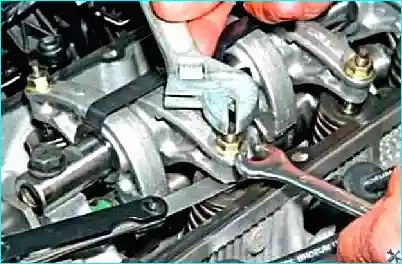
Loosen the locknut of the adjusting bolt of one of the rocker arms, holding the bolt with pliers to prevent it from turning.
Insert the feeler gauge into the gap between the ends of the valve and the adjusting screw.
While holding the locknut from turning, turn the adjusting bolt clockwise until the feeler gauge can be moved with slight force in the gap.
Do not tighten the adjusting bolt until the feeler gauge is completely pinched, as this will cause the valve to move and The clearance will be clearly less than the norm.
Holding the adjusting bolt from turning, tighten the locknut and check the clearance.
Repeat the adjustment if necessary.
Adjust the clearance for the second valve in the same way.
Turn the crankshaft exactly half a turn.
In this position of the crankshaft, both valves of the 3rd cylinder are completely closed and their rocker arms are released.
Adjust the clearances between the ends of the valves and the adjusting bolts of the 3rd cylinder.
By further turning the crankshaft exactly half a turn, set the pistons of the 4th, and then the 2nd cylinder to TDC of the compression stroke and adjust the clearances for the rest valves.
Reinstall the cylinder head cover and all removed parts in the reverse order of removal.
Replace a tightly compressed cover gasket if necessary.


