


Checking and adjusting wheel alignment is essential to ensure good vehicle stability and handling, as well as even tire wear during operation.
Checking and adjusting wheel alignment is performed on special stands in accordance with their operating instructions.
Check wheel alignment with the vehicle unloaded, with a half-full fuel tank, normal tire pressure, and no excessive play in the suspension components.
After installing the vehicle on the stand, immediately before checking the alignment, "compress" the vehicle's suspension by applying a downward force of 392-490 N (40-50 kgf) two or three times, first to the rear bumper and then to the front.
The vehicle's wheels should be parallel to the longitudinal axis of the vehicle.
When checking and adjusting the front wheel alignment, first check the longitudinal inclination of the steering axis. then the camber angle and lastly the toe-in.
The caster angle of the front wheel steering axis is formed by the vertical and the line passing through the center of the upper support of the telescopic strut and the center of the sphere of the ball joint fixed on the lower arm.
The design of the vehicle does not provide for adjustment of the caster angle.
The front wheel camber angle is characterized by the deviation of the average plane of rotation of the wheel from the vertical.
The design of the vehicle does not provide for adjustment of the front wheel camber angle.
The toe-in of the front wheels is the angle between the plane of rotation of the wheel and the longitudinal axis of the vehicle.
The toe-in of the front wheels is adjusted by changing the length of the steering rods.
The design of the vehicle does not provide for adjustment of the camber and toe-in angles of the rear wheels.
Discrepancy between the actual values measured on the vehicle and the control The values listed below may be caused by wear and deformation of suspension components, as well as body deformation.
If deviations in the rear suspension parameters are detected due to deformation of its elements and the body, it is necessary to find the cause of the deviations and eliminate it by replacing the faulty parts.
Replacing or repairing suspension components may lead to a change in the wheel alignment angles, so checking the wheel alignment angles is mandatory.
Wheel alignment angles
Pitch angle
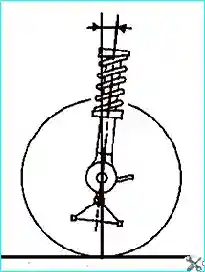
- - Front steering axis 2°42" ± 30"
Camber angle:
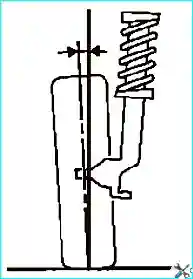
- - Front wheels - 0°10‘ ± 30‘
- - Rear wheels -0°51‘±15‘
Toe-in:
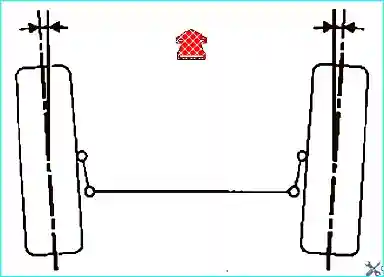
- - Front wheels - 0°10" ±10"
- - Rear wheels +0°44" ±15"
Maximum difference in right and left wheel alignment angles...1°


