


We remove the cylinder head for repair, for replacement of the gasket under the head and for a complete engine overhaul.
All operations are conventionally described on the engine already removed from the vehicle.
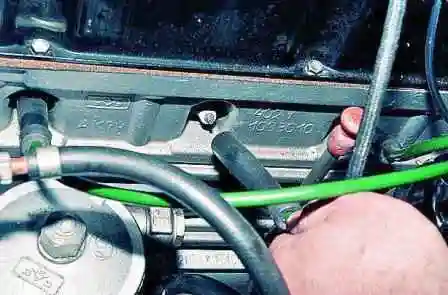
We remove the lead terminals from the spark plugs.
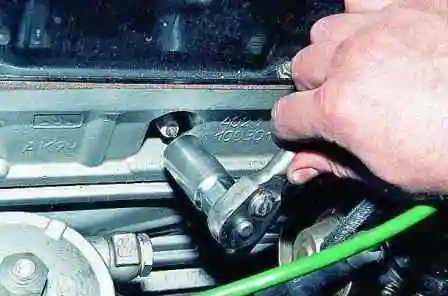
We unscrew and remove the spark plugs.
We disconnect the crankcase gas vent pipe.
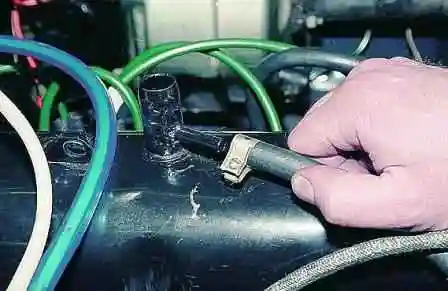
We disconnect the vacuum regulator hose of the ignition distributor sensor.
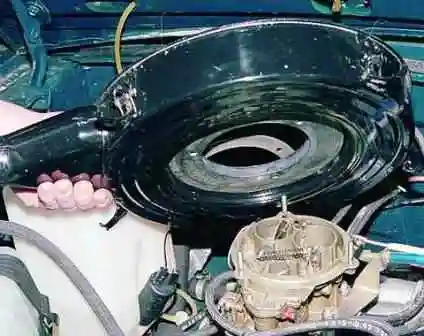
We remove the air filter housing and the carburettor.
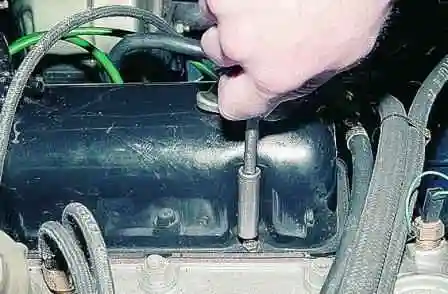
Using a box spanner or a 10 mm socket, we unscrew the six cylinder head cover bolts.
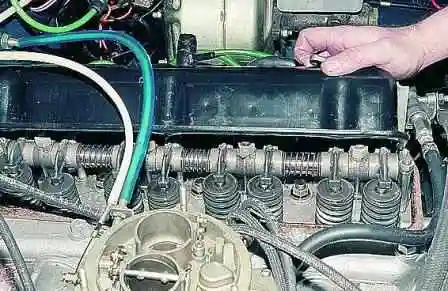
We remove the cylinder head cover.
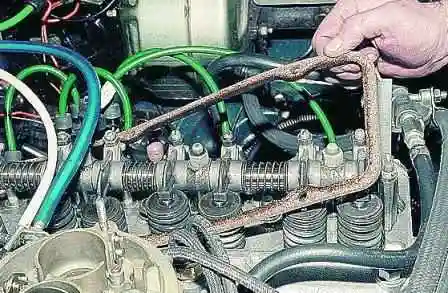
We remove the cylinder head cover sealing gasket.
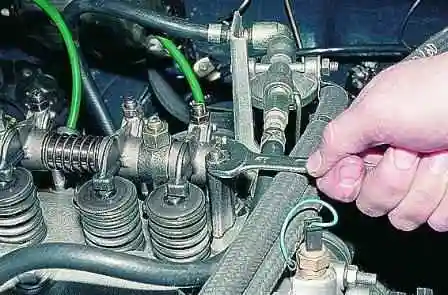
Using a 13 mm spanner, we unscrew the two nuts of the side posts of the rocker shaft.
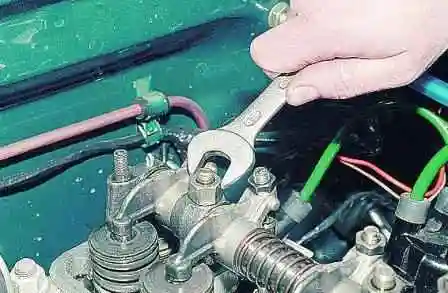
Using a 17 mm spanner or socket, we successively unscrew the four nuts of the rocker shaft posts.
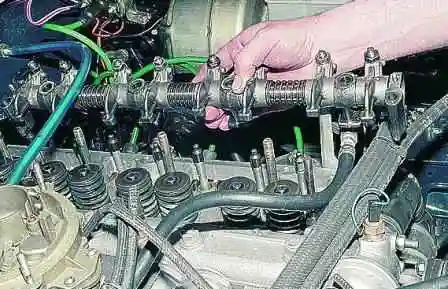
We extract the rocker shaft from the studs (it can be carefully prised off with a screwdriver).
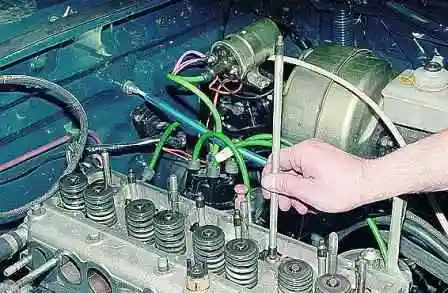
We successively withdraw the eight tappet rods.
At this, the rods must be marked or laid out in a row and their position remembered, so that during assembly all rods are fitted in their places.
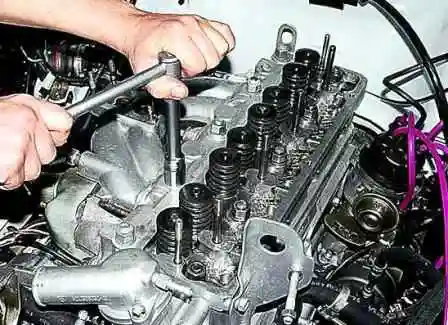
Using a 17 mm socket, we successively unscrew the ten cylinder head mounting nuts.
It is desirable to unscrew in the reverse order to tightening (see the nut tightening sequence in the figure).
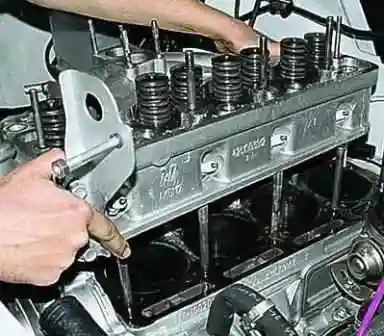
We remove the cylinder head (when extracting, the head must not be prised off with a screwdriver or any other tool in the mating plane).
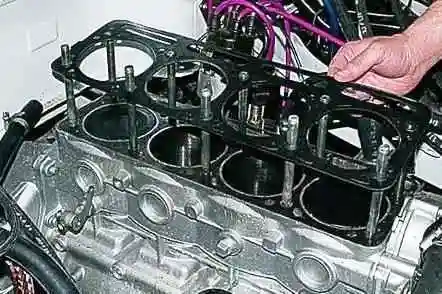
We extract the cylinder head gasket.
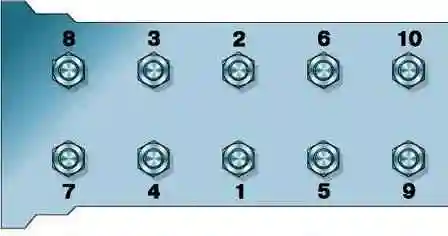
The cylinder head nut tightening sequence is shown in the figure.
We fit the head in the reverse order, having previously coated the cylinder head gasket with graphite grease and fitted it onto the block studs.
The cylinder head mounting nuts are tightened in two stages:
- 1st stage — 40–60 N·m (4.0–6.0 kgf·m);
- 2nd stage — 83–90 N·m (8.3–9.0 kgf·m).