


The vehicle's high-current electrical circuits are protected by blade fuses.
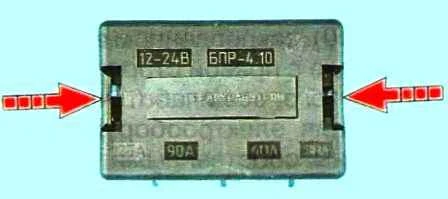
The blade fuses are installed in a common box (VPR-4.10), secured in the engine bay on the right-hand side and closed by a plastic cover.
The starter circuit is designed for a high short-term current, so it has no fuse.
Required materials and tools
- Spare blade fuses of the appropriate ratings.
- 19 mm socket, flat-blade and cross-head screwdrivers.
- Multimeter or tester for checking circuits.
- Gloves and safety glasses.
To replace a blown blade fuse, squeeze the two clips of the box cover and remove the cover.
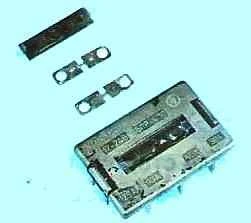
Spare fuses of various ratings are secured under the plate of the box cover.
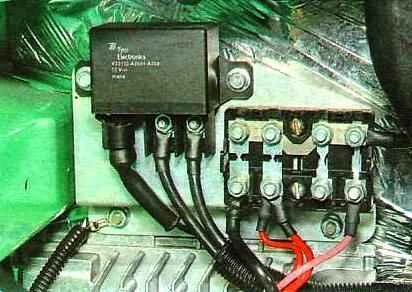
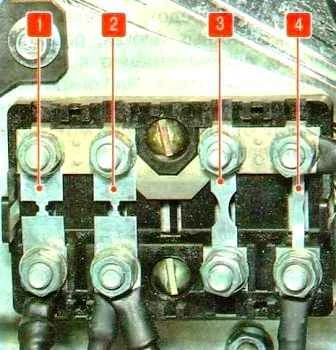
Unscrew the two nuts of the blown fuse and replace the fuse.
Low-current electrical circuits are also protected by blade fuses located in the mounting boxes in the vehicle interior and in the engine bay.
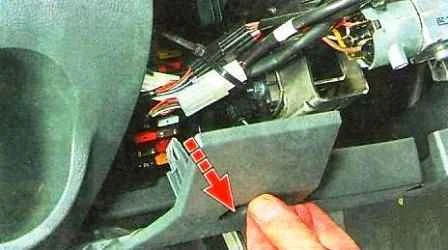
To access the mounting box in the interior, pull the edges of the two recesses in the lower trim panel and remove the panel.
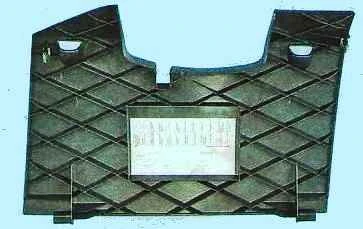
The layout diagram of the relays and fuses is printed on the inner side of the panel.
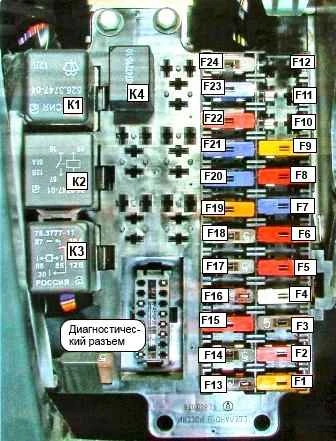
Function of the fuses and relays in the mounting box in the vehicle interior
№ — A — Protected circuit
- F1 — 20 — Windscreen wiper, windscreen washer.
- F2 — 10 — Lighting control module, instrument illumination.
- F3 — 5 — Electric mirror adjustment.
- F4 — 25 — Electric window lifters.
- F5 — 10 — Exterior mirror heating.
- F6 — 10 — Driver's seat heating.
- F7 — 15 — Auxiliary heater.
- F8, F11, F12 — Spare.
- F9 — 10 — Locking differential.
- F10 — 15 — Second-row seat socket.
- F13 — 7.5 — Daytime running lights.
- F14 — 5 — Rear fog lights.
- F15 — 10 — Direction indicators.
- F16 — 7.5 — Instrument cluster, speed sensor, heater control panel.
- F17 — 5 — Engine management system.
- F18 — 5 — Anti-lock braking system.
- F19 — 20 — Cigarette lighter, socket.
- F20 — 15 — Hazard warning lights.
- F21 — 15 — Lighting control module, illumination.
- F22 — 10 — Interior lighting.
- F23 — 15 — Central locking, audio system.
- F24 — 5 — Instrument cluster, diagnostic connector, pre-heater control panel.
Relays
- K1 — Windscreen wiper.
- K2 — Heater.
- K3 — Power circuit of the instruments and starter switch.
- K4 — Coolant after-heater.
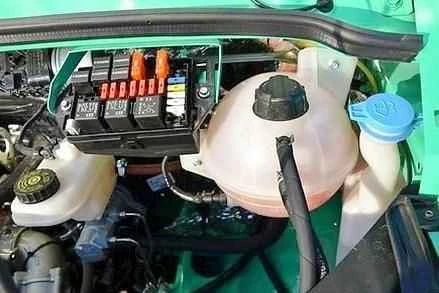
Some of the fuses and relays are located in the mounting box in the engine bay.
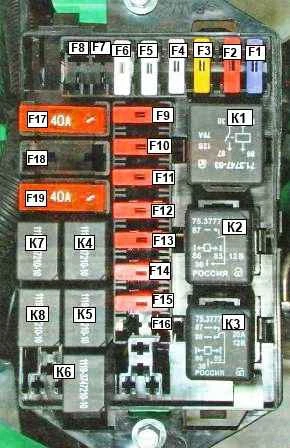
Function of the relays and fuses in the mounting box in the engine bay
№ — A — Protected circuit
- F1 — 15 — Fog light relay winding.
- F2 — 10 — Brake lights.
- F3 — 20 — Horn relay winding.
- F4 — 25 — Fuel heater relay winding.
- F5 — 25 — Coolant after-heater.
- F6 — 25 — Instruments and starter switch.
- F7 — 25 — Anti-lock braking system (ABS).
- F8 — Spare.
- F9 — 10 — Dip beam (left-hand headlamp).
- F10 — 10 — Dip beam (right-hand headlamp).
- F11 — 10 — Main beam (left-hand headlamp).
- F12 — 10 — Main beam (right-hand headlamp).
- F13 — 10 — Side lights (left-hand side).
- F14 — 10 — Side lights (right-hand side).
- F15 — 10 — Reversing lights.
- F16 — Spare.
- F17 — 15 — Heater.
- F18 — 25 — Anti-lock braking system (ABS).
- F19 — Spare.
Relays
- K1 — Starter relay.
- K2 — Fuel heater relay.
- K3 — Wiper blade return relay.
- K4 — Dip beam relay.
- K5 — Main beam relay.
- K6 — Fog light relay.
- K7 — Horn relay.
- K8 — Starter inhibit relay.
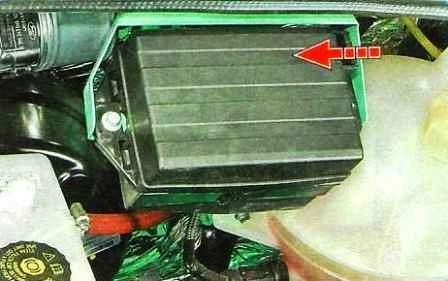
To access the mounting box in the engine bay:
We release the cover clip in the direction of the arrow.
We remove the cover.
Before replacing a blown fuse, the cause of the fuse or relay blowing must be established.
Replacing the direction indicator flasher relay
Tools required: 19 mm socket, flat-blade and cross-head screwdrivers.
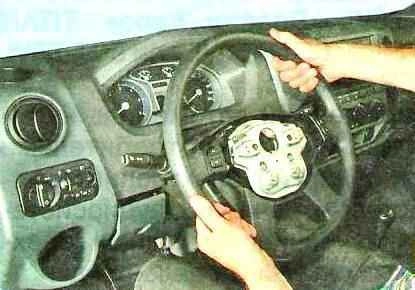
We remove the steering wheel.
We remove the left-hand steering column switch (article — Replacing the steering column switches).
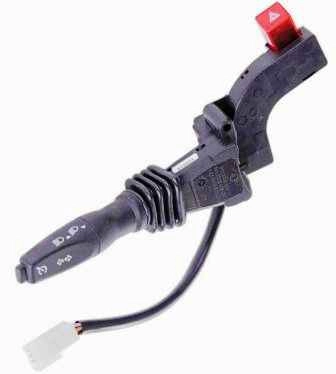
We extract the relay from the switch base, gently rocking the relay body from side to side.
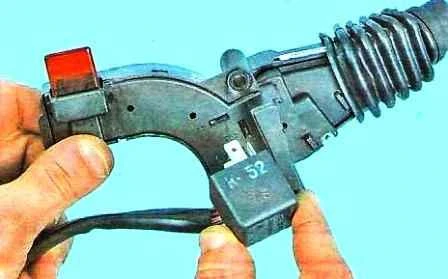
We install the relay and all parts in the reverse order.