


General body structure
The body of the Renault Megane 2 vehicle is of load-bearing construction, of the four-door saloon, five-door hatchback or five-door estate type. The body consists of a framework and bolt-on assemblies.
The body framework includes the floor pan, the side panels, the roof and other parts joined by electric welding (spot, seam and arc), and represents a non-detachable construction possessing sufficient rigidity and capable of carrying all the vehicle assemblies, the bolt-on body assemblies, and the interior assemblies and parts.
Bolt-on assemblies
The bolt-on assemblies include the side doors, the bonnet, the boot lid or tailgate (on vehicles with estate or hatchback body), the front wings, the bumpers.
- The doors, the bonnet and the boot lid (tailgate) are secured to the body by hinges.
- The front wings are secured by bolts.
- The front and rear bumpers are plastic, painted in the body colour, secured by self-tapping screws and plastic retainers.
- The bumpers are provided with metal energy-absorbing reinforcements. Polymer energy-absorbing elements are installed under the bumpers.
- The radiator grille is non-detachable, it is part of the bumper.
Glass
- The windscreen is three-layer, of the laminated type.
- The side door windows, the side panel windows, and also the rear window (tailgate window) are toughened.
- The windscreen and rear window (tailgate window), the side panel windows are bonded into the corresponding body apertures.
Seats
- The front seats are separate, with mechanical adjustment of the backrest angle and longitudinal movement mechanisms.
- The driver's front seat is equipped with a mechanism for changing the height of the front and rear parts of the cushion.
- The front seat backrests can be set in a position convenient for rest.
- The seat head restraints are easily removable, height-adjustable, installed on the backrests of all seats (three head restraints are installed on the rear seat backrest).
- The rear seat of the vehicle has a one-piece cushion and a backrest divided by a folding armrest into two parts (depending on equipment).
- Behind the armrest a hatch is provided, closed by a cover, after folding which it becomes possible to carry long items in the boot, passing them partially into the cabin.
Safety system
- The front and rear seat belts are inertia reel diagonal type.
- In order to improve passive safety, the vehicle is equipped with the SRS system. This system includes the airbags and the front seat belt pretensioners, which are actuated at the moment of an accident at significant vehicle speeds.
Cabin equipment
- In the vehicle cabin a cigarette lighter, front and rear ashtrays (depending on equipment), sun visors, a heating, air conditioning and ventilation system, an interior mirror, grab handles are installed.
- Under the driver's seat a mounting for a fire extinguisher is provided, and under the passenger's seat — for a first-aid kit.
- The volume, temperature, direction and intensity of the air flows are regulated by switches installed in the control unit of the heating, air conditioning and ventilation system, as well as by handles for adjusting the nozzles on the fascia.
- The vehicle is equipped with front and rear towing eyes, electric door lock locking, an electric boot lock (tailgate) actuator, electrically heated front seats.
- In the body an extractor ventilation is provided through deflectors with valves installed in the rear part of the body behind the rear bumper.
Body care recommendations:
- During prolonged parking of the vehicle, do not cover the body with a cover made of dense material. A cover soaked by rain creates, when heated in the sun, a steam bath, and the paint coating of the body under it may peel off and blister. Besides, under gusts of wind the cover moves and wears away the paint on the protruding parts of the body.
- Do not place rubber objects on the body. After some time the rubber will leave indelible marks on the coating (especially a light one).
- After washing, always remove the rubber mats and dry the cabin. Moisture under the mats is the main cause of corrosion of the floor.
Body gaps
When repairing the body and replacing body parts it is necessary to know the dimensions of the gaps of the mating parts.
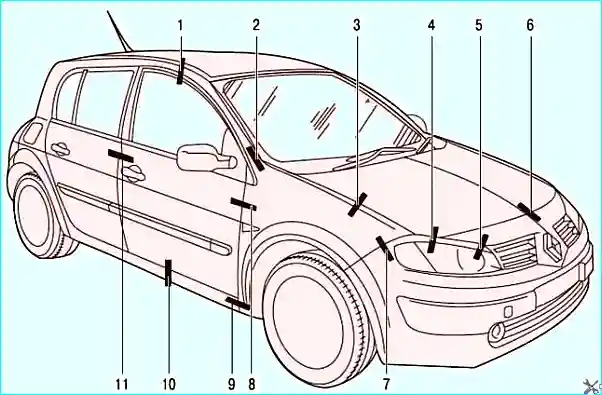
Front part of the vehicle
| Mating parts | Permissible gap, mm |
|---|---|
| Front door — roof | 22.7 ± 1.6 |
| Front wing — front body pillar | 2.5 ± 1.3 |
| Bonnet — front wing | 2.0 ± 1.9 |
| Bonnet — front headlamp | 2.0 ± 1.4 |
| Front bumper — front headlamp | 1.5 ± 1.3 |
| Bonnet — front bumper | 3.5 ± 1.1 |
| Front headlamp — front wing | 3.5 ± 1.1 |
| Front door — front wing | 4.0 ± 1.2 |
| Front wing — door sill | 3.0 ± 1.3 |
| Front door — front door sill | 4.2 ± 1.4 |
| Front door — rear door (top gap) | 4.2 ± 1.2 |
Rear part of the vehicle with hatchback body
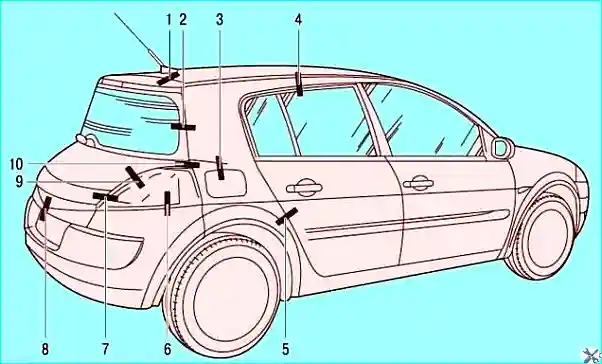
| Mating parts | Permissible gap, mm |
|---|---|
| Roof — tailgate | 5.1 ± 0.9 |
| Tailgate — rear wing (top gap) | 4.5 ± 1.9 |
| Fuel filler flap — rear wing | 2.5 ± 0.9 |
| Rear door — roof | 22.7 ± 1.6 |
| Rear door — rear wing | 4.0 ± 1.2 |
| Rear lamp — rear bumper | 1.5 ± 1.4 |
| Rear lamp — tailgate (bottom gap) | 4.5 ± 2.1 |
| Tailgate — rear bumper | 5.0 ± 1.9 |
| Rear lamp — tailgate (top gap) | 4.5 ± 1.7 |
| Tailgate — rear wing (bottom gap) | 4.5 ± 1.9 |
Rear part of the vehicle with saloon body
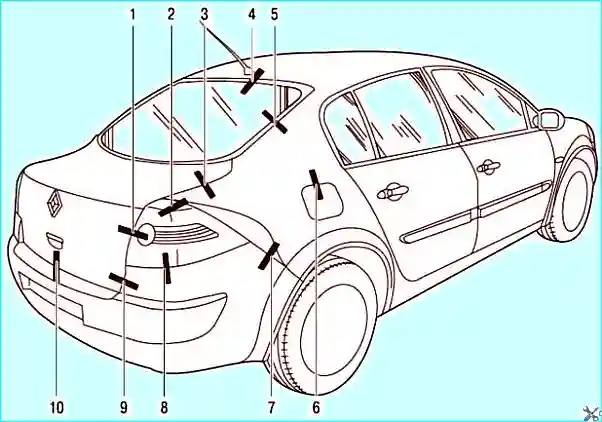
| Mating parts | Permissible gap, mm |
|---|---|
| Rear lamp — boot lid | 4.0 ± 2.0 |
| Rear lamp — boot lid | 1.5 ± 0.9 |
| Boot lid — rear wing | 4.0 ± 1.5 |
| Rear window — roof | 5.0 ± 0.5 |
| Rear window — rear wing | 3.0 ± 1.9 |
| Rear wing — fuel filler flap | 2.5 ± 0.0 |
| Rear wing — rear bumper | 0.5 ± 0.9 |
| Rear bumper — rear lamp | 1.5 ± 1.4 |
| Rear bumper — boot lid (side gap) | 4.0 ± 2.0 |
| Rear bumper — boot lid (bottom gap) | 6.0 ± 2.5 |
Rear part of the vehicle with estate body
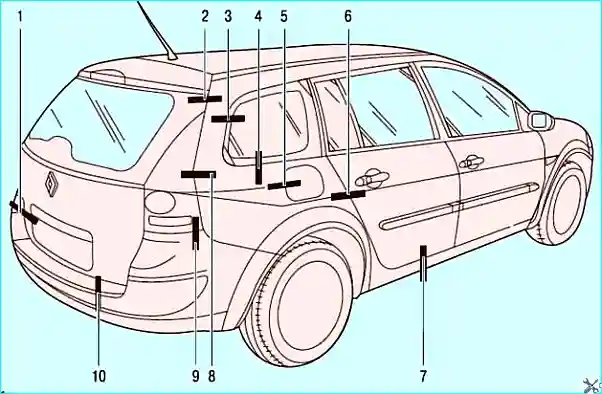
| Mating parts | Permissible gap, mm |
|---|---|
| Tailgate — rear bumper (side gap) | 4.5 ± 1.8 |
| Tailgate — rear body pillar | 4.5 ± 2.0 |
| Rear body pillar — fixed side window | 3.0 ± 1.0 |
| Fixed side window — rear wing | 3.0 ± 1.0 |
| Rear wing — fuel filler flap | 2.5 ± 1.0 |
| Rear door — rear wing | 4.0 ± 1.3 |
| Rear door — rear door sill | 4.5 ± 2.0 |
| Rear bumper — rear lamp | 1.5 ± 1.5 |
| Rear lamp — rear wing | 1.5 ± 1.0 |
| Tailgate — rear bumper (bottom gap) | 4.5 ± 1.8 |
Body floor control dimensions
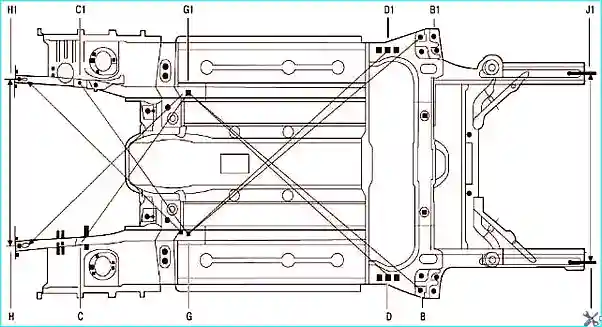
| Designation | Dimension, mm |
|---|---|
| B-G1 | B1 – G |
| G1 – C | G – C1 |
| G1 – H | 1391 |
| G – H1 | 1401 |
| G – B1 | G1 – B |
| G – D1 | G1 – D |
| H – H1 | 968 |
| J – J1 | 1102 |
Note: when adjusting the gaps use the data of the tables. The permissible deviations are indicated in millimetres. For precise adjustment it is recommended to use feeler gauges and measuring instruments.


