


General information
We remove the coolant pump for a major engine overhaul, and also in the event of absence or insufficient circulation of the coolant.
Causes of insufficient circulation:
- breakage of the pump impeller drive shaft;
- breakage of the impeller;
- large scale deposits in the pump cavity.
Necessary tools
- 10 mm, 12 mm, 16 mm, 18 mm sockets;
- 13 mm spanners;
- TORX E14;
- TDC setting retainer;
- camshaft retainer;
- flat-blade screwdriver;
- sealant;
- container for draining the coolant.
Preparatory operations
Preliminary work:
- We drain the coolant (see the article Method of replacing the coolant on a Renault Megane 2).
- We remove the auxiliary drive belt (see the article Replacing the auxiliary drive belt on a Renault Megane 2).
- We remove the timing belt (see the article Replacing the timing belt on the K4J engine of a Renault Megane 2).
Removing the coolant pump
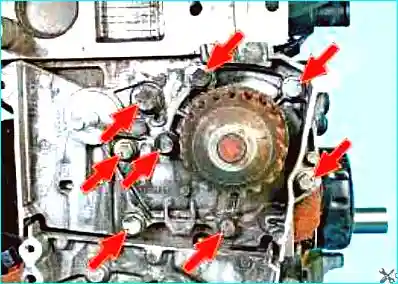
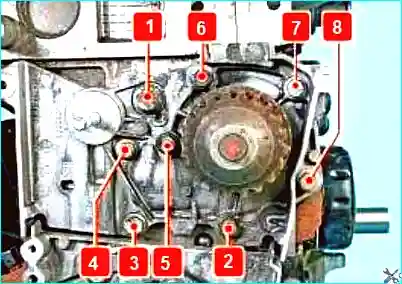
Removing the pump: we unscrew eight bolts securing the pump to the cylinder block. Important! The bolts differ in size — their location must be remembered.
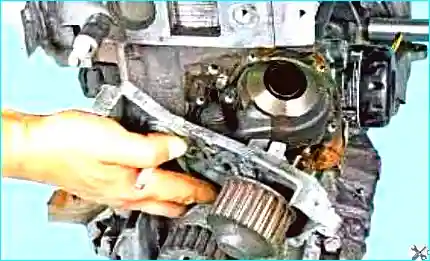
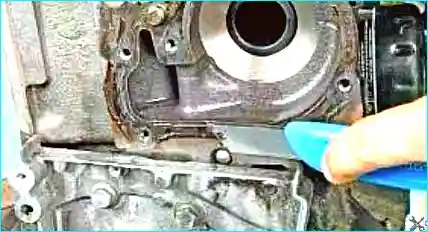
Preparation before refitting
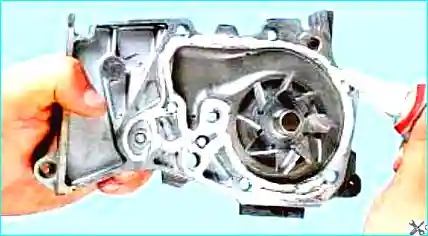
Applying sealant: we apply sealant to the pump flange.
Refitting and tightening torques
Tightening sequence of the bolts: we tighten the coolant pump securing bolts in the sequence indicated in Fig. 5.
Tightening torques:
- bolt М8 — 22 N·m;
- bolts М6 — 10 N·m.
Refitting: we refit all the parts in the reverse sequence.
Check after replacement
Final operations:
- We pour in the coolant.
- We remove air locks from the cooling system.
- We check the tightness of the connections.
- We check the performance of the pump (heating of the upper radiator hose after warming up the engine).
Recommendation: after replacing the coolant pump it is recommended to check the coolant level after the first warming up of the engine and to top up if necessary.


