


General requirements for the cooling system
Important! When performing work requiring complete draining of the fluid from the cooling system, always rinse the system with clean water and blow it through with compressed air to remove water residues.
Fill with coolant, remove the air from the system and measure its actual frost resistance. The system must ensure frost resistance:
- at a temperature down to –25 °C ± 2 for countries with a cold and temperate climate;
- at a temperature down to –40 °C ± 2 for countries with a very cold climate.
Precautions: before starting the work, cover the electrical equipment devices with plastic bags.
Replacing the coolant
Replacement interval: as recommended by the manufacturer, the coolant should be replaced after 6 years of operation or 90 000 km of mileage, whichever comes first.
Necessary materials and tools
- coolant — use GLACEOL RX (type D);
- clean cloth;
- container for draining the coolant with a volume of at least 10 litres;
- pliers.
Important! The coolant must be replaced with the engine cold.
Procedure
We place the vehicle on a lift or over an inspection pit.
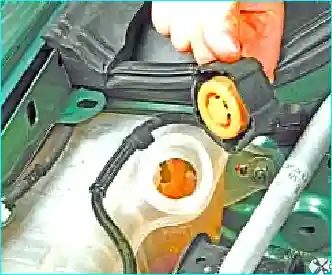
We open the expansion tank cap. We remove the engine undertray and the engine splash guard.
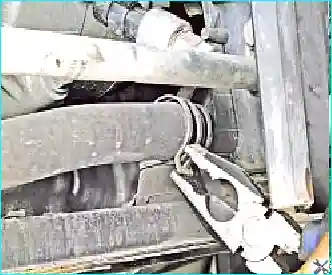
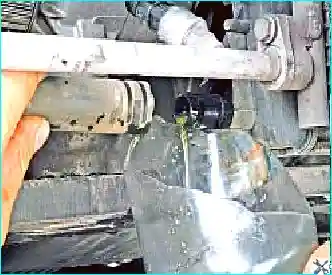
We remove the hose from the radiator stub and drain the fluid into the container placed underneath. After the coolant has finished draining, we refit the hose onto the stub.
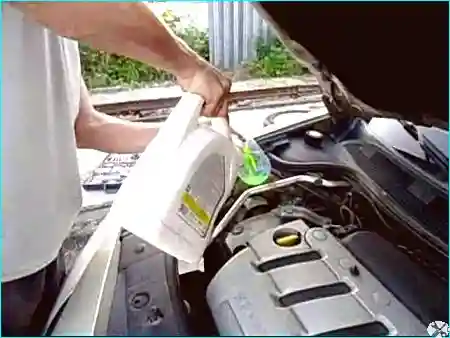
Removing air locks
We start the engine and warm it up to operating temperature (until the fan switches on). After that we stop the engine and check the coolant level. If necessary, we top it up in the expansion tank to the «max» mark.
Temperature monitoring: while the engine is running, the coolant temperature must be monitored using the gauge.
If the gauge has reached the overheating zone but the radiator fan has not switched on:
- switch on the heater and check what air passes through it;
- if the heater supplies warmed air — the fan is most likely faulty;
- if it supplies cold air — an air lock has formed in the engine cooling system.
To remove the air lock:
- We switch off the engine and let it cool down.
- We unscrew the filler neck cap.
- We start the engine and let it run for 3–5 minutes.
- We close the filler neck cap.
Tip: for better filling of the system without air locks, the radiator hoses should be periodically squeezed by hand.
After replacement: a few days after operating the vehicle following the coolant replacement, its level must be checked. If necessary, we top up the fluid.
Additional information: Method of replacing the coolant on a Renault Megane 2


