


Note. The valve train clearances are checked and adjusted with the engine cold (at a coolant temperature of 20 °C) with the cylinder head installed.
1. Removing the decorative cover and the cylinder head cover
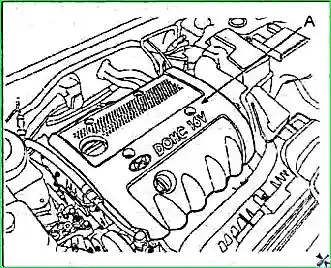
- Unscrew the fastening bolts and remove the decorative engine cover (A).
- Remove the cylinder head cover:
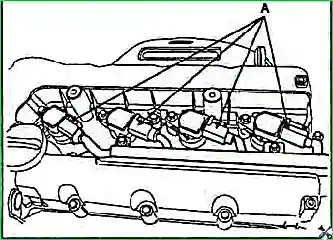
- disconnect the ignition coil connectors (A), then remove the coils by unscrewing the corresponding fastening bolts;
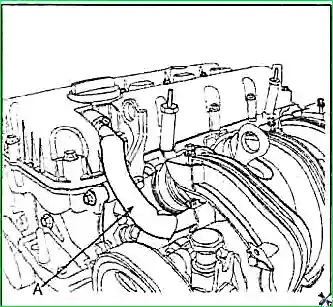
- disconnect the crankcase forced ventilation hose (A) from the cylinder head cover;
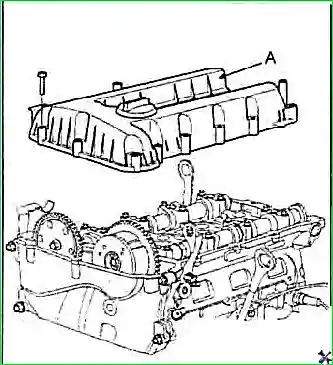
- unscrew the cylinder head cover fastening bolts, then remove the cover (A) and the gasket.
2. Setting the piston of cylinder No. 1 to TDC of the compression stroke
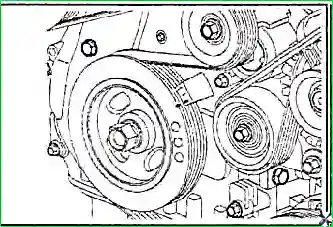
- Turn the crankshaft pulley clockwise and align its slot with the setting mark “T” on the timing chain cover.
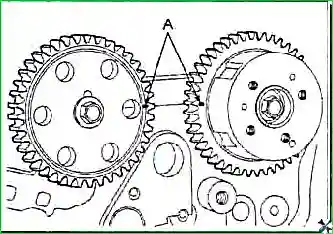
- Make sure that the TDC marks (A) on the exhaust valve camshaft sprocket and on the coupling of the variable valve timing (CVVT) system of the inlet valve camshaft are directed towards each other (aligned with the upper plane of the cylinder head). If there is no alignment, turn the crankshaft one revolution (360°).
3. Checking the valve train clearances
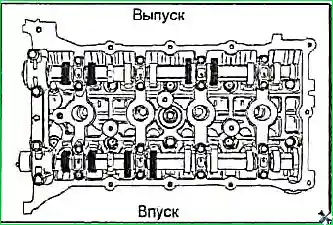
- Check the clearances only of the valves indicated in the figure (with the piston of cylinder No. 1 at TDC of compression):
- inlet valves of cylinders No. 1 and No. 2;
- exhaust valves of cylinders No. 1 and No. 3.
To measure the clearance:
- use a flat feeler gauge;
- measure the clearance between the valve tappet and the surface of the back (non-working) part of the cam.
- Nominal clearances at a coolant temperature of 20 °C:
- inlet valves: 0.10–0.30 mm;
- exhaust valves: 0.20–0.40 mm.
Record the measurement results in cases where the clearance value does not correspond to the permissible values. These data will be needed to select a new valve tappet.
- Turn the crankshaft pulley one revolution (360°) and align its slot with the setting mark “T” on the ignition advance angle indicator (scale on the timing chain cover).
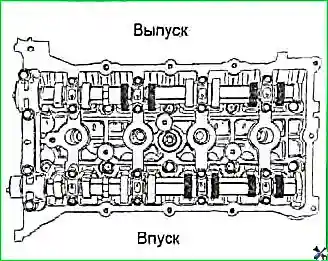
- Check the clearances only of the valves indicated in the figure (with the piston of cylinder No. 4 at TDC of compression):
- inlet valves of cylinders No. 3 and No. 4;
- exhaust valves of cylinders No. 2 and No. 4.
Measure the clearances in the same way as in point 3.1.
4. Adjusting the clearances in the inlet and exhaust valve train
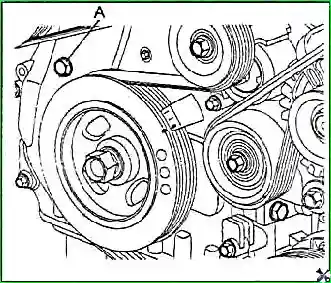
- Set the piston of cylinder No. 1 to TDC of the compression stroke.
- Make sure that the TDC marks on the exhaust valve camshaft sprocket and on the CVVT coupling of the inlet valve camshaft are aligned with the upper plane of the cylinder head.
- Unscrew the service hole bolt on the timing chain cover.
Caution! Do not reuse the bolt — replace it with a new one.
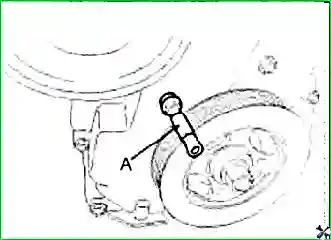
- Insert a thin rod (pin) into the service hole on the timing chain cover to lock the chain tensioner plunger.
- Lock the exhaust valve camshaft with a spanner and loosen the sprocket fastening bolt.
- Unscrew the bolts and remove the cover (A) of the camshaft bearings.

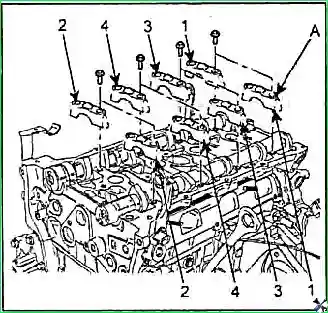
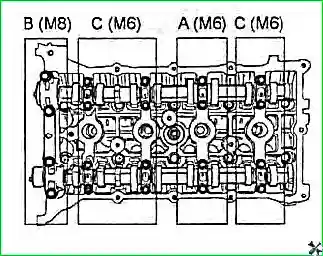
- Unscrew the bolts and remove the camshaft bearing caps (A) in the sequence shown in the figure.
- Loosen and remove the inlet valve camshaft bearing caps in the sequence specified in point 4.6.
- Remove the camshafts, holding the timing chain to prevent it from falling when disconnecting it from the sprockets.
- Secure the timing chain with a rope.
Note. Do not allow foreign objects to enter behind the timing chain cover. - Using a micrometer, measure the thickness of the removed valve tappet.
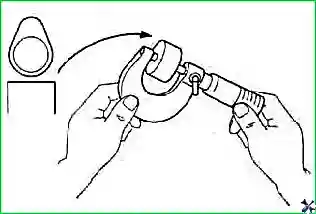
- Calculate the thickness of the new tappet to ensure the nominal clearance:
- for an inlet valve: N = T + [A − 0.20] mm;
- for an exhaust valve: N = T + [A − 0.25] mm,
where:
T — thickness of the removed tappet;
A — measured clearance in the valve train;
N — thickness of the new tappet.
- Select a new valve tappet with a thickness as close as possible to the calculated value.
Note. 41 tappet sizes are available with a step of 0.015 mm in the range from 3.00 mm to 3.60 mm. - Install the selected valve tappet, having first applied a little engine oil.
- Holding the timing chain, place the inlet valve camshaft on the cylinder head.
- Install the timing chain on the inlet valve camshaft.
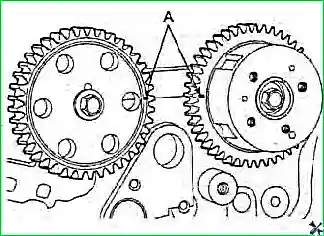
- Install the exhaust valve camshaft, aligning the marks (A) of the relative position of the chain and the shaft sprocket.
- Install and tighten (in several passes) the camshaft bearing caps to the nominal torque in the sequence shown in the figure:
- M6 bolt: 11–13 N·m;
- M8 bolt: 28–31 N·m.
- Remove the thin rod (pin) from the service hole on the timing chain cover (installed in point 4.4), then install a new service hole bolt. Tightening torque: 12–15 N·m.
5. Re-checking the valve train clearances
- Turn the crankshaft pulley clockwise two revolutions.
- Check:
- the alignment of the marks of the relative position of the chain and the camshaft sprockets;
- the alignment of the slot on the crankshaft pulley with the setting mark “O” on the ignition advance angle indicator (scale on the timing chain cover).
- After adjustment, re-check the valve train clearances.
Nominal clearances after adjustment (at a coolant temperature of 20 °C):- inlet valves: 0.17–0.23 mm;
- exhaust valves: 0.27–0.33 mm.
6. Installing the cylinder head cover
- Remove remnants of the old gasket and sealant from the mating surfaces of the timing chain cover and the cylinder head cover.
- Install a new gasket in the groove of the cylinder head cover.
- Degrease the surface for applying the sealant.
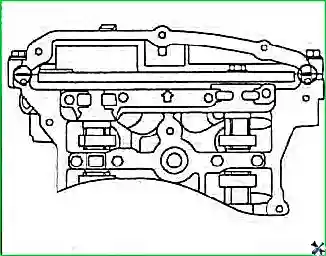
- Apply the sealant Loctite 5900 in a continuous bead of 2.0–2.5 mm diameter onto the mating surface of the timing chain cover (see figure).
Note. Before applying the sealant, make sure that the mating surfaces are dry and clean.
Caution:
- install and secure the cylinder head cover within 5 minutes after applying the sealant;
- wait at least 30 minutes before pouring engine oil into the engine.
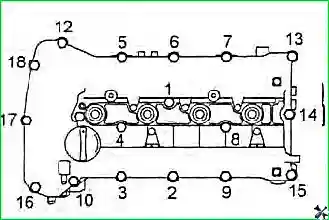
- Install the cylinder head cover with a new gasket and tighten its fastening bolts to the nominal torque in two passes in the sequence shown in the figure:
- pass 1: 4–6 N·m;
- pass 2: 8–10 N·m.
7. Final operations
- Connect the crankcase forced ventilation hose to the cylinder head cover.
- Install the ignition coils, tighten the corresponding fastening bolts to the nominal torque and connect the connectors. Tightening torque: 10–12 N·m.
- Install the decorative engine cover. Tightening torque: 8–12 N·m.


