


Let us consider the example of a Hyundai vehicle
Caution:
- To avoid damaging the painted surfaces of the body, cover the front wings of the vehicle with protective covers.
- Be careful when disconnecting hoses, do not spill oil or other fluid.
- Plug the disconnected pipes or hoses to prevent foreign particles from entering.
Note: when disconnecting hoses, always apply installation marks beforehand so that, when reconnecting, the hoses are installed in their original position.
- 1. Disconnect the cable from the negative terminal of the battery.
- 2. Remove the decorative engine cover.
- 3. Remove the air filter.
- 4. (Models up to 2009.) Remove the intake air duct and the air filter housing.
- a) Remove the mass air flow sensor.
- b) Disconnect the breather hose from the air filter housing.
- c) Disconnect the engine control unit connector.
- d) Remove the intake air duct and the air filter housing (A). Tightening torque: 8–12 N·m.
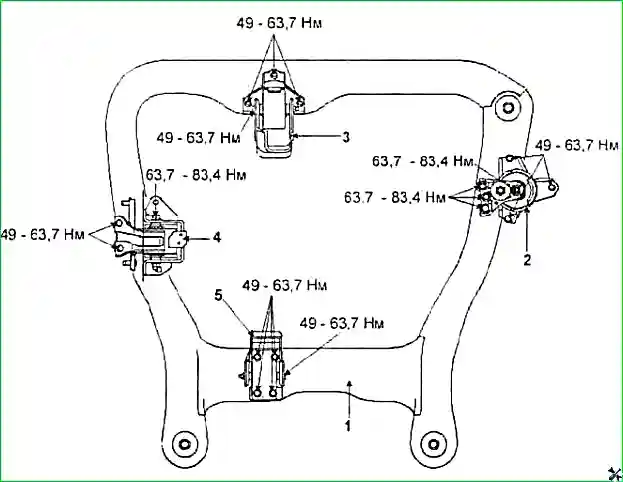
5. (Models from 2009.) Remove the intake air duct and the air filter housing.
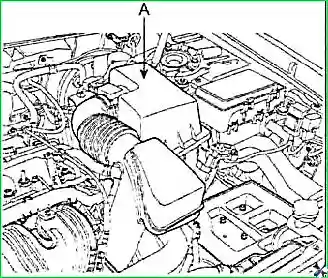
a) Remove the intake air duct (A).

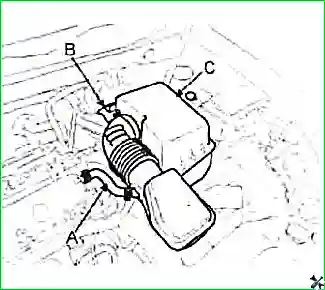
b) Disconnect the breather hose (A), the engine control unit connector (B) and remove the air filter housing (C).
Tightening torque: 8–12 N·m.
6. Remove the front wheels.
Tightening torque: 88.5–107.5 N·m.
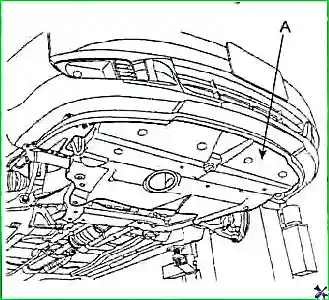
7. Remove the lower engine guard (A).
Tightening torque: 8–12 N·m.
- 8. Drain the coolant.
- 9. Remove the radiator hoses (A).
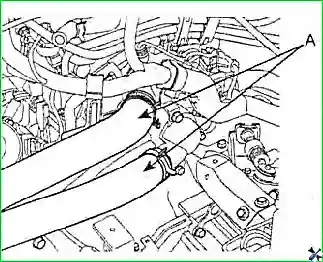
Models up to 2009.
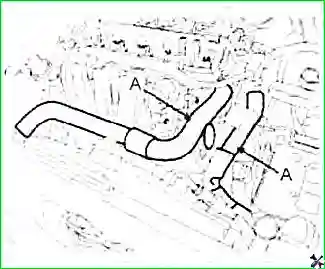
Models from 2009.
10. Remove the heater hoses (A).
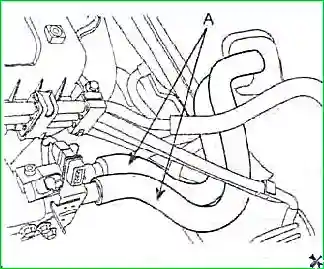
Models up to 2009.
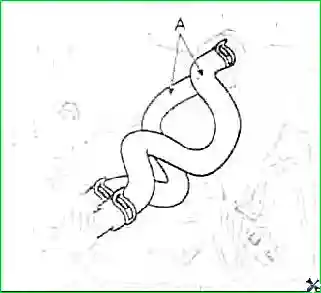
Models from 2009.
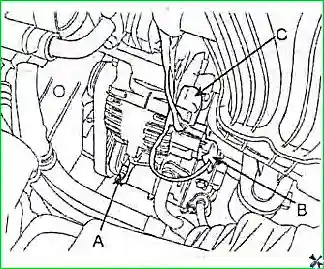
11. (Models up to 2009.) Disconnect the air conditioning compressor switch (A), the alternator connector (B) and the oil pressure warning sensor connector (C).
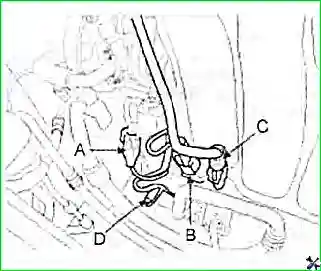
12. (Models from 2009.) Disconnect the solenoid valve connector of the intake manifold geometry change system (A), the oil pressure warning sensor connector (B), the knock sensor connector (C) and the air conditioning compressor connector (D).
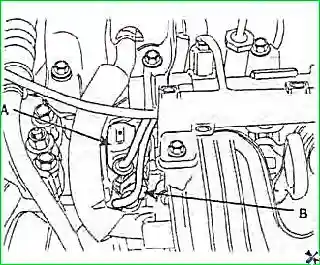
13. (Models up to 2009.) Disconnect the CVVT system valve (A) and oil temperature sensor (B) connectors.
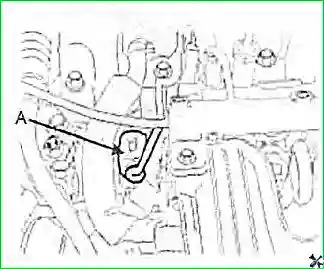
14. (Models from 2009.) Disconnect the CVVT system valve connector (inlet valves) (A).
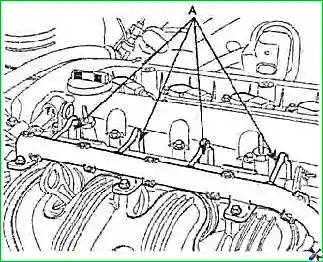
15. (Models up to 2009.) Disconnect the injector connectors (A).
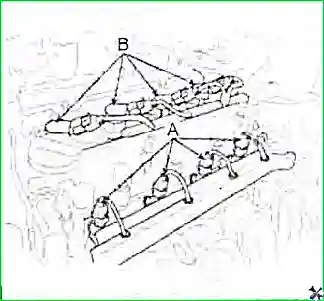
16. (Models from 2009.) Disconnect the injector connectors (A) and the ignition coil connectors (B).
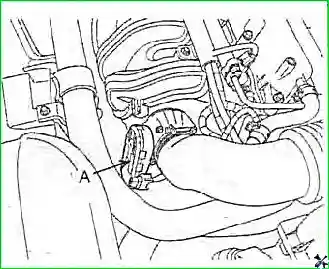
17. (Models up to 2009.) Disconnect the throttle actuator connector (A).
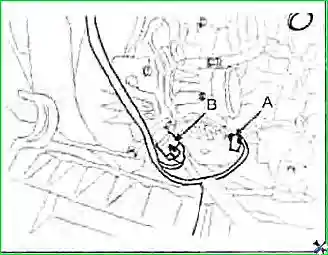
18. (2.4 l, models from 2009.) Disconnect the throttle actuator connector (A) and the intake manifold absolute pressure sensor connector (B).
19. (2.0 l, models from 2009.) Disconnect the idle speed control valve connectors (A), the throttle position sensor (B), the intake manifold absolute pressure sensor (C) and the throttle cable (D).
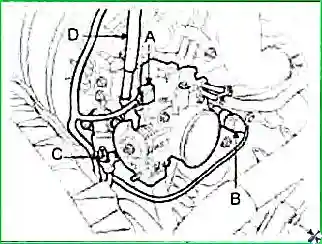
20. (Models up to 2009.) Disconnect the knock sensor (B) and camshaft position sensor (A) connectors.
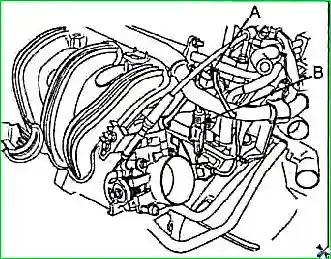
21. (Models up to 2009.) Disconnect the ignition coil connectors (A).

22. (Models from 2009.) Disconnect the camshaft position sensor connector (A) and the fuel pipe (B).
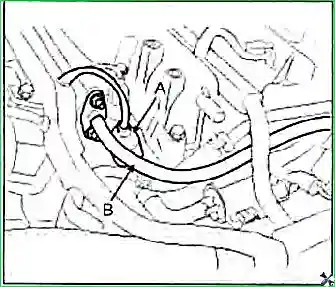
23. (Models up to 2009.) Disconnect the crankcase forced ventilation valve connector (A), the coolant temperature sensor connector (B), the capacitor connector (C), the crankshaft position sensor connector (D).
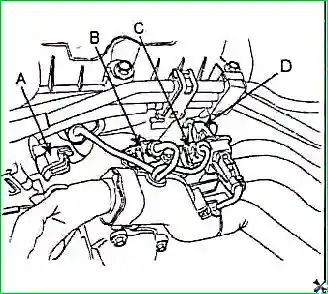
24. (Models up to 2009.) Remove the fuel rail (A), the brake servo vacuum hose (B) and the crankcase forced ventilation hose (C).

25. (Models from 2009.) Disconnect the crankcase forced ventilation valve connector (A), the coolant temperature sensor connector (B), the capacitor connector (C), the crankshaft position sensor connector (D), the camshaft position sensor connector (E) and the brake servo vacuum hose (F).

26. (Models from 2009.) Disconnect the connector (A) and the output “B” cable of the alternator (B).

27. (Models from 2009.) Disconnect the connector (A) and the cable (B) of the starter motor.

28. (Models up to 2009.) Disconnect the power steering fluid pressure sensor connector.

29. (Models from 2009.) Disconnect the power steering fluid pressure sensor connector (A) and the CVVT system valve (exhaust valves) connector (B).

30. Disconnect the power steering pump hose (A).

31. Remove the battery tray (A).

32. Disconnect the earth cable from the gearbox (A).

33. (Models with automatic transmission.) Disconnect the following connectors:
- starter inhibitor switch connector;
- automatic transmission selector connector;
- input shaft speed sensor connector;
- output shaft speed sensor connector;
- vehicle speed sensor connector;
- selector position cable.
- 34. Drain the automatic transmission fluid or manual transmission oil.
- 35. Disconnect the EPS system solenoid valve connector.

- 36. Disconnect the lower suspension arms.
- 37. Disconnect the track rod ends.
- 38. Remove the anti-roll bar.
- 39. Disconnect the drive shafts.
- 40. Remove the clip (B), disconnect the return hose (A) and drain the power steering fluid.

41. Disconnect the steering column universal joint.
Tightening torque (A): 18–24 N·m.

42. (Models up to 2009.) Disconnect the oxygen sensor connector (A).

- 43. (Models up to 2009.) Remove the front part of the exhaust downpipe.
- 44. (Models from 2009.) Disconnect the oxygen sensor connector (A) and remove the front part of the exhaust downpipe (B).

- 45. Install a support under the engine.
- 46. Unscrew the bolts of the front and rear power unit mount brackets.
- 47. Unscrew the subframe bracket bolts (B) and remove the subframe (A).


48. Remove the side engine mount bracket (A).
Tightening torque: 64–83 N·m.

49. Remove the automatic or manual transmission mount bracket (A).
Tightening torque (B): 64–83 N·m.

- 50. Lower the engine out of the engine compartment.
- 51. Installation is carried out in the reverse order of removal.
- 52. After installation, carry out the following operations:
- a) Adjust the transmission control cables and the accelerator pedal cable.
- b) Fill with engine oil, coolant, manual transmission oil or automatic transmission fluid (ATF).
- c) Check the condition of the battery cables and terminals.
- d) Check for fuel leaks after connecting the fuel lines. Turn on the ignition for 2 seconds (do not operate the starter) so that the fuel pump creates pressure in the fuel lines. Repeat this operation two or three times, then check for leaks at the connections.


