


The engines installed in Renault Megane 2 vehicles are equipped with an electronic engine management system with distributed fuel injection.
This system ensures compliance with modern emissions and evaporative emissions standards while maintaining high performance and low fuel consumption.
The control device in the system is the electronic control unit (ECU).
Based on information received from sensors, the ECU calculates fuel injection control parameters and ignition timing control.
In addition, in accordance with a predefined algorithm, the ECU controls the operation of the engine cooling fan motor and the electromagnetic clutch of the air conditioning compressor, performs self-diagnostics of system components, and notifies the driver of any malfunctions.
If individual sensors and actuators fail, the ECU activates emergency modes to ensure engine operation.
Quantity The amount of fuel delivered by the injectors is determined by the duration of the electrical signal from the ECU.
The ECU monitors engine status data, calculates fuel demand, and determines the required duration of fuel delivery by the injectors (signal duration).
To increase the amount of fuel delivered, the signal duration increases, and to decrease fuel delivery, the signal duration decreases.
The engine management system, along with the ECU, includes sensors, actuators, connectors, and fuses.
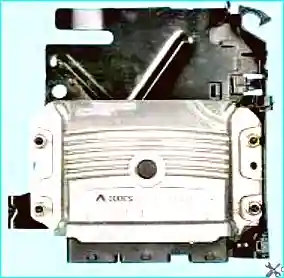
The ECU (controller) is connected via electrical wires to all system sensors.
Receiving information from them, the unit performs calculations in accordance with the parameters and algorithm The control unit stores the programmable read-only memory (EPROM) and controls the system's actuators.
The program version stored in the EPROM memory is designated by the number assigned to a given ECU modification.
The control unit detects a fault, identifies it, and stores its code, even if the fault is intermittent and disappears (for example, due to a poor connection).
The engine management system malfunction indicator in the instrument cluster goes out 10 seconds after the failed component is restored to operation.
After repairs, the fault code stored in the control unit's memory must be cleared.
To do this, disconnect the power supply to the control unit for 10 seconds (remove the fuse in the power supply circuit of the electronic control unit or disconnect the wire from the negative terminal of the battery).
The control unit supplies various sensors and switches of the control system with a direct current of 5 and 12 V.
Since The electrical resistance of the power supply circuits is high; the indicator lamp connected to the system terminals does not light.
To determine the supply voltage at the ECU terminals, use a voltmeter with an internal resistance of at least 10 megohms.
The electronic control unit controls the immobilizer system.
The ECU is not repairable and must be replaced if it fails.
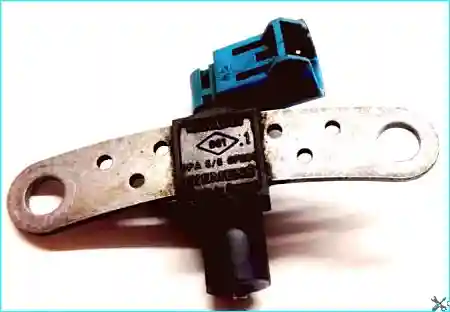
The crankshaft position sensor is designed to synchronize the operation of the engine control unit with the angular position of the crankshaft.
The sensor operates based on the Hall effect.
The sensor is installed in the front part The clutch housing is located above the flywheel timing ring.
The timing ring is a toothed wheel.
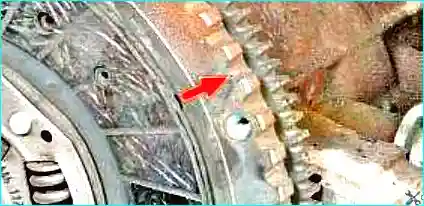
As the crankshaft rotates, the flywheel teeth alter the sensor's magnetic field, inducing AC voltage pulses.
The control unit uses the sensor's signals to determine the crankshaft speed and sends pulses to the injectors.
If the sensor fails, the engine cannot start.
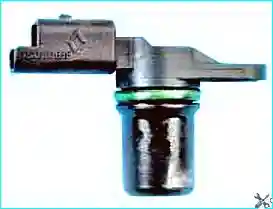
The inductive camshaft position (camshaft phase) sensor is mounted at the rear of the cylinder head.
As the intake camshaft rotates, projections on its front journal alter the sensor's magnetic field, inducing AC voltage pulses.
The sensor signals are used by the ECU to organize phased fuel injection according to the operating sequence cylinders, as well as to control the change in valve timing depending on the engine operating mode.
If a malfunction occurs in the camshaft position sensor circuit, the electronic unit stores its code in memory and turns on the indicator light.
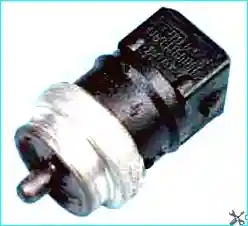
The coolant temperature sensor is installed in the water distributor housing of the engine cooling system.
The sensor's sensitive element is a thermistor, the electrical resistance of which varies inversely proportional to temperature.
At low coolant temperatures (-20 °C), the thermistor's resistance is approximately 15 kOhm; as the temperature rises to +80 °C, the resistance decreases to 320 Ohm.
The electronic control unit supplies the temperature sensor circuit with a constant "reference voltage."
The sensor signal voltage reaches its maximum value when the engine is cold and decreases as it warms up.
The electronic control unit uses this voltage to determine engine temperature and takes it into account when calculating injection and ignition adjustment parameters.
If the sensor fails or there are problems in its connection circuit, the ECU sets a fault code and stores it.
An additional thermistor is also installed in the sensor housing to control the coolant temperature gauge in the instrument cluster.
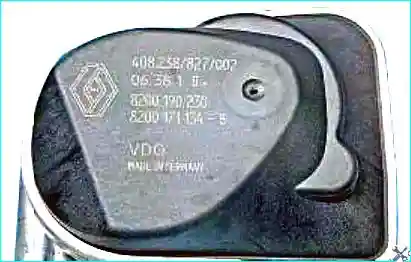
The throttle position sensor is mounted on the housing. The throttle assembly is connected to the throttle shaft.
The sensor is a potentiometer, with a positive supply voltage (5 V) applied to one end and a ground connection to the other.
The third terminal of the potentiometer (from the slider) sends an output signal to the electronic control unit.
When the throttle valve is rotated (due to pressure on the control pedal), the voltage at the sensor output changes.
When the throttle valve is closed, it is below 0.5 V.
When the throttle valve opens, the voltage at the sensor output increases; when the throttle valve is fully open, it should be over 4 V.
By monitoring the sensor's output voltage, the ECU adjusts fuel delivery depending on the throttle valve opening angle (i.e., according to the driver's preference).
Throttle Position Sensor It does not require adjustment, since the control unit perceives idle speed (i.e., fully closed throttle valve) as zero.
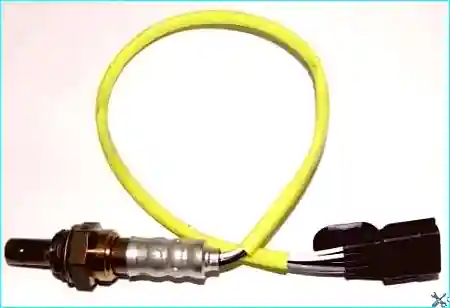
The oxygen concentration control sensor is used in the closed-loop injection system and is mounted on the exhaust manifold.
Information on the presence of oxygen in the exhaust gases is used to adjust the injection pulse duration calculations.
The oxygen contained in the exhaust gases reacts with the sensor, creating a potential difference at the sensor output.
It varies from approximately 0.1 V (high oxygen content - lean mixture) to 1 V (low oxygen content - rich mixture).
By monitoring the output voltage of the oxygen concentration sensor, the controller determines which command to send to the injectors to adjust the mixture composition.
If the mixture is lean (low potential difference at the sensor output), the controller sends a command to enrich the mixture; If the mixture is rich (high potential difference), the mixture is lean.
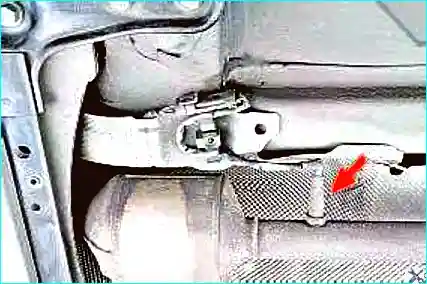
The diagnostic oxygen concentration sensor operates on the same principle as the control sensor.
The signal generated by the diagnostic oxygen concentration sensor indicates the presence of oxygen in the exhaust gases after the catalytic converter.
If the catalytic converter is operating normally, the readings from the diagnostic sensor will differ significantly from those from the control sensor.
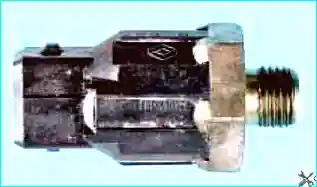
The knock sensor is attached to the side of the cylinder block in the area between cylinders 2 and 3 and detects abnormal vibrations (detonation shocks) in the engine.
The sensing element of the knock sensor is a piezoelectric crystal plate.
During detonation, voltage pulses are generated at the sensor's output, which increase with increasing detonation intensity.
Electronic The unit, using the sensor's signal, adjusts the ignition timing to eliminate detonation flashes from the fuel.
During operation, the ECU also uses vehicle speed data received from the speed sensor.
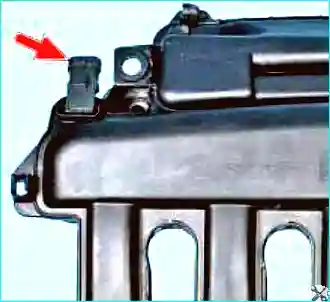
The absolute pressure sensor in the receiver converts the degree of vacuum in the receiver into a change in electrical voltage, which the ECU uses to set engine operating parameters. The sensor is mounted on the receiver.
The sensor's output voltage varies according to the pressure in the intake manifold - from 4.0 V (at wide open throttle) to 0.79 V (at wide open throttle).
When the engine is not running, the control unit uses the sensor voltage to determine the atmospheric pressure and adapts the injection control parameters to the specific altitude.
The atmospheric pressure values stored in memory are periodically updated during steady vehicle movement and during wide open throttle.
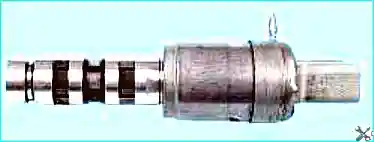
Variable valve timing solenoid valve The engine's valve timing system is installed in the cylinder head.
The valve regulates the oil pressure supplied to the variable valve timing actuator, mounted on the front end of the intake camshaft.
The system optimally adjusts valve timing, varying it across the entire range of engine speed and load, which increases power and torque at any speed.
When the engine is stopped, oil pressure forces the control valve spool to move to the position corresponding to the most retarded valve timing.
The control valve is triggered by a signal from the engine control unit and supplies oil to either the retard or advance chamber during continuous valve timing advancement or retardation, respectively.
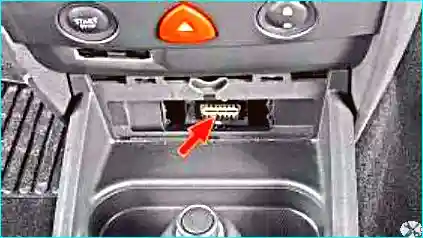
The diagnostic connector is used to retrieve error codes from the ECU memory, which are detected during operation of the engine management system.
It is located in the vehicle's interior, in a recess in the floor tunnel trim, and is covered by a cover. The following main engine operating parameters are read through this connector:
- - fuel trim system operating mode;
- - estimated engine load;
- - coolant temperature;
- - fuel pressure in the fuel system;
- - air pressure in the intake manifold;
- - engine speed;
- - vehicle speed (while driving - with a portable scanning device connected);
- - ignition timing;
- - intake air temperature;
- - air flow;
- - throttle position;
- - oxygen concentration sensor data.
Electronic control unit
128-channel SAGEM brand ECU and "S3000" type with The flash EPROM controls the injection and ignition systems.
Multipoint sequential injection system.
Communication with other ECUs:
- - Protection and switching unit
- - UCH
- - Automatic transmission ECU
Engine immobilizer system
The engine immobilizer function is provided by the UCH and the injection ECU.
Before the owner performs a control action (card operation + button press), the injection ECU and the UCH exchange identification frames via the multiplex network and, based on the information contained in them, grant or deny permission to start the engine.
If more than 5 unsuccessful identification attempts are made in a row, the injection ECU goes into protective mode mode (anti-scan mode) and stops trying to identify the UCH.
The injection ECU exits this mode only after the following operations are performed in the following sequence:
- - the ignition remains on for at least 60 seconds, then
- - the message will stop and, if
- - the duration of the injection ECU self-powering phase is observed (the duration of the self-powering phase depends on the engine temperature).
After this, only one identification attempt is made. If it is unsuccessful again, then all the above operations must be repeated from the beginning.
Impact detection
If the impact information is stored in the injection ECU memory, switch Move the dial in the reader to the first detent position for 10 seconds, then return it to the second detent position to start the engine.
Then clear the fault memory.
Camshaft Phaser
The injection system ECU controls the camshaft phaser, the type of which depends on the engine:
K4J engine:
There is no camshaft phaser.
F4R engine:
The inlet camshaft phaser is controlled by a two-position solenoid valve, which is commanded by the injection system ECU.
K4M engine:
The inlet camshaft phaser is continuously variable
Valve timing from 0 to 43° of crankshaft rotation is controlled by a solenoid valve, to the input of which a control signal is supplied from the injection system ECU, changing according to the cyclic opening ratio (OCR) law.
When carrying out welding work on the vehicle, disconnect the wiring connectors from the injection system ECU.
Switching on warning lamps
The S 3000 injection system illuminates three warning lamps and generates warning messages depending on the severity of the detected faults, which provides the owner with relevant information and allows for proper diagnostics. The injection system ECU controls the illumination of the warning lamps and the display of messages on the instrument cluster.
These warning lamps come on during the engine starting phase and also light up in the event of a fault in the injection system or engine overheating.
Commands to turn on the warning lamps are transmitted to Instrument cluster via multiplex network.
How the warning lights work
During the engine starting phase (pressing the engine start button), the "OBD" (On-Board Diagnostic) warning light comes on for approximately 3 seconds and then goes out.
In the event of an injection system malfunction (severity 1), the display shows the message "injection a controler" (check injection system) and the "service" warning light comes on.
This indicates a reduction in safety and the need to use the engine in a "gentle" mode.
The owner must rectify the malfunction as soon as possible.
The following must be checked and, if necessary, rectified:
- - throttle valve with servo motor
- - accelerator pedal position sensor
- - sensor Absolute pressure
- - ECU
- - actuator power supply circuits
- - ECU power supply circuits
In the event of a serious injection system malfunction (level 2), a red engine icon with the word "stop" lights up (only with a matrix display) and the message "surchauffe moteur (engine overheating)" is displayed, accompanied by the "stop" warning light and an audible signal.
In this case, you should stop driving immediately.
If a malfunction is detected that causes the exhaust gas toxicity threshold to be exceeded, the orange on-board diagnostics warning light with the engine icon lights up:
- – flashing light in the event of a malfunction that could lead to the destruction of the catalytic converter (misfires leading to its destruction); in this case, you should stop driving immediately. movement.
- – constant light in case of non-compliance with toxicity standards (misfires leading to increased harmful emissions, catalytic converter malfunction, oxygen sensor malfunction, oxygen sensor signal inconsistency, and canister malfunction).
Odometer with malfunction
This parameter allows you to record the vehicle's mileage while one of the fuel injection system malfunction warning lights is illuminated: the Level 1 malfunction warning light (yellow), the coolant temperature warning light, or the on-board diagnostic system warning light.
The counter can be reset using a diagnostic tool.
Backup modes
Motorized throttle body
In backup mode, the motorized throttle body It can be in 6 different states.
State 0:
- The throttle valve opening is less than the "Reserve Mode" position.
- Throttle control is stopped, and the throttle valve is automatically set to the "Reserve Mode" position.
- The operation of the electronic stability control system, the distance control system to the vehicle ahead, the speed limiter, and the automatic transmission is prohibited.
State 1:
- The throttle valve opening is no longer controlled.
- The engine speed is limited by stopping injection.
State 2:
The fallback mode consists of setting a specific accelerator pedal position (the accelerator pedal remains in a specific position depending on the gear engaged).
State 3:
- The fallback mode consists of limiting the throttle opening.
- The maximum throttle opening is maintained so that the speed does not exceed 90 km/h.
State 4:
- The ECU no longer processes requests for torque changes from the electronic stability control system, the distance control system to the vehicle ahead, the speed limiter, and the automatic transmission.
- This fallback mode is activated in the event of an ECU malfunction or a faulty MAP sensor or pressure sensor. boost.
- The operation of the trajectory stability system, the distance control system to the vehicle ahead, and the speed limiter are prohibited.
- The automatic transmission is operating in "backup mode".
State 5:
The boost pressure limiting valve is not operating.
Camshaft Phaser
In backup mode, the camshaft phaser can be in two states:
State 1:
- This backup mode is used for all faults that affect the measurement of the phaser position.
- The phaser is set to the extreme lower position, and the measured camshaft angle position is forced to 0.
- Fault in the crankshaft position sensor signal circuit shaft.
- Crankshaft position sensor signal / camshaft position sensor signal compliance diagnostics.
State 2:
- This backup mode is used for all faults affecting the operation of the phase shifter (toothed pulley and solenoid valve).
- The phase shifter is set to the extreme lower position.
- Diagnosing the electrical circuits of the solenoid valve.
- Diagnosing the position of the phase shifter.
Gasoline injection system fault codes
Fault by diagnostic tool - Corresponding diagnostic trouble code - Name by diagnostic tool
- DF001 – 0115 - Coolant temperature sensor circuit fluid
- DF002 – 0110 - Air temperature sensor circuit
- DF005 – 0335 - Engine speed sensor circuit
- DF008 – 0225 - Accelerator pedal position sensor circuit track 1
- DF009 – 2120 - Accelerator pedal position sensor circuit track 2
- DF011 – 0641 - Sensor supply voltage #1
- DF012 – 0651 - Sensor supply voltage #2
- DF026 – 0201 - Cylinder 1 injector control circuit
- DF027 – 0202 - Control circuit Cylinder 2 Injector Error
- DF028 – 0203 - Cylinder 3 Injector Control Circuit
- DF029 – 0204 - Cylinder 4 Injector Control Circuit
- DF037 – 0513 - Engine Immobilizer System
- DF038 – 0606 - ECU
- DF046 – 0560 - Battery Voltage
- DF049 – 0530 - Coolant Pressure Sensor Circuit
- DF059 – 0301 - Cylinder 1 Misfire
- DF060 – 0302 - Cylinder 1 Misfire № 2
- DF061 – 0303 - Misfire, Cylinder 3
- DF062 – 0304 - Misfire, Cylinder 4
- DF065 – 0300 - Misfire
- DF072 – 0351 - Ignition Coil Circuit, Cylinder 1
- DF073 – 0352 - Ignition Coil Circuit, Cylinder 2
- DF074 – 0353 - Ignition Coil Circuit, Cylinder 3
- DF075 – 0354 - Ignition Coil Circuit, Cylinder 4
- DF078 - 2101 - Throttle control circuit with motorized actuator
- DF079 - 0638 - Motorized throttle body servo system
- DF080 - 0010 - Camshaft phase shifter solenoid valve circuit
- DF081 – 0443 - Canister purge solenoid valve circuit
- DF082 – 0135 - Upstream oxygen sensor heater circuit
- DF083 – 0141 - Downstream oxygen sensor heater circuit
- DF084 – 0685 - Actuator relay control circuit
- DF085 – 0627 - Fuel pump relay control circuit
- DF088 – 0325 - Knock sensor circuit
- DF089 – 0105 - Crankshaft absolute pressure sensor circuit pressure
- DF091 – 0500 - Vehicle speed information
- DF092 – 0130 - Upstream oxygen sensor circuit
- DF093 – 0136 - Downstream oxygen sensor circuit
- DF095 - 0120 - Throttle position sensor gang 1 circuit
- DF096 – 0220 - Throttle position sensor gang 2 circuit Dampers
- DF097 – 0340 - Camshaft position sensor circuit
- DF099 – C101 - Automatic transmission or manual transmission control unit communication via multiplex network
- DF100 – C155 - Multiplex communication with instrument cluster
- DF101 – C122 - Multiplex communication with electronic stability control system
- DF105 – 0585 - Cruise control/limiter switch circuit
- DF106 – 0575 - Steering wheel cruise control/limiter switches
- DF109 – 0313 - Misfires with minimum fuel level
- DF110 – 0420 - Catalytic converter Neutralizer
- DF125 – 0315 - Torque meter programming
- DF126 – 1604 - Interior heating element
- DF127 – 0703 - Brake light switch circuit 1
- DF128 – 0571 - Brake light switch circuit 2


