


The manufacturer recommends replacing spark plugs after 60,000 km.
As a rule, spark plugs last this long under normal use.
If the engine is difficult to start or runs rough after starting, the spark plugs may be the cause.
All Megane engines fire in the order 1-3-4-2.
Cylinder 1 is located on the left, near the gearbox.
The spark plugs' job is to ignite the air-fuel mixture in the combustion chamber. This creates temperatures of up to 2500˚ and pressures of up to 60 bar.
To ensure that the spark passes between the electrodes, the spark plug connecting bolt is surrounded by ceramic insulation.
Furthermore, the center electrode and the spark plug connecting bolt are embedded in a conductive glass mass, which ensures a rigid attachment of these parts and a tight seal with respect to the combustion chamber.
When the required voltage is reached, an electric current jumps between the spark plug electrodes in the form of a spark from the center electrode to the side electrode.
This ignites the fuel-air mixture in the combustion chamber.
For the spark plug to function properly, it must reach its self-cleaning temperature of approximately 400˚ after starting the engine.
If this temperature is not reached, combustion residues will settle on the thermal cone of the insulator.
At full load, the temperature should not exceed 800 degrees.
The heat rating of a spark plug determines whether it is suitable for a given engine.
If you use, for example, spark plugs with a heat rating that is too high, the insulator cone may become very hot.
This can result in unusual glow ignitions, which can destroy the engine.
Conversely, if you select spark plugs with a heat rating that is too low, they will not reach the required self-cleaning temperature, which will lead to fouling of the insulator cone.
Spark plugs used for the Megane
For the E7J engine:
- - brand - EYQUEM - type - F52 LS:
- - brand - NGK - type - BCP 5ES
For the K7M engine:
- brand - EYQUEM - type - FC 52 LS;
- brand - CHAMPION - type - C10YC
For the F3R engine:
- brand - EYQUEM - type - C 52 LS;
- brand - CHAMPION - type - N7YCX;
- brand - BOSSCH - type - W7DCO
Preparatory operations:
For work, we will need a spark plug wrench, a spark plug tester, a feeler gauge, and a torque wrench (if available).
Removing the spark plugs
Turn off the ignition.
Blow out the spark plug ports with compressed air to prevent any dirt from getting into the hole when removing them.
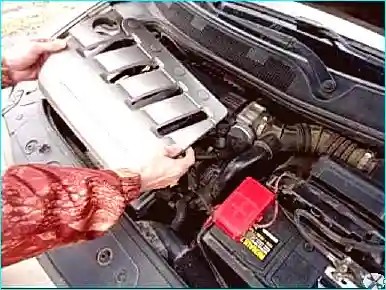
Remove the top plastic engine cover
Disconnect the coil connectors
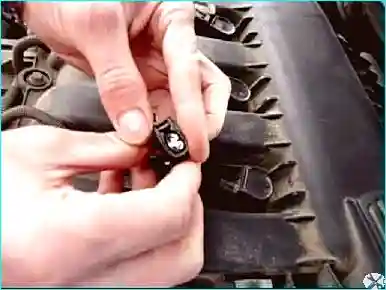
Check the condition of the high-voltage wires.
Frayed wires or wires with traces of carbon deposits should be replaced.
Be sure to remove street salt deposits from the high-voltage wires.
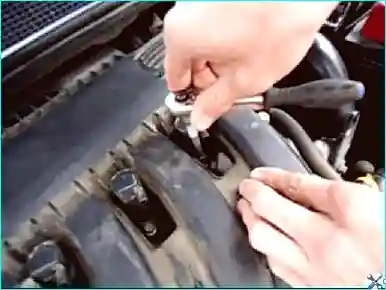
Using a 10 mm socket wrench, loosen the coil mounting bolt.
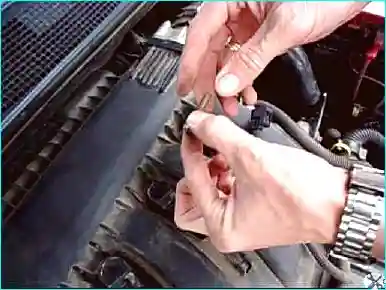
Removing the coil mounting bolt.
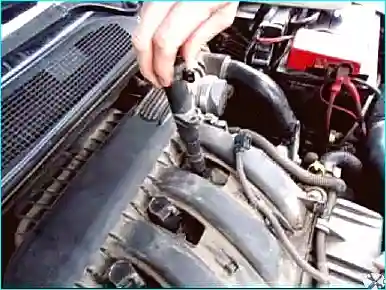
Remove the rod coils, paying attention to any visible defects in the coil insulators.
There should be no cracks or burn marks (from spark flashover) on the coil housing.
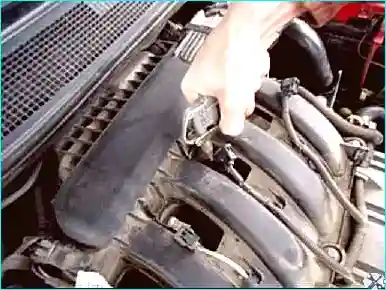
Blow out the spark plug wells with compressed air to prevent dirt from getting into the cylinders when removing the plugs.
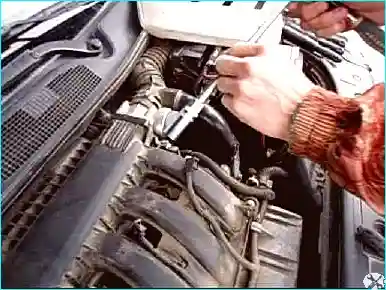
Use a spark plug wrench to remove the spark plugs.
Use the same wrench to remove the spark plugs.
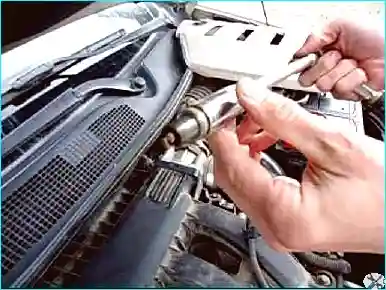
If the spark plug is "seated very tightly," do not force it. Otherwise, the spark plug threads in the cylinder head may be stripped.
In this case, bring the engine to operating temperature, and then try to remove the spark plug.
Wait until the engine has cooled before installing new spark plugs.
If you screw a cold spark plug into a hot engine, it will sit there as if welded.
Checking the condition of the spark plugs
The condition of the spark plug electrodes and threaded portion can determine whether the engine is operating optimally.
If the apex of the heat cone If the spark plug insulator is light gray to gray, the engine cylinder is operating normally and the fuel injection system is properly adjusted.
If the tip of the spark plug insulator's heat cone is white, the ignition timing is incorrect.
Black, soot-like deposits indicate that the spark plug is not reaching its self-cleaning temperature (frequent short-distance driving), the heat range is incorrect, or the carbon monoxide content is too high.
An oil film on the electrodes. Damaged piston rings, valve guides, or valve stem seals.
You may have used oil or fuel with additives.
In this case, you should change the oil or fuel with additives and recheck the condition of the spark plugs.
Installing the Spark Plugs
Preparing new spark plugs for installation This:
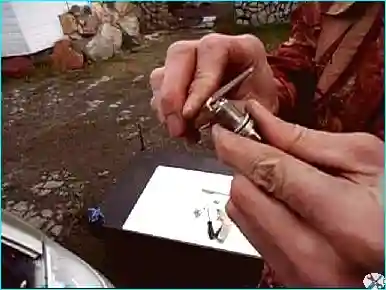
Using a feeler gauge, check the gap between the spark plug electrodes.
The gap on Renault Megane spark plugs should be 0.9 mm.
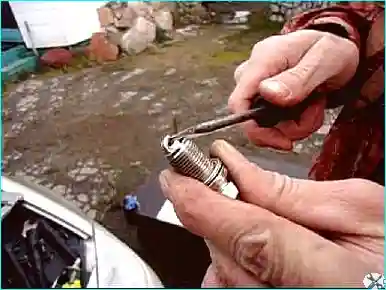
If the spark plug gap is small, bend the outer electrode with a screwdriver, resting the screwdriver on the edge of the thread.
Never lean on the center electrode, as this can damage the insulator.
If the spark plug gap is large, bend the outer electrode by tapping it from the side.
Inspect the spark plugs for visible defects (pay attention to the spark plug insulators); there should be no chips or cracks.
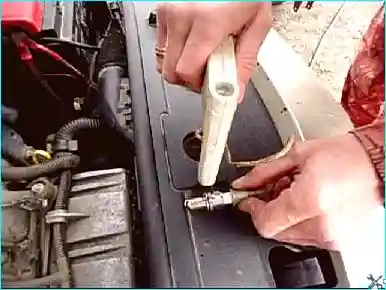
Checking spark plugs with a tester.
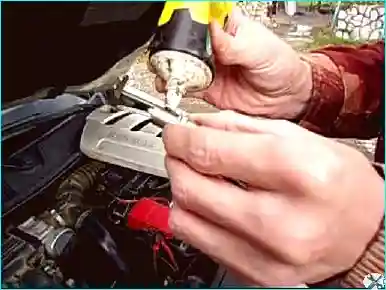
Apply non-stick grease (you can use SHRUS-4 grease) to the threaded portion of the spark plug.
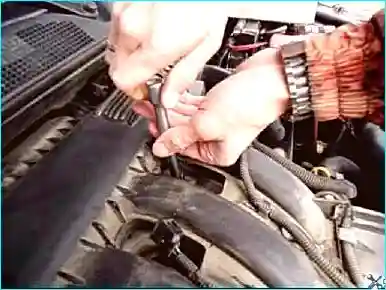
Install the spark plug in the cylinder head and screw it in with your fingers until it stops.
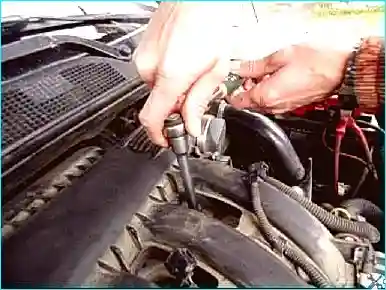
Tighten the spark plug using a torque wrench.
If you don't have a torque wrench, tighten the spark plug by turning it 90˚ for a new spark plug and 15˚ for a working spark plug


