


The Renault Megane 2 is equipped with a liquid-type heater.
The heating, air conditioning and ventilation system of the Renault Megane 2 is an integrated unit designed to provide maximum comfort in the vehicle cabin regardless of weather conditions and driving mode.
The system includes a heater (raises the air temperature in all operating modes), an air conditioner (lowers the air temperature and humidity), a blower (fan) and air ducts with a filter (ensure air exchange in the cabin and remove dust), as well as a control unit (manages all components to achieve the desired comfort parameters).
The heater radiator is connected to the engine cooling system by two hoses running through the engine compartment.
The radiator is housed in a plastic casing of the climate unit, installed under the central part of the instrument panel.
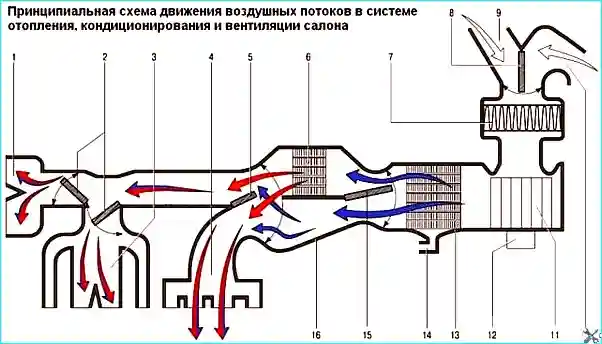
Fig. 1. Airflow diagram in the heating system: 1 — windscreen demister vents; 2 — air distribution flaps to the windscreen vents and dashboard vents; 3 — dashboard vents; 4 — footwell heating ducts for the driver and passengers; 5 — air distribution flap to the dashboard vents and footwell heating ducts; 6 — heater radiator; 7 — cabin air filter; 8 — air recirculation flap; 9 — air intake box; 10 — air intake in the vehicle cabin; 11 — fan impeller; 12 — fan motor; 13 — air conditioner evaporator; 14 — condensate drain hole; 15 — temperature control flap; 16 — heating and air conditioning unit housing
The main components of the heater:
- the heat exchanger (radiator) 6 (Fig. 1) of the heater, designed to heat the incoming air using the heat from the engine coolant;
- the fan (blower) 11. The fan motor 12, with permanent magnet excitation, provides regulated supply of outside air to the heater and air conditioner flaps. A resistor block is installed in the motor supply circuit to provide different fan speeds;
- the temperature control flap 15 for the air entering the cabin from the heater. Its position determines the amount of air passing through the heater heat exchanger and the amount of outside air bypassing the heat exchanger;
- the air distribution flaps 2 for the air coming from the heater to the cabin or to the windscreen demister vents.
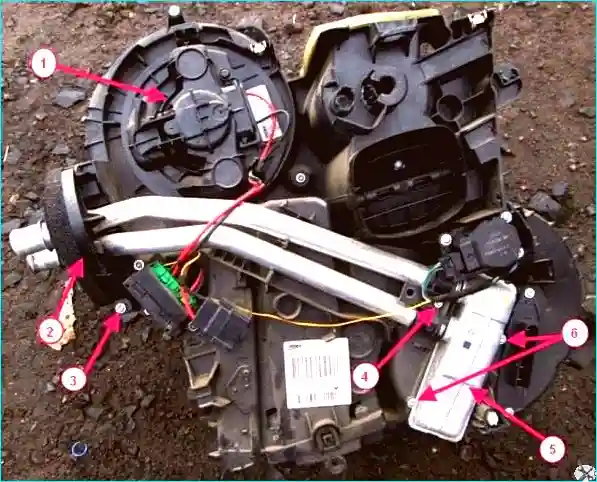
Fig. 2. Heater assembly: 1 - fan motor, 2 - pipe flange, 3 - flange mounting bolt, 4 - radiator connecting clamp bolt, 5 - heater radiator, 6 - radiator retaining screws
Possible heater faults and how to fix them
Poor performance
- The air flap does not close fully — Check cable positions, adjust flap operation, remove foreign objects if necessary.
- The heat exchanger is clogged or the pipes are crushed — Replace the heat exchanger, check the pipes.
- The cable is broken or has come off — Replace or refit respectively.
- The supply or return line of the heat exchanger is blocked or kinked — Check and replace the hoses if necessary.
The heating cuts out while driving
- The heat exchanger has run dry due to coolant loss — Monitor the temperature gauge. If it is already in the red zone, stop immediately, otherwise the cylinder head gasket may be damaged. Fix the fault and top up the coolant.
- The cylinder head gasket is faulty — Replace the gasket.
The fan does not work on any setting
- A fuse has blown — Replace the fuse.
- The fan switch has failed — Check the switch for continuity in all positions.
- The fan motor has failed — Run an auxiliary wire from the battery positive terminal to the white/brown wire connector of the fan motor. If the motor does not run, it is faulty and must be replaced.
- The resistor has burnt out — Replace the heater resistor.


