


General information
We replace the valve stem seals during repair of the cylinder head, and also when the seals are worn.
Signs of valve stem seal wear:
- increased oil consumption;
- presence of blue smoke from the exhaust pipe after starting the engine and during engine braking after prolonged driving under load;
- oiling of the spark plug electrodes (an indirect sign).
Necessary tools and devices
- 10 mm, 16 mm, 18 mm sockets;
- 13 mm spanner;
- a set of screwdrivers;
- Torx E14 socket;
- TDC setting retainer;
- camshaft retainer;
- torque wrench;
- pliers, tweezers.
Special devices:
- valve spring compressor;
- jaw-type valve stem seal puller or impact puller.
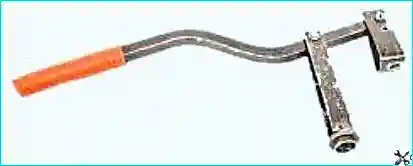
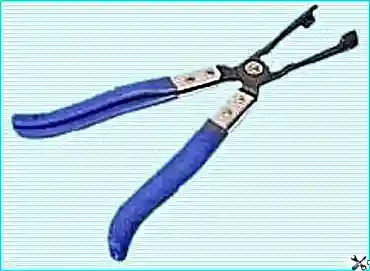
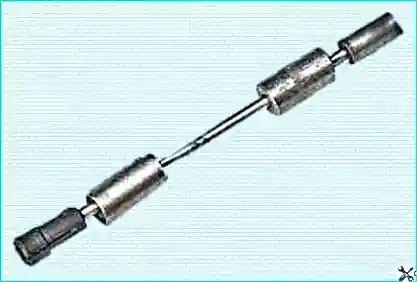
Preparatory work
Precautions: we prepare the vehicle for the work. We disconnect the negative battery terminal.
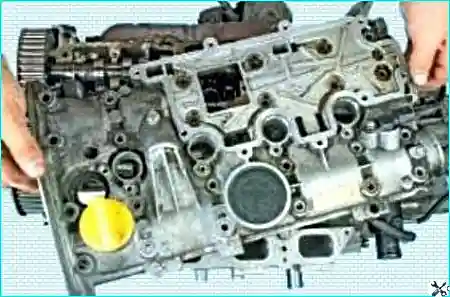
Removing the cylinder head: see the article Removing the cylinder head. With some experience, the valve stem seals can be replaced without removing the cylinder head.
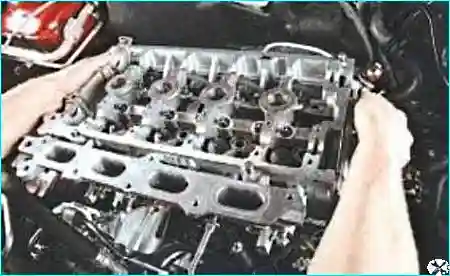
Removing the valve stem seals
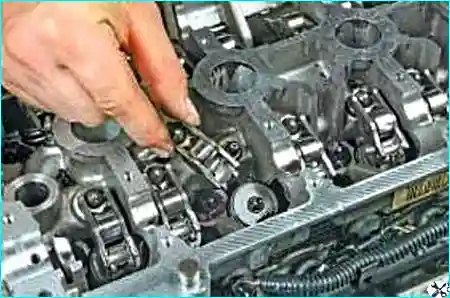
Important! We mark the hydraulic tappets and valve levers according to their locations, so as not to mix them up when refitting.
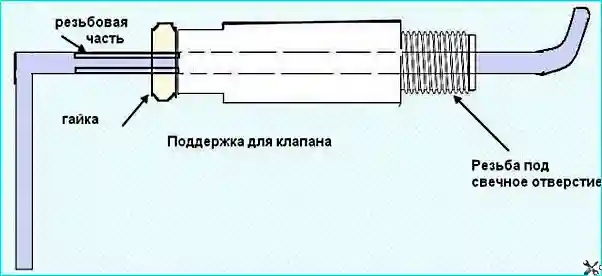
Securing the valves: we set the piston of the cylinder in which we are removing the valve stem seals to TDC (if we carry out the operation without removing the cylinder head). To support the valves, compressed air or a support in the form of a rod can be used (a tin rod can be used).
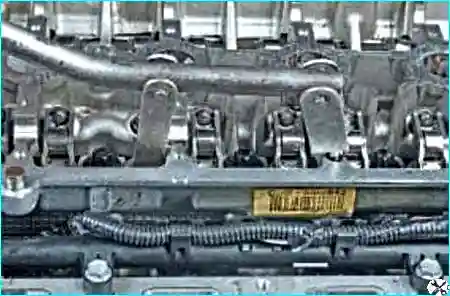
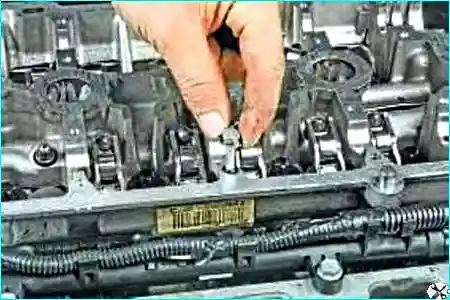
Withdrawing the collets: using tweezers or a magnetised screwdriver we withdraw two collets from the spring retainer. If the effort of moving the device lever increases considerably and the collets do not come out of the valve groove, a light hammer blow must be applied to the spring retainer so that the collets are released.
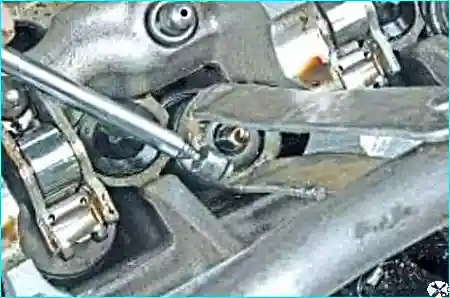
After that we remove the device.
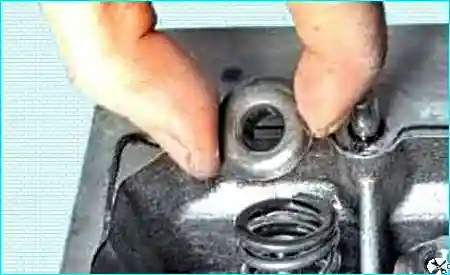
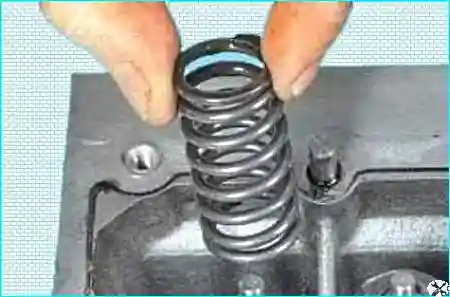
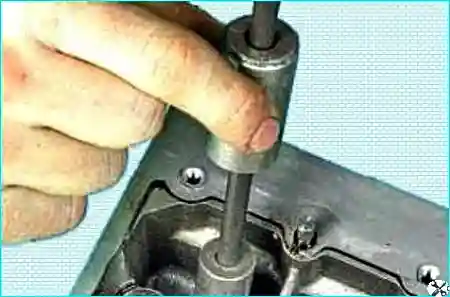
Removing the valve stem seal: we fit the collet of the impact puller onto the valve stem seal, and with two or three sharp blows of the puller striker we achieve fixation of the seal in the collet sleeve. We remove the valve stem seal by pulling the puller strictly upwards.
Fitting the new valve stem seals
Preparation for fitting: if the set of new seals includes a fitting sleeve, we put it on the valve stem to protect the working edge of the seal from the sharp edges of the collet grooves on the valve stem.
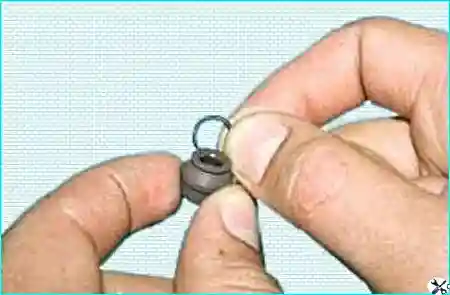
Important! Before fitting the new valve stem seals it is recommended to remove their springs, otherwise the seals may be damaged when they pass through the collet grooves on the valves.
Fitting sequence:
- We dip the valve stem seal in engine oil.
- We fit it by hand onto the valve guide sleeve.
- We fit the puller or drift onto the new valve stem seal.
- With light blows of the striker or hammer we press the seal in as far as it will go.
- We fit the spring onto the seal, if it was removed.
If there is no special device: one can select a cylindrical drift of a suitable diameter and press the seal in through it with light hammer blows on the drift. A long socket from a tool set can be used as a drift. Choose a socket with 12 points and a chamfer inside the opening, so that the contact of the socket with the seal occurs along a continuous circumference.
Assembly
Assembling the valve mechanism:
- We fit the springs and spring retainers.
- Compressing the springs with the device, we fit the collets so that they enter the grooves of the valve stem.
- After fitting the collets and removing the valve spring compressor, we apply several light hammer blows to the end face of the valve stem, so that the collets are secured in the stem groove.
Critically important! If the collets fitted at an angle remain unsecured, when the engine is started the “decolleted” valve will drop into the cylinder, which will lead to engine failure.
In the same way we replace the valve stem seals on the remaining valves of the cylinder head.
We refit the hydraulic tappets and valve pushers.
Refitting: we refit all the parts in the reverse order.
Recommendation: after replacing the valve stem seals it is recommended to replace the engine oil and the oil filter, since contaminants may have entered the oil.


