


The hydraulic unit, or hydraulic distributor, receives signals from the electronic control unit, switches channels in the control valve block and controls the clutch engagement pressure.
Depending on the signal, one or another solenoid is activated, and fluid flows through the distributor channels and acts on the corresponding clutch mechanism.
The hydraulic distributor (Fig. 1) consists of upper and lower solenoid valve housings, separator plates, gaskets, solenoid pressure regulating valves, a solenoid torque converter lockup valve, and solenoid sequential shift valves.
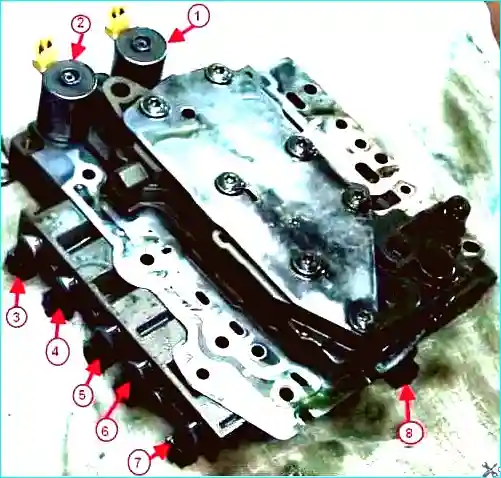
Fig. Location of the electromagnetic valves on the automatic transmission hydraulic distributor: 1 - pressure regulating valve; 2 - torque converter lock-up valve; 3 - electromagnetic valve #4 of the gear shift sequence; 4 - electromagnetic valve #3 of the gear shift sequence; 5 - electromagnetic valve #1 of the gear shift sequence; 6 - electromagnetic valve #2 of the gear shift sequence; 7 - electromagnetic valve #6 of the gear shift sequence; 8 - Solenoid Valve #5 for Shift Sequence
Repairing the valve body involves replacing worn valves, solenoids, and flushing the valve body.
We discussed removing the hydraulic distributor in the article "Disassembling the DPO (AL4) Automatic Transmission"
When working with the control valve body, be especially careful, as it consists of a large number of precision parts.
When removing, arrange the parts in a specific order to avoid mixing them up.
Clean the removed parts with solvent and dry them with compressed air.
Clean all openings and passages with compressed air.
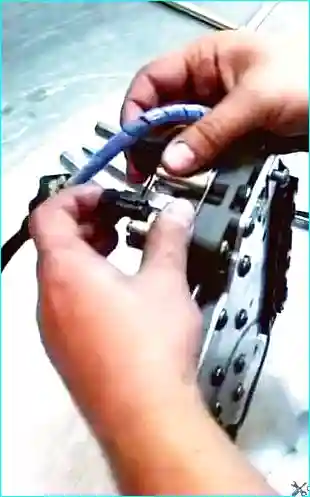
After removing the valve body, disconnect the wiring harness from the valves (Fig. 2)
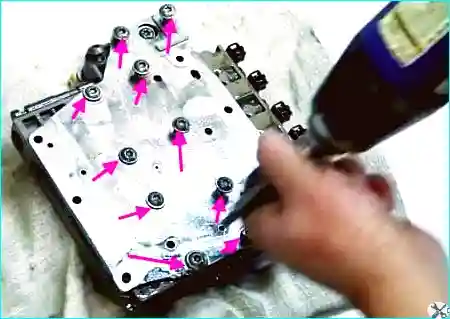
Unscrew the ten screws securing the lower cover of the block (Fig. 3) and remove it.
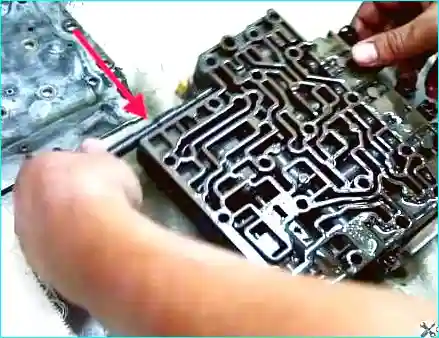
Remove the control rod (Fig. 4).
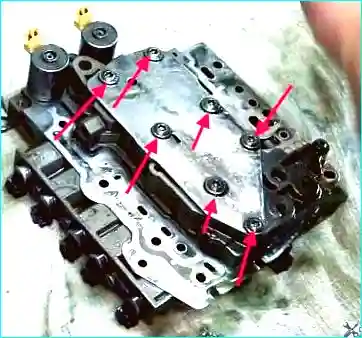
Turn the valve body over and unscrew the seven screws on the top cover (Fig. 5), then remove it.
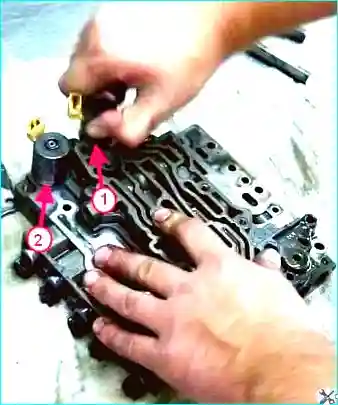
Remove the pressure control solenoid valve 1 (Fig. 6) and the torque converter lockup solenoid valve (2).
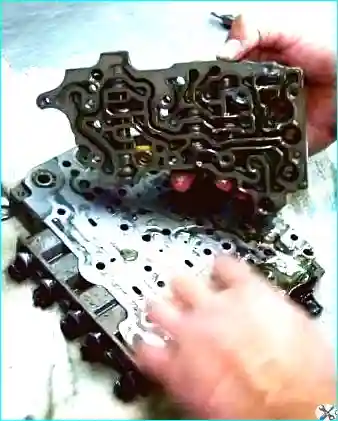
Remove the upper housing of the control valves (Fig. 7)
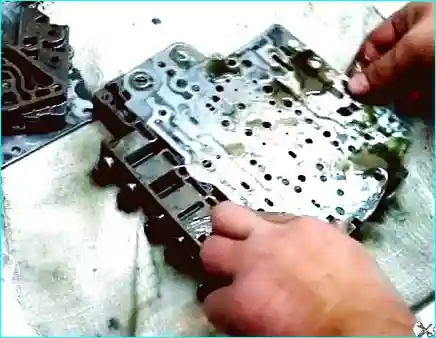
Removing the plate separator (Fig. 8)
Remove the solenoids' mounting screws and remove them (Fig. 9)
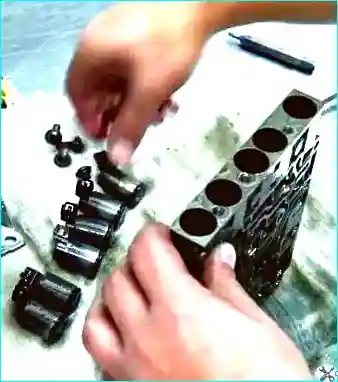
Removing the piston rods and springs (Fig. 10)
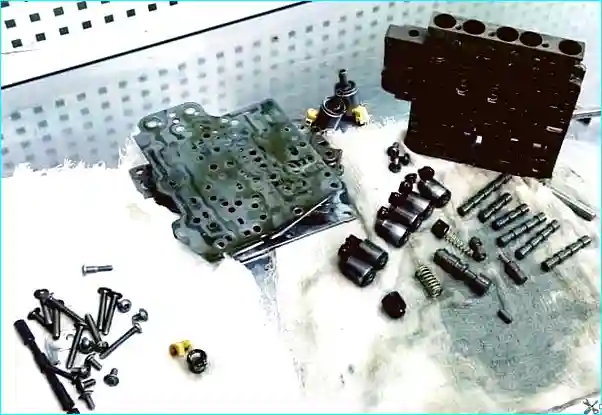
After disassembly, the block and all hydraulic distributor components are washed. Seals and defective parts are replaced.
Assemble the block in reverse order.


