


Place the vehicle on a two-post lift
Check the brake pad thickness. To do this, lift the vehicle, remove the wheels, and inspect the brake pads through the inspection hole in the cylinder body.
The minimum brake pad thickness is 1 mm. Wear limit 2.0 mm.
Place the car on a lift.
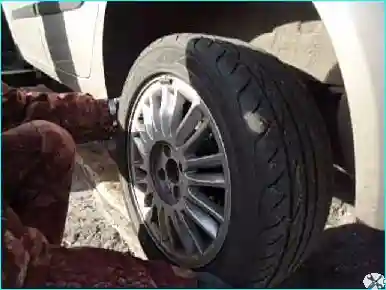
Removing the rear wheels
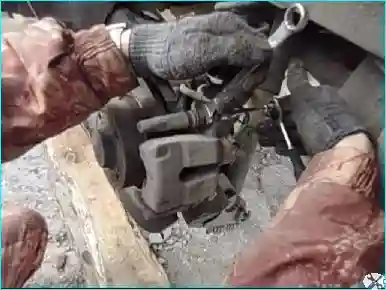
Using 13mm and 15mm wrenches, unscrew the upper brake caliper guide.
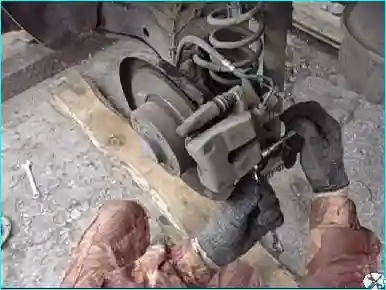
Using the same wrenches, unscrew the lower brake caliper guide mounting bolt.
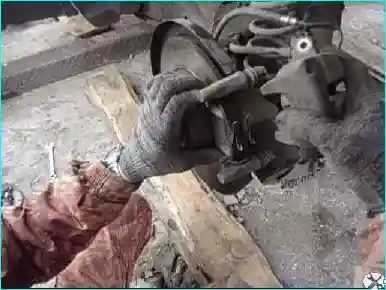
Removing the caliper
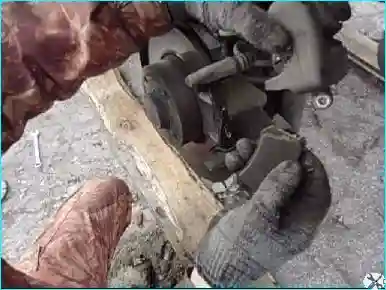
Removing the brake pads
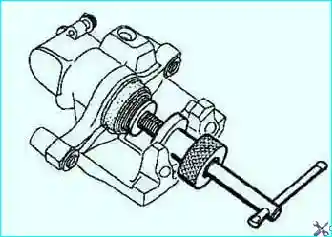
Fig. Removing the piston using the Fre1190-01 tool
Using a puller, retract the caliper piston
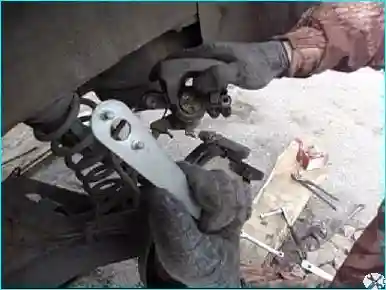
(If you don't have a puller, you can use a grinder disc wrench).
Using the tool or wrench, turn the piston clockwise until it retracts.
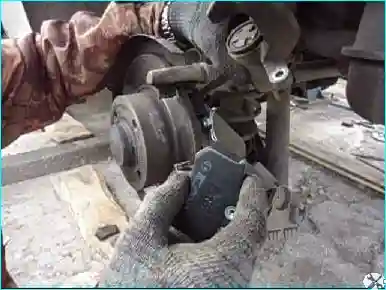
Installing new brake pads
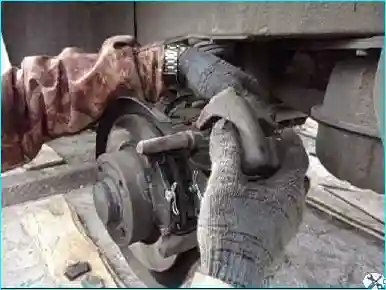
Replacing the brake caliper
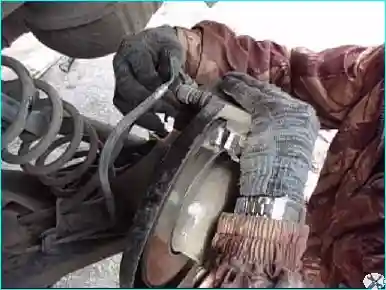
Tighten the guide mounting bolts to a torque of 36 Nm.
You can watch a video on replacing the rear brake pads:
Press the brake pedal several times to set the pistons to working condition.
Pull the parking brake handle several times to activate the parking brake system and the automatic brake pad wear compensation system.
Install the wheels and tighten the wheel bolts to a torque of 105 Nm.


