


The timing chain and drive parts are removed when replacing parts. Usually this operation is carried out during a major engine overhaul.


Execution process
- 1. Disconnect the cable from the negative terminal of the battery.
- 2. Unscrew the fastening bolts and remove the decorative cover (A) of the engine.

Models up to 2009.
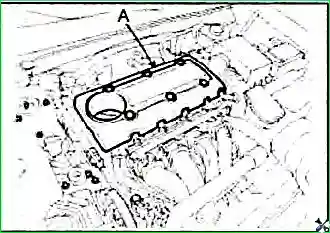
Models from 2009.
- 3. Remove the right front wheel.
- 4. Remove the right part of the engine guard.
- 5. Set the piston of cylinder 1 to TDC of the compression stroke (see “Checking and adjusting the valve train clearances”).
- 6. Remove the side engine mount bracket.
- a) Place a trolley jack under the engine oil sump, then slightly raise the engine until the side mount is relieved of load.

Note: place a wooden block between the oil sump and the support pad of the trolley jack.
- b) Unscrew the bolts and nuts of the side engine mount bracket fastenings (A).
- c) Remove the side engine mount bracket.
- 7. Temporarily loosen the fastening bolts of the coolant pump pulley.

8. Remove the accessory drive belt (A).

- 9. Remove the intermediate roller (A).
- 10. Remove the accessory drive belt tensioner (B).

- 11. Remove the coolant pump pulley (A).
- 12. Remove the crankshaft pulley (B).
- 13. Remove the engine mount bracket (C).

14. (Models from 2009.) Disconnect the power steering fluid pressure sensor connector (A) and the CVVT system valve (exhaust valves) connector (B).

15. Disconnect the ignition coil connectors (A).

16. Remove the ignition coils (A).

17. Disconnect the crankcase forced ventilation hose (A) and the breather hose from the cylinder head cover.

18. Remove the cylinder head cover (A).

19. Unscrew the bolts and remove the air conditioning compressor.

20. Remove the air conditioning compressor bracket (A).

21. Drain the engine oil.
22. Remove the oil sump (A).

Caution: do not damage the contact surfaces of the cylinder block and the oil sump.
23. Unscrew the bolts and, using a screwdriver, remove the timing chain cover (A).

24. Press the plunger with a screwdriver, then insert the rod into the timing chain tensioner opening.

25. Remove the timing chain tensioner (A).
26. Remove the timing chain tensioner guide (B).

27. Remove the timing chain.
28. Remove the timing chain damper (A).

29. Remove the oil jet (A) and the crankshaft sprocket (B).

30. Press the plunger with a screwdriver, then insert a suitable rod into the chain tensioner opening.
31. Remove the chain tensioner (A), the tensioner guide (B) and the balance mechanism drive chain damper (C).

32. (Except 2.0 l from 2009.) Unscrew the four bolts and remove the housing (A) and the balance mechanism drive chain (B).

Caution: do not dismantle the balance mechanism housing or the oil pump.
33. (2.0 l models from 2009.) Unscrew the three bolts and remove the oil pump housing (A) and the balance mechanism drive chain (B).

Caution: do not dismantle the oil pump housing.
Checking
Checking the tensioner
- 1. Check the chain tensioner for oil leaks. If there are leaks, replace the tensioner.
- 2. Check the tensioner plunger for wear and damage. If necessary, replace the tensioner.
- 3. Check that the drive chain tensioner plunger has sufficient travel and that the tensioner ratchet mechanism is in good condition.
Checking the tensioner parts
1. Check the tensioner guide for cracks, peeling or other defects on surface “A” (sliding contact with the timing chain) and on surface “B”, which is in contact with the tensioner. Replace the tensioner guide if necessary.


2. Check the chain damper for cracks, peeling or other defects on surface “A” (sliding contact with the timing chain). Replace the chain damper if necessary.
Checking the chain
Check the chain elements (bushes and plates) for wear. Replace the chain if the wear is excessive.
Checking the drive parts
- 1. Check the teeth of the camshaft sprockets and the crankshaft sprocket for excessive wear, cracks and other defects. Replace the defective part if necessary.
- 2. Check the ease and smoothness of rotation of the accessory drive belt guide roller and make sure there is no excessive play or extraneous noise during rotation. Replace if necessary.
- 3. Replace the accessory drive belt guide roller if signs of lubricant leakage from its bearing are detected.
- 4. Check the crankshaft pulley for vibration during rotation, oil contamination and dust deposits in the accessory drive belt groove.
- 5. Check the condition of the accessory drive belt.
Installation
1. Make sure that the TDC marks of the compression stroke for cylinder No. 1 on the exhaust valve camshaft sprocket and on the coupling of the variable valve timing (CVVT) system of the inlet valve camshaft are directed towards each other (aligned with the upper plane of the cylinder head).
Note: check that the crankshaft locating pin, at the moment of mark alignment, is directed upwards (towards the cylinder head gasket).
2. Align the balance shaft marks as shown in the figure.

3. (Except 2.0 l from 2009.) Install the housing and the balance mechanism drive chain, aligning the coloured marks on the chain and on the crankshaft and balance shaft sprockets, and evenly, in several passes, screw in the bolts in the sequence shown in the figure.

Tightening torque:
- 1st pass: 17 N·m;
- 2nd pass: 60°;
- 3rd pass: 60°.
4. (2.0 l models from 2009.) Install the oil pump housing and drive chain.
- a) Make sure that the piston of the first cylinder is at TDC of the compression stroke.
- b) Install the crankshaft sprocket.
- c) Screw in the oil pump drive chain tensioner bolts, then insert the rod into the opening of the tensioner locking plate and secure the plunger in the pressed position.
- d) Secure the chain on the crankshaft sprocket.
- e) Install the oil pump housing and evenly, in several passes, screw in the bolts in the sequence shown in the figure.

Tightening torque:
- 1st pass: 9 N·m;
- 2nd pass: 17 N·m;
- 3rd pass: 25 N·m.
f) Install the control and remove the rod from the tensioner.
Tightening torque: 10–12 N·m.
5. Install the balance mechanism drive chain damper (C), the chain tensioner guide (B) and the chain tensioner (A), then remove the rod.
Tightening torque: 10–12 N·m.

6. Install the crankshaft sprocket (B) and the oil jet (A).
Tightening torque: 8–10 N·m.

7. Install the timing chain damper (A).
Tightening torque: 10–12 N·m.

8. Install the timing chain, aligning the marks on the chain and the sprockets.


A — crankshaft sprocket; B — chain damper; C — CVVT system sprocket; D — exhaust valve camshaft sprocket.
9. Install the tensioner guide (B) and the timing chain tensioner (A), then remove the rod.
Tightening torque: 10–12 N·m.

10. Turn the crankshaft two revolutions clockwise and make sure that the marks on the camshaft sprockets are positioned as shown in the figure.

11. Install the timing chain cover.
- a) Clean the mating surfaces of the cylinder block and cylinder head under the cover, as well as the flange of the timing chain cover, from remnants of the old sealant.
- b) Degrease the surface for applying the sealant on the timing chain cover flange, as well as the mating surface on the cylinder block and cylinder head under the cover.
- c) Apply the sealant in a continuous bead of 2.5 mm diameter along the timing chain cover flange and at the points shown in the figure.


Caution: do not allow the sealant to squeeze out in the cover area on the timing chain side.
- d) Align the locating pin on the cylinder block with the opening on the timing chain cover and install the cover.

- e) Evenly, in several passes, tighten the fastening bolts of the timing chain cover.
Tightening torques:
- M6 bolt: 8–10 N·m;
- M8 bolt: 19–23 N·m.
Caution:
- The parts must be assembled within 5 minutes after applying the sealant; otherwise, remove the sealant and apply it again.
- After installing the timing chain cover, wait at least half an hour before starting the engine.
12. Install the oil sump.

- a) Clean the mating surfaces of the cylinder block and the oil sump from remnants of the old sealant.
- b) Degrease the oil sump surface for applying the sealant, as well as the mating surface on the cylinder block.
Sealant: Loctite 5900. - c) Apply the sealant in a continuous bead of 2.5 mm diameter along the timing chain cover flange and at the points shown in the figure.
Sealant: Loctite 5900. - d) Install the oil sump (A) and evenly, in several passes, screw in the fastening bolts.

Tightening torques:
- M8 bolt (B): 27–31 N·m;
- M6 bolt (C): 10–12 N·m.
Caution:
- The parts must be assembled within 5 minutes after applying the sealant; otherwise, remove the sealant and apply it again.
- After installing the oil sump, wait at least half an hour before starting the engine.
13. Install the air conditioning compressor bracket (A).
Tightening torque: 20–24 N·m.

14. Install the air conditioning compressor.

Tightening torque: 20–25 N·m.
- 15. Install the cylinder head cover (see the section “Checking and adjusting the valve train clearances”).
- 16. Install the ignition coils and connect the connectors (A).

17. Install the engine mount bracket (C).
Tightening torques:
- M10 bolt: 39–44 N·m;
- M8 bolt: 20–25 N·m.
18. Install the crankshaft pulley (B), having first locked the flywheel.
Tightening torques: 167–176 N·m.
19. Install the coolant pump pulley (A).
Tightening torque: 8–10 N·m.

20. Install the accessory drive belt tensioner and the tensioner roller (B).
Caution: the connection has a left-hand thread.
Tightening torque: 54–64 N·m.
21. Install the intermediate roller (A) and screw in the bolt.
Tightening torque: 54–64 N·m.

22. Install the accessory drive belt (A) in the following sequence: crankshaft pulley, air conditioning compressor pulley, alternator pulley, intermediate roller, power steering pump pulley, intermediate roller, coolant pump pulley, tensioner roller.

23. Install the engine mount bracket (A).
Tightening torque: 64–83 N·m.

- 24. Install the right part of the engine guard.
- 25. Install the right front wheel.
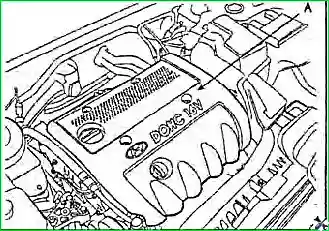
26. Install the decorative cover (A) of the engine.
Tightening torque: 4–6 N·m.


