


Install the gearbox on a special stand or workbench with the rear cover facing up.
Using a 13 mm socket, unscrew the three rear cover mounting bolts (Fig. 1).
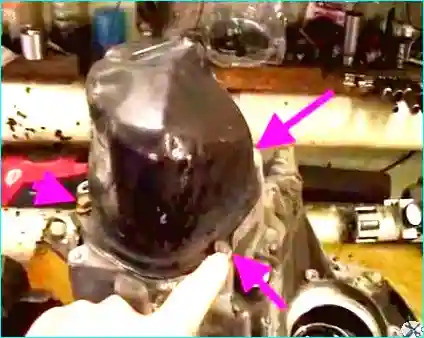
Remove the cover.
Remove the cover carefully along the horizontal axis of the gearbox, as the cover contains a lubrication tube that enters the hole in the input shaft.
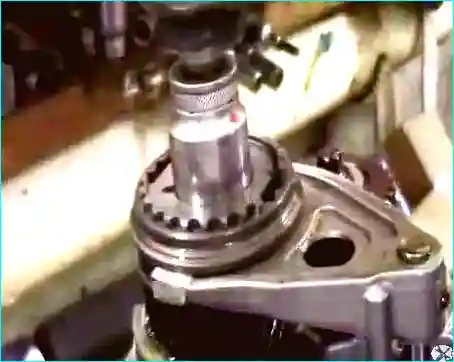
Using a 27 mm socket, loosen the nut securing the fifth and reverse gear block pinion (Fig. 2)
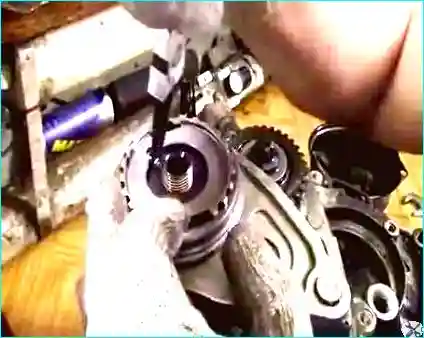
Use pliers to remove the lock washer (Fig. 3)
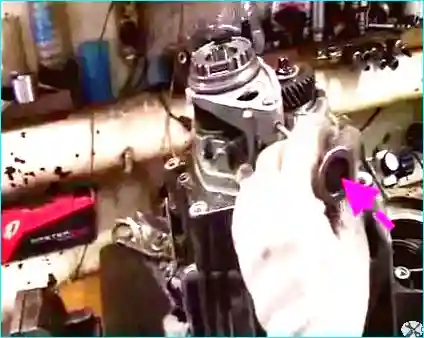
Use a drift (an old valve can be used) and a hammer to knock out the fifth-gear fork mounting pin (Fig. 4)
Use a puller to remove the fifth-gear pinion and fork.
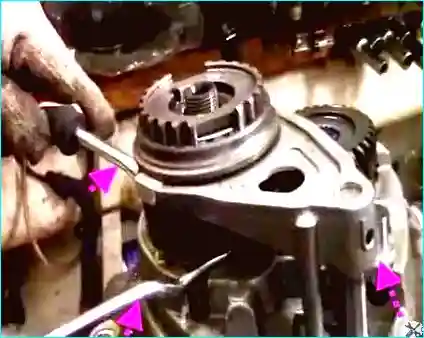
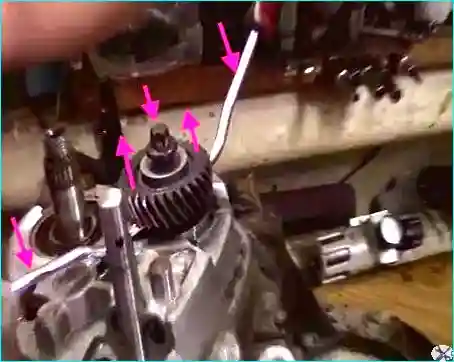
If you don't have a puller, you can use two heavy-duty screwdrivers (Fig. 5)
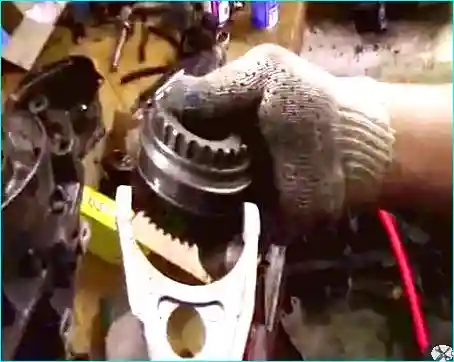
Removing the plug (Fig. 6)
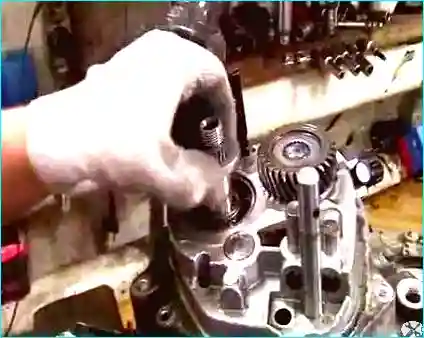
Remove the spacer washer (Fig. 7) (when removing the washer, remember its position to avoid confusion during assembly; Figure 8 shows the correct position of the washer)
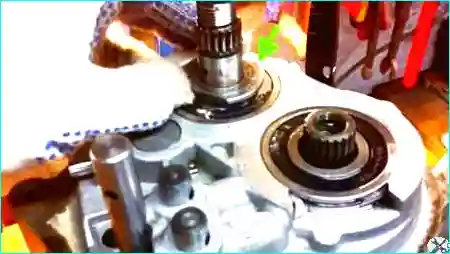
Using an E-16 internal torx socket, unscrew the bolt at the rear end of the secondary shaft (Fig. 9)
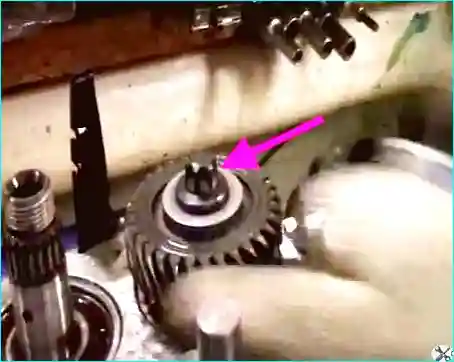
Remove the fifth-gear driven gear using a three-prong puller or using tools B.Vi. 22.01 and B.Vi. 1000-01 (see Fig. 10).
If you don't have a puller, you can use two heavy-duty slotted screwdrivers, after first threading the bolt onto the rear end of the secondary shaft.
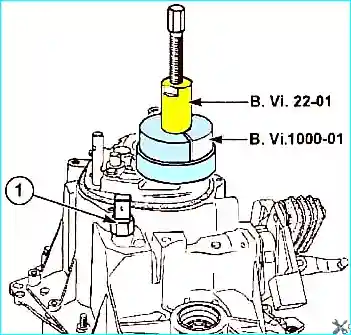
Have an assistant press the screwdrivers against the end of the gear, and gently tap the bolt to press the gear off (Fig. 11).
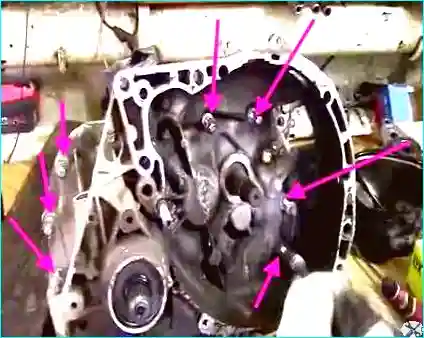
Using a TorxE-12 socket (or in some cases a TorxE-14 socket), remove the 16 bolts securing the gearbox housing to the clutch housing (Fig. 12).
Five bolts are located inside the clutch housing.
Before separating the crankcases, attach a magnet to the fork rod to avoid losing the balls and springs of the detents (Fig. 13)
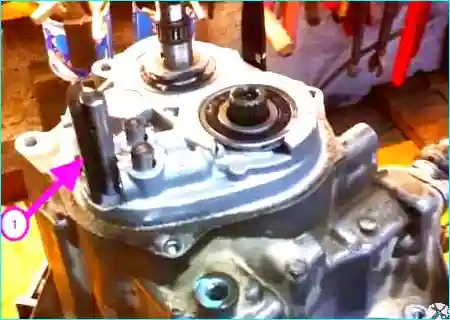
Insert a thin slotted screwdriver between the thickened lugs of the crankcases and use a hammer to separate the gearbox housings (Fig. 14).
The crankcases are sealed with adhesive sealant.
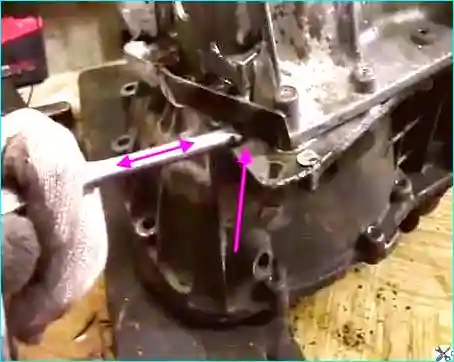
After separating the crankcases, remove the three springs and three retainer balls.
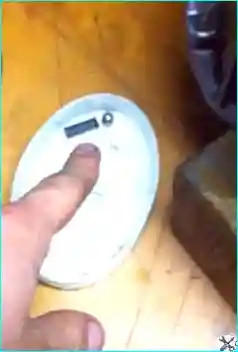
View of the spring and ball in Figure 15.
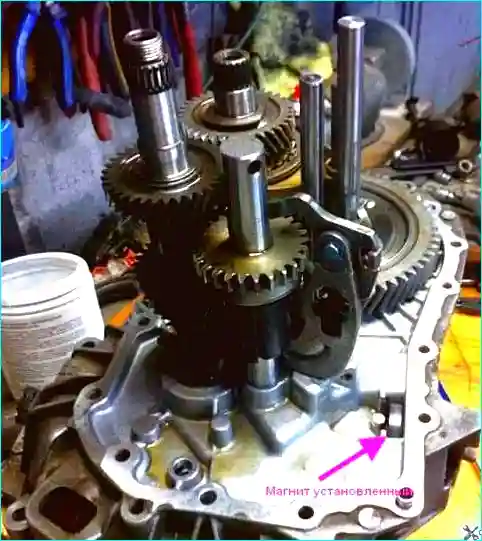
Removing the magnet installed in the gearbox (Fig. 16).
You can see wear chips from gearbox components on the magnet.
Knock out the pin for 3rd and 4th gears (Fig. 17)
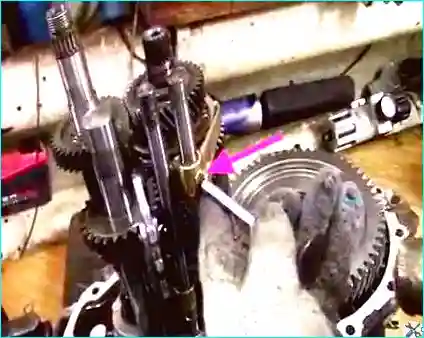
And remove the piston rod together with the fork (Fig. 18)
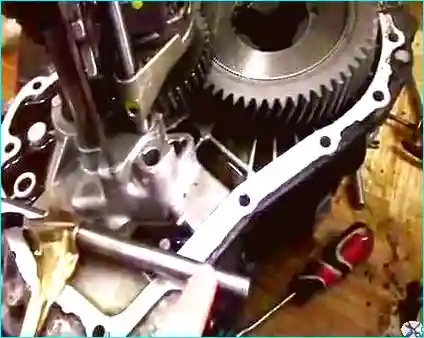
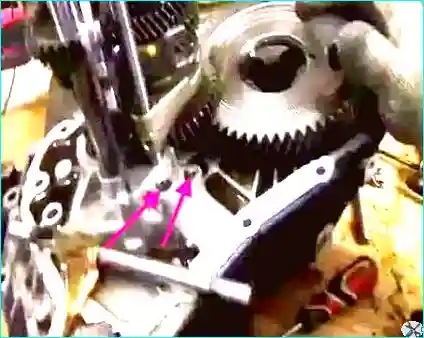
Remove the retaining balls from the holes shown in Figure 19.
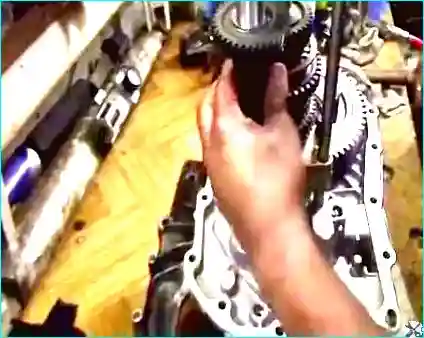
After this, remove the secondary shaft (Fig. 20)
Use a punch to knock out the pin from the reverse gear fork (Fig. 21)
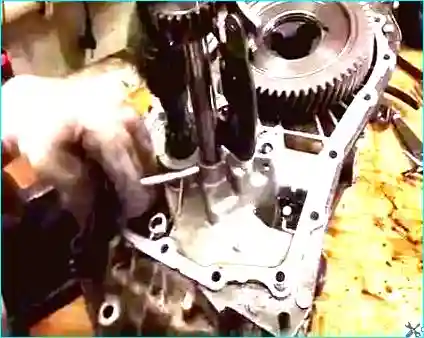
Remove the input shaft and reverse clutch (Fig. 22)
After this, wash all the parts and inspect the bearings.
If there are signs of wear, replace the parts.
The gearbox shaft components are shown in Figure 23
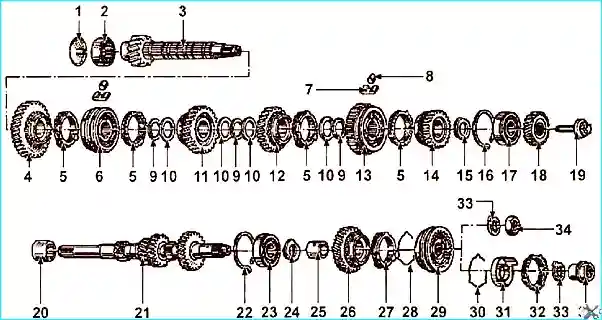
Fig. JH3 gearbox parts: 1 — oil deflector; 2, 17, 23 — bearings; 3 — secondary shaft; 4 — 1st gear pinion; 5 — synchronizer locking ring; 6 — 1st and 2nd gear synchronizer hub; 7, 28, 30 — springs; 8 — cracker; 9, 16, 22 — retaining rings; 10 — splined washer; 11 — 2nd gear pinion; 12 — 3rd gear pinion; 13 — 3rd and 4th gear synchronizer hub; 14 — 4th gear pinion; 15 — thrust washer; 18 — 5th gear pinion; 19 — secondary shaft rear end bolt (70 N⋅m); 20 — front bearing; 21 — primary shaft; 24 — thrust washer; 25 — pinion sleeve; 26 — 5th gear pinion; 27 — synchronizer locking ring; 29 — synchronizer hub; 31 — friction cone; 32 — synchronizer locking ring; 33 — washer; 34 — primary shaft rear end nut (190 N⋅m)
Prepare all parts for gearbox assembly.
Gearbox assembly will be discussed in the next article - "Assembling the JH3 Gearbox"


