


General structure and operating principle of the thermostat
The thermostat in the engine cooling system serves for the rapid warming up of the engine to operating temperature.
At low ambient air temperatures the thermostat allows the operating temperature of the engine to be maintained, which leads to lower heat losses.
Operating principle: the thermostat is a thermovalve which shuts off the passage of the fluid through the radiator.
- As soon as the fluid in the engine reaches a certain temperature, on the F4R engine this is 89 °C, the thermostat valve begins to open gently and the fluid begins to circulate through the radiator.
- On reaching the temperature of 99 °C ± 2 °C, the thermostat valve opens completely.
Signs of a thermostat fault:
- Thermostat failures may occur in the event of oxidation of the working parts of the valve, scale deposits. In this case the thermostat valve may jam both in the open position and in the closed position.
- If it jams in the open position — the engine will take a long time to warm up. The cabin heater in winter will warm the cabin poorly.
- If it jams in the closed position — overheating of the engine is possible. In this case the hot fluid does not circulate through the radiator, as a consequence the radiator cooling fan does not operate, since the activation sensor is installed on the large circulation circuit of the engine cooling fluid.
Replacing the thermostat
Preparatory work
Precautions:
- To replace the thermostat we place the vehicle over an inspection pit or on a lift.
- The thermostat must be replaced with the engine cold so as not to get burnt.
- We disconnect the negative battery terminal.
To gain access to the thermostat we remove the air duct.
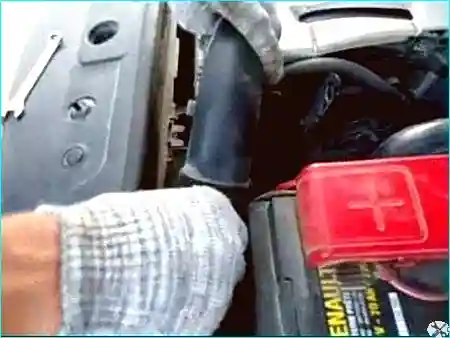
Draining the coolant: we place under the thermostat housing a container for draining the coolant (a cut-off plastic bottle with a volume of 2 litres can be used).
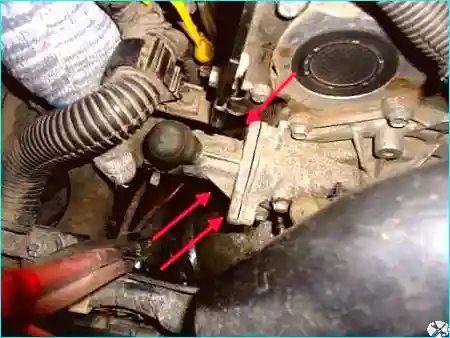
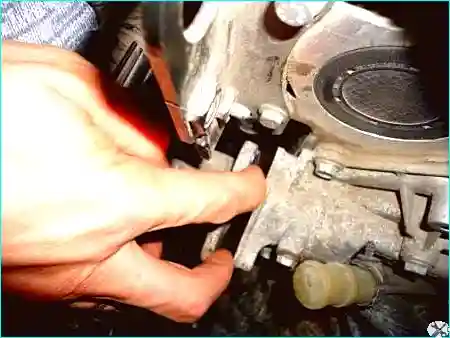
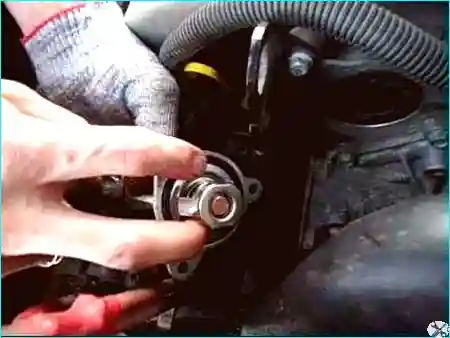
Refitting and checking
We refit all the parts in place and pour coolant into the expansion tank.
Coolant level: the level must be above the min mark (approximately halfway between min and max).
Checking the thermostat operation:
- We start the engine and set the speed to approximately 1500 rpm.
- When the thermostat operates, the upper radiator hose must be hot.
- We monitor the engine temperature readings.
- If the radiator cooling fan has started and the upper radiator hose is hot — this indicates that the thermostat has opened.
- We check the coolant level once more.
Recommendation: after replacing the thermostat it is recommended to check the tightness of the connections and, if necessary, top up the coolant to the required level.


