


The front suspension is independent, with MacPherson struts, lower transverse arms, and an anti-roll bar.
The struts, with coil springs and built-in telescopic shock absorbers, are attached at the top to reinforced body mounts.
The lower part of the strut is bolted with two bolts to the upper part of the steering knuckle, which carries the hub, brake disc and caliper.
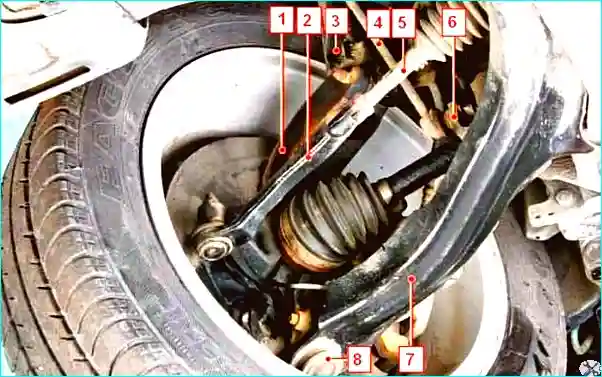
Fig. 1. Location of front suspension components: 1 - steering knuckle, 2 - track rod end, 3 - damper strut, 4 - anti-roll bar link, 5 - track rod, 6 - anti-roll bar, 7 - front suspension arm, 8 - ball joint
The main component of the front suspension is the telescopic damper strut 3, which combines the functions of a telescopic guiding element and a damping element for vertical wheel movements relative to the body.
The damper strut assembly includes a cylindrical coil spring, a compression bump stop, a dust cover, and an upper mount.
The load is transmitted to the body through the upper mount.
The damper strut is connected to the suspension arm 7 via the steering knuckle 1 and the ball joint 8.
The anti-roll bar 6, with its rubber bushes, is attached to the rear part of the front suspension subframe with two clamps.
The arm 7 is attached to the rear part of the front suspension subframe using rubber-metal bushings.
The hubs rotate in bearings mounted in the steering knuckles.
The lower part of the steering knuckle is connected via a ball joint to the lower transverse suspension arm.
The ball joint is bolted to the arm and secured to the hub with a clamp and bolt.
The inner end of the arm is attached to the body via rubber bushes, limiting the lateral and longitudinal movement of the front wheels.
The anti-roll bar is fitted to all models.
The anti-roll bar is connected to the suspension arms and attached to the subframe through rubber mounts.
Possible front suspension faults and how to fix them
Noise and knocking during driving:
- Loosening of the anti-roll bar clamp fixings to the rear of the subframe and its links to the damper strut — Tighten the loosened threaded connections.
- Wear of the rubber components of the anti-roll bar and its links — Replace the worn components.
- Wear of the rubber element of the upper mount — Replace the upper mount of the damper strut.
- Wear of the ball joint — Replace the arm.
- Wear of the track rod joints — Replace the track rod end.
- Wear of the front wheel hub bearings or loosening of the hub nut — Replace the bearing or tighten the nut.
- Breakage of the front suspension spring — Replace the springs.
- Destruction of the damper strut compression bump stop — Replace the compression bump stop.
Vehicle pulling away from a straight line on a level road:
- Incorrect front wheel alignment angles — Eliminate the causes of the incorrect angles and adjust the alignment.
- Uneven spring sag — Replace the front suspension springs.
Excessive or uneven tyre tread wear:
- Front wheel alignment angles are incorrect — Adjust the angles.
- Excessive wear of suspension component joints or track rod joints — Replace suspension components or track rods.
- Damper strut malfunction — Replace the damper struts.


