 ZH
 FR
 BE
 DE
 RU
 UK
 KK
 EN
 ES
We prepare the vehicle for the task.
We remove the front wheel on the side where the work is being done.
We bring the brake shoes together.
Removing the brake drum and shoes
We undo the three screws securing the brake drum and remove it.
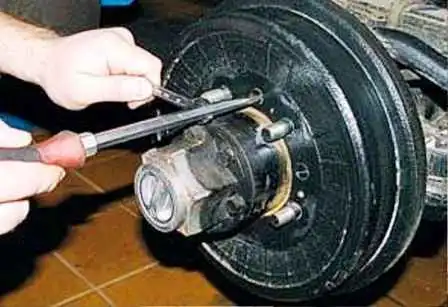
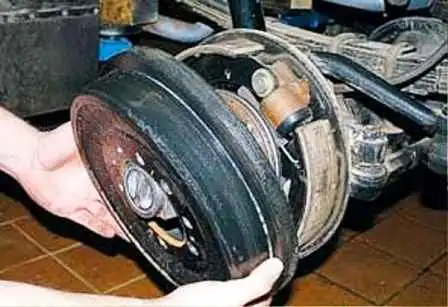
If the drum is difficult to remove, we knock it off the hub with hammer blows through a wooden block.
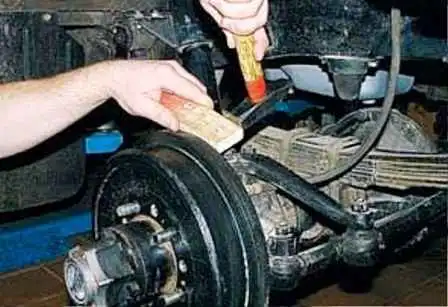
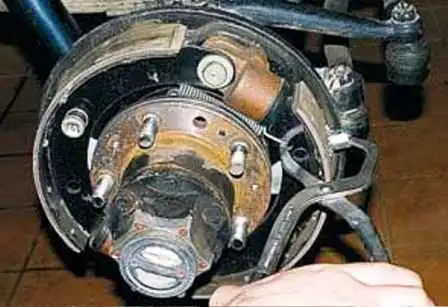
With a screwdriver, we prise off and remove the retracting springs.
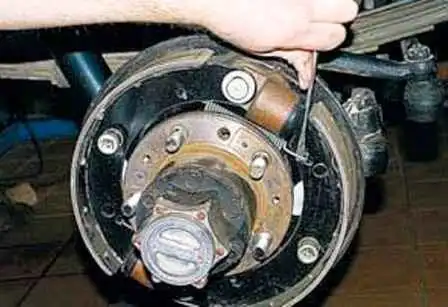
It is convenient to use special pliers to remove the springs.
From the inner side of the brake backplate, we hold the head of the brake shoe pin.
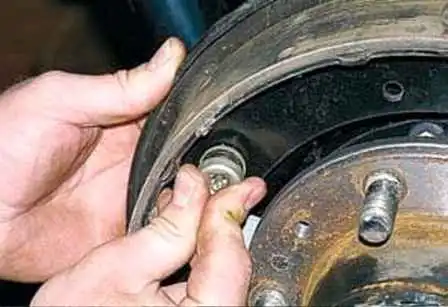
With the other hand, we press on the cup, compressing the spring. We turn the spring cup through 90°.
In doing so, the slot in the cup aligns with the end of the shoe steady pin.
We remove the cups with the spring.
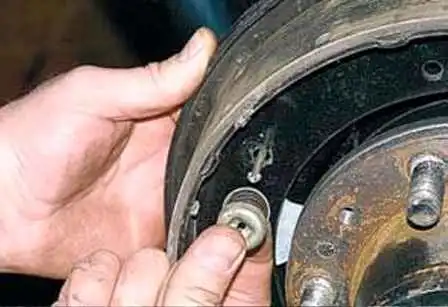
We withdraw the pin from the hole in the brake backplate.
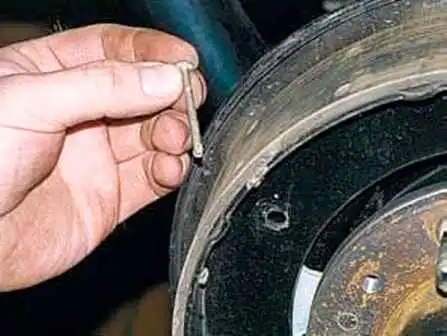
We also remove the pin of the other shoe.
Using a 19 mm spanner, we undo the nut of the shoe steady pin.
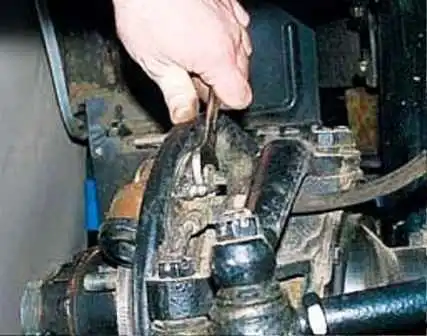
We withdraw the steady pin together with the washer and bronze bush.
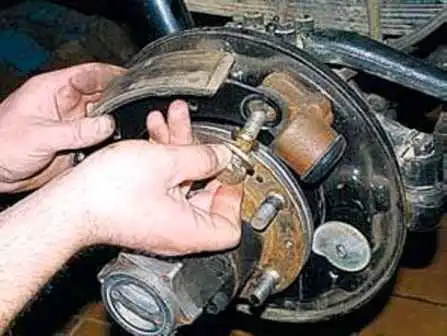
We remove the shoe.
In the same way, we remove the second shoe.
Fitting new brake shoes
We fit the new shoes onto the pins (with washers and bushes) and secure the pins to the brake backplate by tightening their nuts.
The marks on the ends of the pins must face the brake cylinder tee pieces.
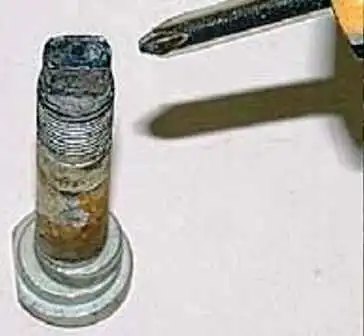
We fit the pins with springs and cups onto the shoes.
We fit the retracting springs.
By turning the eccentric bolts with a 17 mm spanner, we bring the shoes together.
We fit the brake drum onto the hub and adjust the clearance between the shoe and the drum.
Adjusting the clearance when fitting new brake shoes
We slacken the steady pin nuts and press the brake pedal with a force of 12–16 kgf.
By turning the steady pins, we bring the ends of the shoes into contact with the drum. Holding the pins from turning, we tighten their nuts.
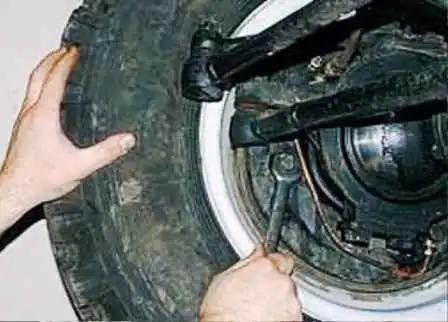
We turn the adjusting eccentric bolts until they stop against the brake shoes. The eccentric bolts are turned in the direction of wheel rotation.
We release the brake pedal and, slowly turning the adjusting eccentric nuts in the opposite direction, release the eccentrics until the wheel starts to rotate freely.
After fitting new shoes, while the friction linings have not bedded in, heating of the brake drums is possible.
If the heating is slight (the hand can bear it), no additional adjustment is required.
In case of heavy heating, we bring the brake shoes of the wheel slightly together with the eccentrics.
During the first 100 km, while the new shoes have not bedded in, take care, as the vehicle's braking distance may increase.
Adjusting the brake shoes during operation
We jack up the wheel.
We rotate the wheel forwards and turn the eccentric bolt of one of the shoes with a 17 mm spanner in the direction of wheel rotation until the wheel is braked.
After that, we slowly release the eccentric until the wheel starts to rotate freely, without the shoe touching the drum.
In the same way, we adjust the clearance of the second shoe.
When adjusting the brake shoes during operation, the shoe steady pins must not be turned.
We check the heating of the brake drums, the efficiency and evenness of braking while the vehicle is moving.
Materials and design features
The brake shoes are steel, with friction linings based on asbestos or asbestos-free materials. The drum is cast iron, with three securing screws. The steady pins are steel, with bronze bushes and washers. The retracting springs are steel. The cups with springs are steel, with a slot for the pin end. The eccentrics are steel, with 17 mm bolts. The fasteners are metric-thread screws and nuts. When fitting new shoes, the marks on the ends of the pins must face the brake cylinder tee pieces. It is convenient to use special pliers to remove the springs. After fitting new shoes, bedding-in is required during the first 100 km, and the braking distance may increase.