


The vehicle's air filter consists of a housing and a filter element.
The air filter is installed on the right-hand side of the engine compartment.
The filter housing is removed during repair or to gain access to other components of the vehicle's power unit.
The air filter element is replaced after 20 thousand km of vehicle mileage.
However, it is desirable to shorten this interval depending on the vehicle's operating conditions (dustiness of the area).
Between element replacements, the air filter should where possible be blown out with compressed air.
The filter element can be replaced without removing the filter housing.
If the air filter is clogged, black smoke will come from the exhaust pipe, and the fuel will not burn completely in the engine combustion chambers.
As a consequence, engine power will be reduced and fuel consumption increased.
We press the three spring retainers securing the housing cover.

Location of the spring retainers securing the air filter housing cover.

We lift the air filter housing cover.

We remove the filter element from the housing.

We blow out the internal cavity of the housing with compressed air or remove dust with a vacuum cleaner.
We install a new filter element in the housing.

We fit the housing cover and latch the retainers.
Removing the air filter housing
We disconnect the wiring connector from the mass air flow sensor.

We loosen the clamp securing the air supply hose. We disconnect the hose from the cover.

We loosen the clamp securing the air supply hose to the turbocharger cover.

We disconnect the hose from the union.

We unscrew the nut «А» of the lower mounting and unscrew the bolt «Б» of the upper mounting of the filter housing.

We lead the air intake end fitting out of the holder in the radiator frame, lift the air filter up and remove it.
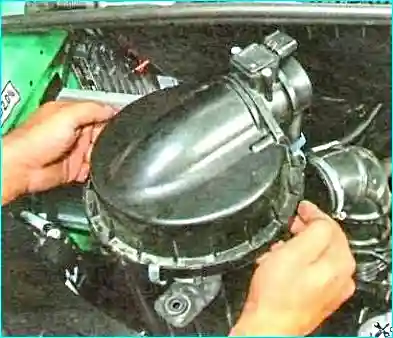
We install the air filter in the reverse order.
Materials used and recommendations
Replace the air filter element after 20 thousand km of mileage; when operating in dusty areas, it is desirable to shorten the replacement interval. Between replacements, blow out the filter with compressed air where possible. To clean the internal cavity of the housing, use compressed air or a vacuum cleaner; prevent dust from entering the intake tract.
When removing the filter housing, disconnect the mass air flow sensor wiring connector and the air supply hoses carefully so as not to damage the connectors and clamps. Pay attention to the markings of the mountings «А» (lower mounting nut) and «Б» (upper mounting bolt). After installation, check that the cover seats properly and that all three spring retainers latch, as well as the tightness of the air supply hose connections. A clogged filter causes black smoke from the exhaust, incomplete fuel combustion, reduced power and increased fuel consumption.