


General information
Setting the piston of the first cylinder to top dead centre is necessary during various engine repair operations.
Preparing the vehicle:
- We place the vehicle on a lift or over an inspection pit.
- We remove the right front wheel.
- We remove the right front wheel arch liner.
Preparatory operations
Preparation sequence:
- We unscrew four bolts securing the bracket of the front part of the subframe to the body and remove the bracket.
- We remove the auxiliary drive belt (see the article Replacing the auxiliary drive belt on a Renault Megane 2).
- We jack up the engine and install a support.
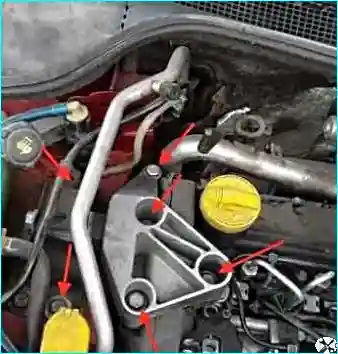
Removing the upper timing cover
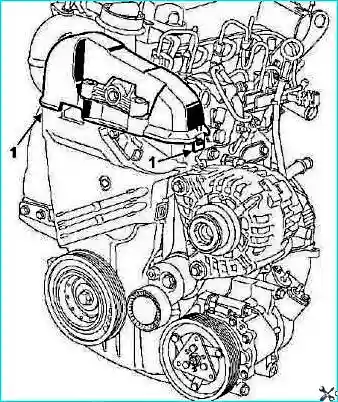
Having unfastened the retainers, we remove the upper plastic cover.
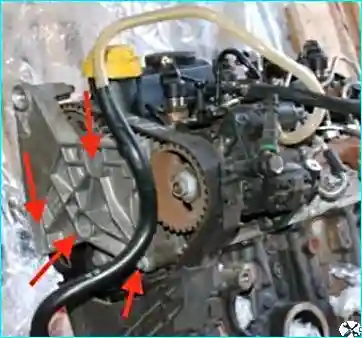
Setting the first cylinder to TDC
Important! We rotate the crankshaft clockwise by the bolt securing the auxiliary drive pulley.
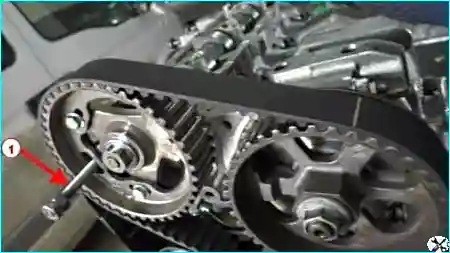
Aligning the openings: by rotating the crankshaft clockwise, we align the opening in the cylinder head with the opening on the camshaft pulley.
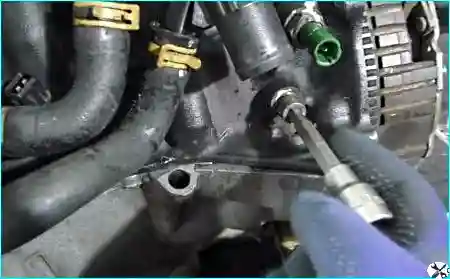
Location of the plug: the plug is located to the left of the flywheel in the cylinder block at the level of the 1st cylinder.
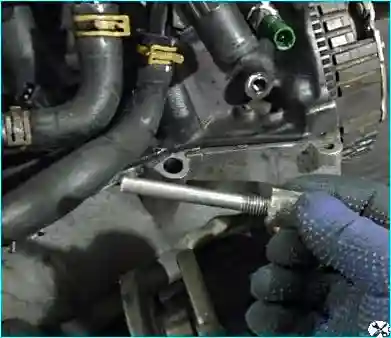
Control position: after fitting the retainer, the keyway on the crankshaft must be located at the top.
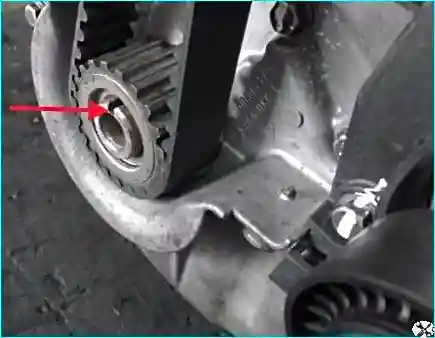
Completion of work: after carrying out the necessary repair work all the parts are refitted in the reverse order. Do not forget to withdraw the TDC retainer before starting the engine.
Recommendation: when fitting the TDC retainer, make sure that the piston of the first cylinder is precisely at TDC of the compression stroke and not of the exhaust stroke. To do this, one can check that both camshafts have marks coinciding with the setting marks.


