


The coolant level should be checked at every engine inspection.
The fluid level should be checked with the engine cold.
With the engine warm, the fluid level will be above the maximum mark on the expansion tank.
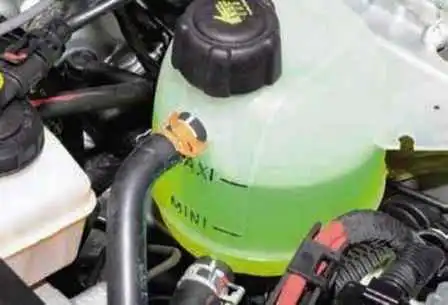
With the engine cold, the fluid level should be between the MAXI and MINI marks.
To determine the fluid level accurately, the vehicle must be placed on a horizontal surface.
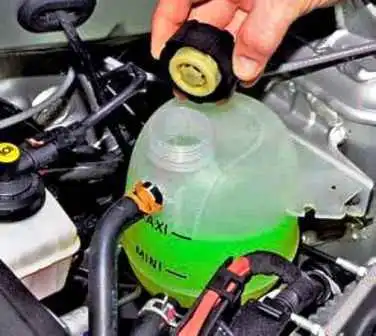
If there is not enough fluid, we unscrew the expansion tank cap.
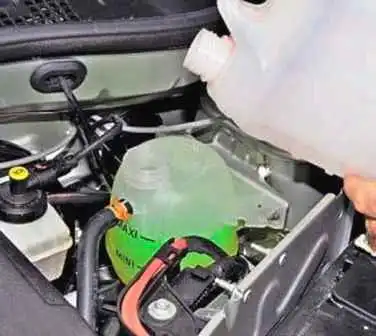
We top up the expansion tank with coolant.
If the fluid level in the cooling system constantly drops, the system is not sealed (there is a leak).
It is necessary to find the place of the fluid leak and rectify the fault.
Replacing the engine coolant.
Glaceol (type D) is poured into the engine cooling system — a solution of antifreeze concentrate in distilled water, containing no amines, in an amount of 5.45 l.
The coolant in the engine should be replaced after three years of operation.
We place the vehicle on a lift or an inspection pit.
There are no taps or drain plugs for the coolant on the engine block or the radiator.
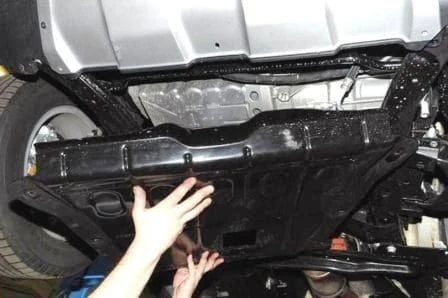
To drain the coolant, we remove the engine undertray (article — Removal of engine protection, wheel arch liners and mudflaps Renault Duster).
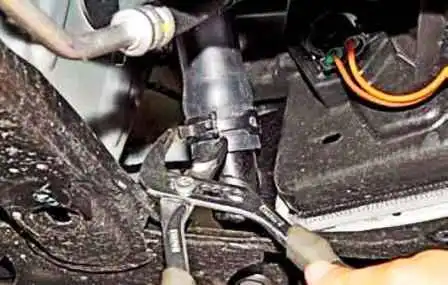
We place a container for draining the coolant underneath, preferably a basin or a wide container of at least 6 l.
With slip-joint pliers we squeeze the ends of the hose clip securing the hose to the lower radiator connection and slide the clip along the hose (the clip can be replaced with a screw-type clip to make it easier to remove and fit the clip in future).
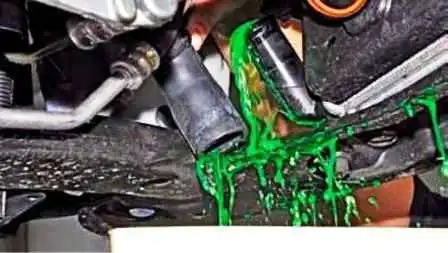
We disconnect the hose from the radiator connection and drain the fluid into the container placed underneath.
After the fluid starts to drain, we open the expansion tank cap.
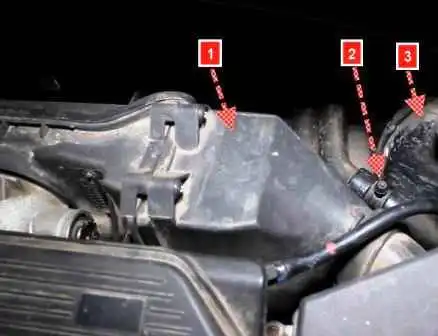
We unscrew cap 2 (figure 7) of the drain union located on the hose for draining fluid from the heater radiator.
After draining the fluid, it is advisable to flush the cooling system with water.
After draining the fluid, we fit the outlet hose onto the radiator connection and secure it with the clip.
We pour the coolant in through the expansion tank.
As soon as the fluid starts to flow out of the drain union, we screw the cap onto the union.
We top up the fluid in the expansion tank.
For better filling of the system without air locks, the radiator hoses should be pressed periodically by hand.
We pour the fluid up to the maximum mark on the tank wall.
We start the engine, warm it up to operating temperature and set the crankshaft speed to 2500 min⁻¹.
Holding this speed, we wait for two or three fan activations.
During this time, air is automatically removed from the system.
While the engine is running, we monitor the coolant temperature on the gauge in the instrument cluster.
If the gauge scale is completely shaded and the fan has not activated, we switch on the heater and check what air is coming through the heater.
If the heater supplies warmed air, the fan is faulty; if it supplies cold air, an air lock has formed in the system.
It is necessary to stop the engine and, after it has cooled down, open the expansion tank cap.
We start the engine and let it run for four to five minutes.
We press the radiator hoses by hand.
We close the expansion tank cap.
After a few journeys, the coolant level should be checked.


