


The rear wheel drives with constant-velocity joints on an all-wheel-drive car serve to transmit torque from the final drive of the rear final drive to the rear wheels.
The drives of the right and left rear wheels are interchangeable.
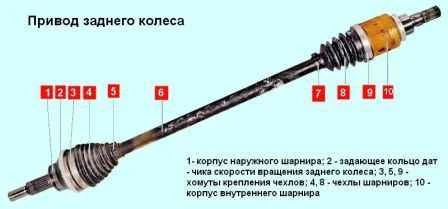
The wheel drive consists of an inner and an outer constant-velocity joint connected to each other by a shaft.
The drive shaft is made of forged steel bar.
At the ends of the shaft splines are made, on which the CV joints are installed.
The outer and inner joints of the drives have different designs.
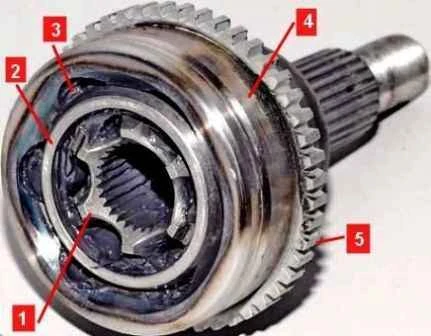
The outer joint of the drive allows the angular movements of the suspension.
It consists of the body, the cage, the race and six balls, which are placed in profiled grooves of the body and the race.
The cage constantly holds the balls in the bisector plane between the body and the race of the joint and ensures uniform transmission of rotation from the race to the body.
The race of the joint is installed on the splines of the shaft and fixed against longitudinal movement by a circlip.
The splined shank of the outer joint body, at the end of which a thread is cut, is inserted into the rear wheel hub and secured with a nut.
The outer joints of the right and left drives of the rear wheels are interchangeable, and the inner joints are also interchangeable.
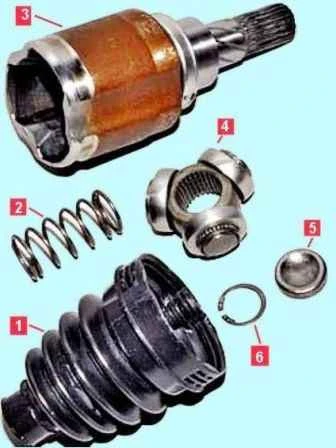
The inner joint of the drive allows the angular movements of the suspension and compensates for the movements of the suspension relative to the body by changing the length of the drive shaft.
On the splined end of the drive shaft on the side of the inner joint a hub with three pins is installed — a tripod, on each of the pins (journals) of which a roller with an outer spherical surface is placed, rotating on a needle bearing.
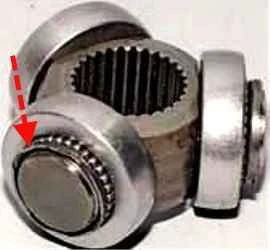
The tripod is fixed on the drive shaft by a circlip.
The spring, installed inside the body of the inner joint, ensures constant pressing of the joint body against the side gear of the differential.
The circlip in the connection of the splined shank of the inner joint body with the side gear of the differential is not installed.
The movements of the rear suspension relative to the body are compensated by the movement of the tripod rollers in the longitudinal grooves of the inner joint body.
The tightness of the joints is an indispensable condition for their reliable operation.
The tightness of the outer and inner joints is ensured by plastic protective covers, secured on the shaft and the body by single-use metal clamps.
We replace a worn joint as an assembly.
In the outer and inner joint, before assembly, a special grease for the joints of the wheel drives with molybdenum disulphide (domestic analogue — ШРУС-4) is placed.
Replenishment or replacement of the grease, as well as any other maintenance of the wheel drives during the operation of the car, is not required.
The owner of the car only needs to monitor the condition of the protective covers of the joints and the securing of their clamps.
The joints of the drives are very durable, their calculated resource is almost equal to the resource of the car.
However, in operation the joints of the drives are changed or repaired quite often.
Such work is quite expensive and labour-intensive.
In order to save seriously, regularly check the condition of the protective covers of the joints and replace them immediately at the slightest damage.


