


We remove the clutch cover and the driven plate for replacement when they fail, as well as when replacing the flywheel and the rear crankshaft oil seal.
We carry out the work on an inspection pit or a lift.
We remove the gearbox (see the article — Removal and installation of the Renault Duster manual gearbox).
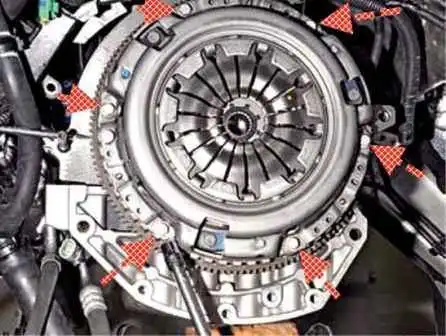
Using an 11 mm socket, we undo the six bolts securing the clutch cover to the flywheel.
We prevent the flywheel from turning by inserting a sturdy screwdriver or a pry bar between its teeth and resting it against a gearbox mounting stud.
At first we undo the bolts evenly, no more than one turn per pass, so as not to distort the diaphragm spring.
Once the action of the diaphragm spring weakens, we undo the bolts freely.
When undoing the last bolt, we support the clutch cover and the driven plate.
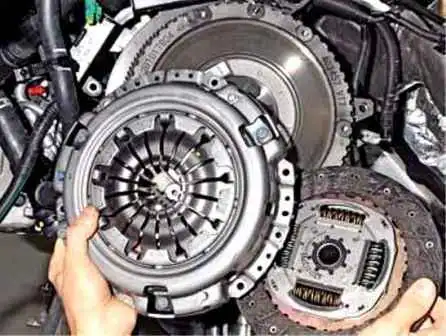
We remove the clutch cover and the driven plate.
We install the driven plate and the cover in the reverse order.
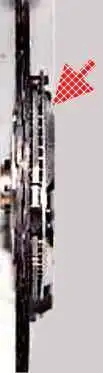
When installing the driven plate, we orient its protruding part towards the clutch cover.
We position the clutch cover on the flywheel so that the flywheel pins enter the corresponding holes in the cover.
We insert the centring mandrel into the splines of the driven plate and introduce the mandrel shank into the hole in the crankshaft flange.
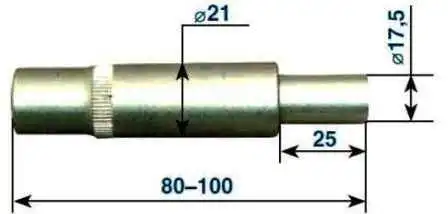
The mandrel can be turned from any material to the required dimensions.
We start and evenly tighten the oppositely located bolts securing the driving plate housing to the flywheel.
Clutch fastening tightening torques:
- bolt/nut securing the clutch housing to the engine — 44 Nm;
- bolt securing the clutch housing to the flywheel — 20 Nm;
- bolt securing the clutch slave cylinder to the gearbox — 25 Nm.
We extract the centring mandrel of the driven plate and install the gearbox.
We install all parts in the reverse order and bleed the clutch hydraulic drive.


