


General description of the supplementary restraint system (SRS)
The supplementary restraint system (SRS) of the Renault Megane 2 vehicle combines in a complex the airbags for the driver and the front passenger (depending on the version).
In addition, the complex supplementary restraint system includes height-adjustable seat belts for the driver and the front passenger with pretensioners, inertia reel seat belts with pretensioners for the rear passengers, ISOFIX child seat mountings, front seats with specially designed head restraints to prevent spinal injuries.
Important! Airbags do not replace seat belts. While the vehicle is moving, the driver and the front passenger must be fastened with the seat belts, since in the event of a road traffic accident the deployed airbag can itself inflict a severe injury on a person not fastened with the seat belt.
Rear seat passengers must be fastened with the seat belts. In the event of an accident, a rear seat passenger not fastened with the seat belt can inflict injuries and serious mutilation on all the passengers in the vehicle cabin.
Warning: do not install or place objects on the fascia in front of the passenger above the glovebox. They can suddenly come into motion and cause injuries when the passenger airbag deploys.
Airbag deployment may be accompanied by a loud noise and the spread of finely dispersed dust through the cabin. This is normal, since the airbags in the non-operating state are packed in this powder. The dust that appears during airbag deployment can cause irritation of the skin or the organs of sight, and aggravate the asthmatic reaction of some people. After a road traffic accident accompanied by airbag deployment, always thoroughly wash all exposed areas of the skin with warm water and toilet soap.
Operating features of the system:
- The SRS airbag system is designed to deploy them only when the force of the frontal impact is sufficiently great and its direction forms an angle of not more than 30° with the longitudinal axis of the vehicle.
- The system is single-use.
- The front airbags are not designed to deploy in the event of a side collision, a rear impact or the vehicle overturning.
Carrying children: children under the age of 12 must be carried using a special child restraint. The use of the child restraint is determined by the Road Traffic Regulations, and its fitting in the vehicle cabin — by the manufacturer's recommendations.
SRS system elements
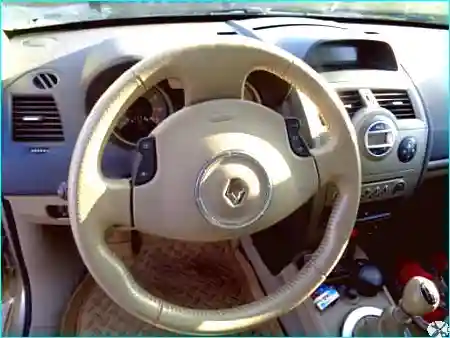
Airbag modules
- Driver airbag module — located in the steering wheel hub, consists of a folded airbag envelope and a gas generator.
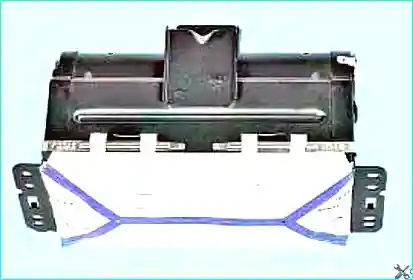
- Front passenger airbag module — located under the fascia on the passenger side, consists of a folded airbag envelope and a gas generator. Differs from the driver airbag in shape and larger volume.
The airbag locations are marked with the inscription «SRS AIRBAG».
Seat belt pretensioners
- Front and rear seat belt pretensioner modules — combined with the lower brackets of the driver's and front passenger's seat belts, located under the front seats, as well as in the inertia reels of the rear passengers' seat belts.
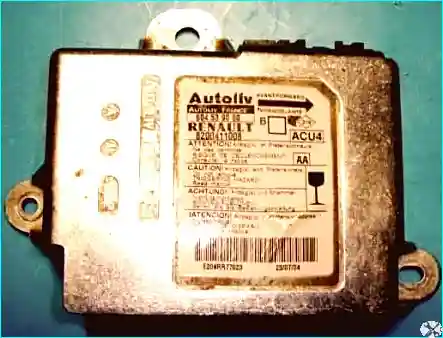
Electronic control unit (SRS ECU)
- Electronic control unit — installed in the lower part, under the floor tunnel trim. Micromechanical sensors are built into the control unit, measuring the longitudinal and lateral acceleration of the vehicle during a collision.
Operating principle: the electronic control unit assesses the impact force by comparing the values it receives from the frontal impact sensors, the side impact sensors and the internal electronic sensors with a set value. If the deceleration signal due to a frontal or side impact exceeds the set value, the electronic control unit initiates the actuation of the seat belt pretensioners and the deployment of the corresponding airbags.
Important: if the vehicle battery has broken during the accident, the voltage hold circuit in the electronic control unit will still be able to activate the airbags for some time from the moment of impact.
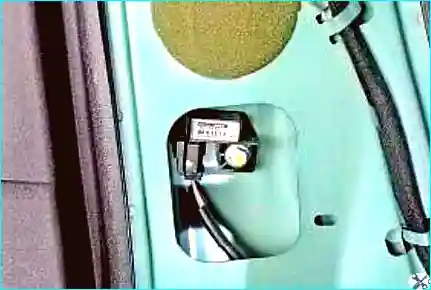
Side impact sensors
- Side impact sensors — transmit information about acceleration to the system control unit. The sensors are located in the cavity of the vehicle's centre pillar. Based on the sensor signals, the electronic control unit activates the airbags and the seat belt pretensioners.
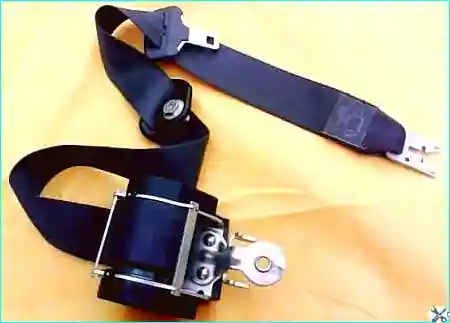
Seat belts
- Seat belts — in the event of an impact of a certain force, the electronic control unit, having received the signals from the impact sensors, before activating the airbags increases the belt tension, issuing a command to the pyrotechnic elements of the pretensioners. The latter ensure a timely response to the emergency deceleration of the vehicle, pulling the driver and the front passenger towards the seat backrests, and exclude their further movement by inertia forwards and injury from the deployed airbag.
Important: the seat belt pretensioner mechanism is always actuated earlier than the airbag.
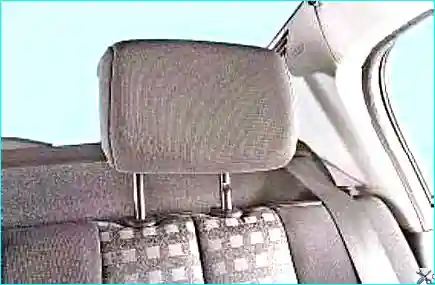
Head restraints
- Head restraints — installed in the backrests of all seats. The head restraints prevent damage to the cervical vertebrae of the people sitting in the vehicle in the event of a strong rear impact and during airbag deployment. The front seat head restraints are made using a special technology that additionally reduces the risk of neck and spinal injuries in a rear impact.
Optimum adjustment: the upper edge of the head restraint should be level with the top of the head.
SRS system indicator
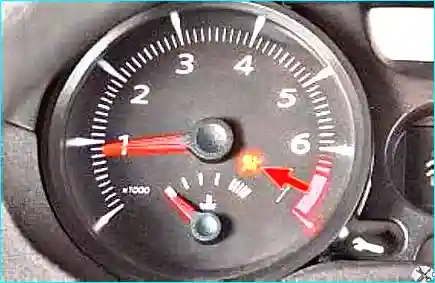
- Supplementary restraint system indicator (with a yellow filter) is located in the left part of the instrument cluster. The indicator illuminates for a few seconds when the ignition is switched on and then goes out.
Attention! If the indicator does not go out or illuminates while driving, a fault has occurred in the SRS system. When the indicator illuminates, immediately contact a car service. Besides the possible failure of the airbag in an emergency situation, it may unexpectedly deploy while driving, which will lead to severe consequences.
Note: removal and refitting of the airbags are covered in the article Removing the airbags on a Renault Megane 2.
Removing and refitting the electronic control unit of the supplementary restraint system
Precautions:
- We disconnect the negative terminal from the battery.
- After disconnecting the battery you must wait at least one minute, and only after that disconnect the wiring harness connector from the SRS unit of the sensors and elements of the safety system.
We remove the floor tunnel trim.
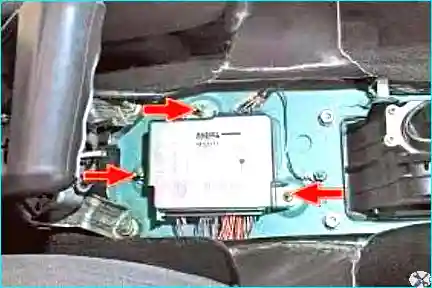
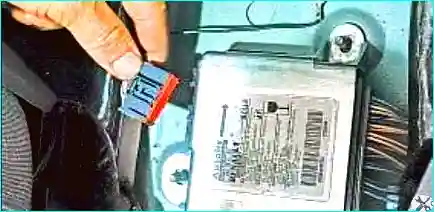
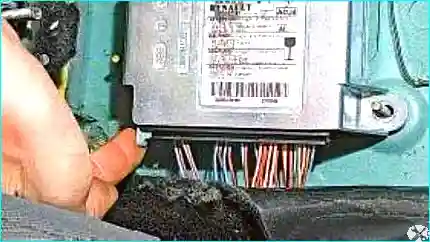
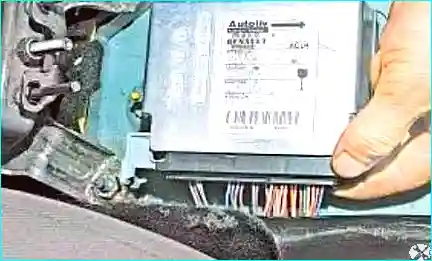
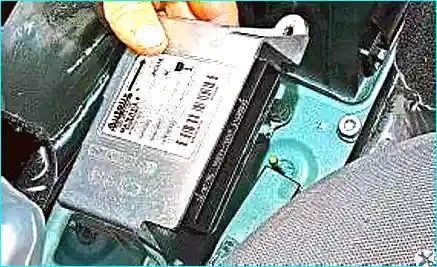
We remove the electronic control unit of the supplementary restraint system.
Refitting: is carried out in the reverse order.
Replacing the impact sensors
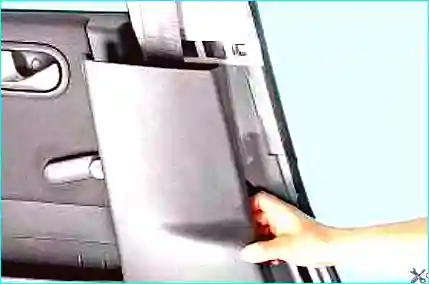
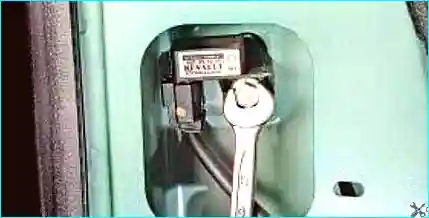
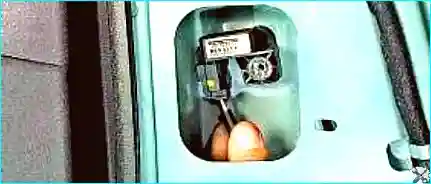
Refitting: refit all parts in the reverse order.


