 ZH
 FR
 BE
 DE
 RU
 UK
 KK
 EN
 ES
Adjustment of the wheel hub bearings is required after bearing replacement and when the play increases.
We prepare the vehicle and jack up the front wheel on the side of the work to be done.
Removing the wheel free-wheeling hub
We remove the wheel free-wheeling hub, for this:
- we clean the hub surface and the free-wheeling hub cap of dirt.
By turning the switch to the “4×2” position, we disconnect the wheel drive.
Using a 14 mm socket, we undo the six bolts securing the drive flange to the hub.

Pulling towards ourselves, we remove the free-wheeling hub with its gasket and flange from the shaft splines.

Adjusting the hub bearings
With a chisel, we bend up the edge of the lock washer.
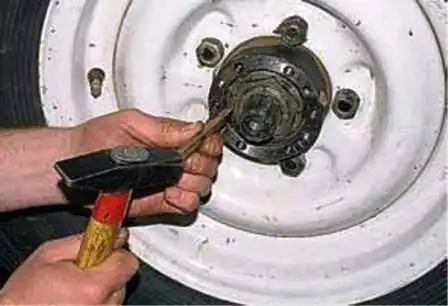
Using a 55 mm box spanner, we undo the bearing locknut and remove it.
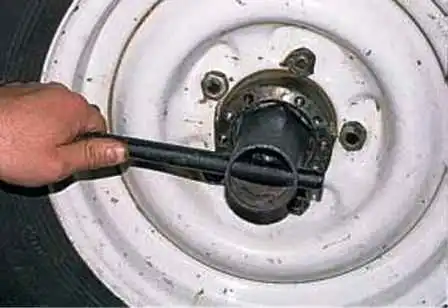
With a screwdriver, we prise out and remove the lock washer.
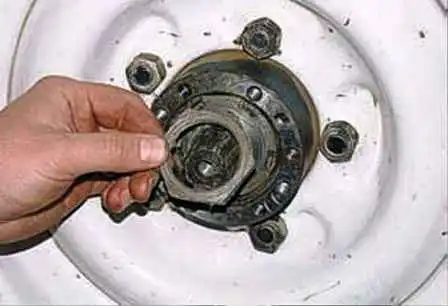
The washer is fitted with its bending tab outwards.
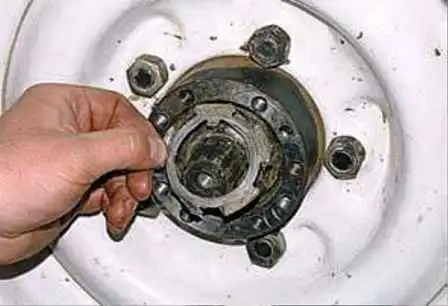
Using a 55 mm box spanner, we tighten the hub adjusting nut to the stop, constantly turning the wheel by hand so that the rollers self-align in the bearings.
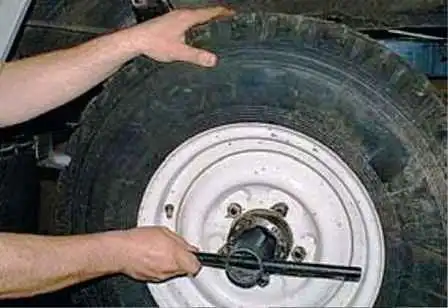
We slacken the adjusting nut by 1/4–1/3 of a turn.
We fit the lock washer, screw on and tighten the locknut.
We check the bearing adjustment by turning the hub by hand.
It must turn freely, without binding, clicking and play.
With a chisel, we bend the edge of the lock washer onto a face of the locknut and fit the wheel free-wheeling hub.
We finally check the correctness of the bearing adjustment by driving 5–10 km without heavy braking.
If the hub becomes very hot (the hand cannot bear it), we slacken the adjusting nut by 1/6 of a turn, as indicated above.
If the hub heating continues while driving, the bearings may be damaged or lack lubricant.
Checking and adjusting the kingpin axial play
We apply the parking brake or place chocks under the rear wheels.
We jack up the right-hand side of the front axle and remove the wheel.
We undo the bolts securing the ball joint seal and the steering stop bolt.
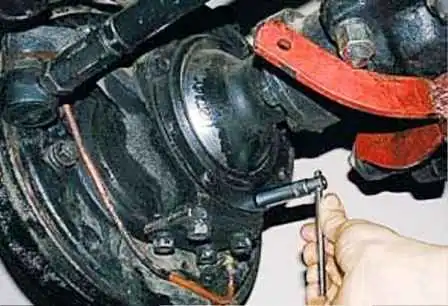
We move the seal aside.
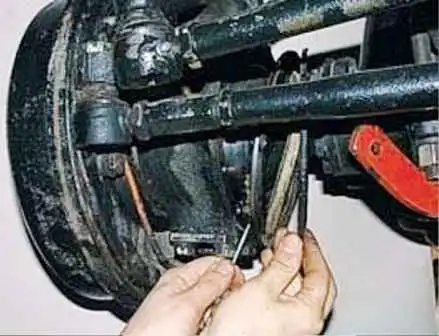
We check the kingpin axial play by rocking the steering knuckle body up and down with our hands.
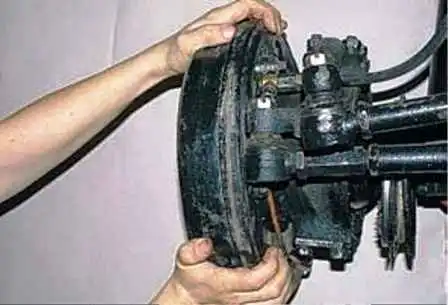
If play is felt, using a 19 mm socket, we undo the four nuts securing the steering knuckle arm.
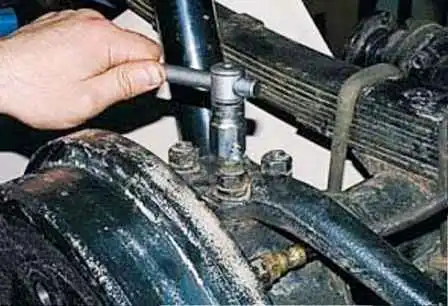
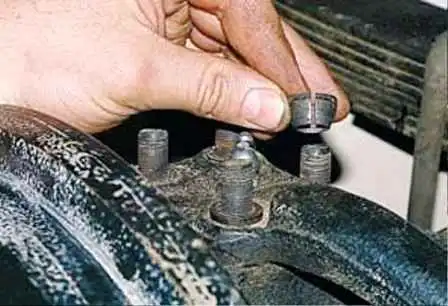
We remove the spring washers and the conical split bushes.
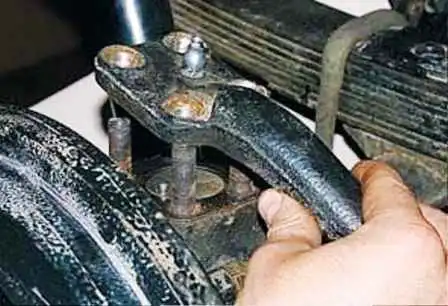
We remove the arm from the steering knuckle and move it aside together with the drop arm steering rod.
We take out one upper kingpin adjusting shim.
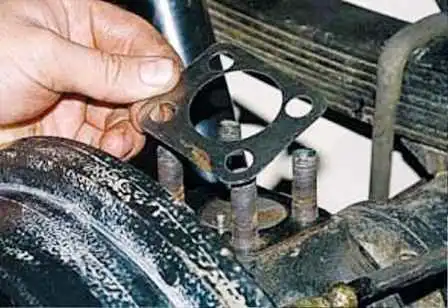
To maintain the coaxiality of the joint parts, shims of the same thickness must be removed at the top and bottom (difference not more than 0.1 mm, measured with a micrometer).
We refit the arm, aligning its hole with the pin.
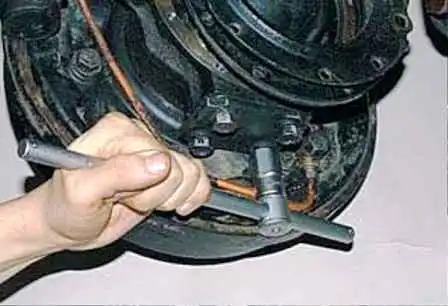
Using a 17 mm socket, we undo the four securing bolts and remove the lower kingpin plate and the lower kingpin shim of the same thickness.
We refit the plate, aligning its hole with the pin.
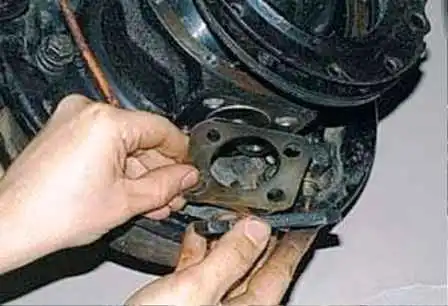
We check the kingpin axial play.
If it is felt, we remove one more shim at the top and bottom.
Having eliminated the axial play, we refit the removed parts.
We also check and eliminate the axial play in the left steering knuckle kingpin, with the difference that, to remove the upper adjusting shim, we remove the upper kingpin plate.
Materials and design features
The wheel free-wheeling hub has a drive flange, a gasket and a splined joint; the “4×2” switch disconnects the wheel drive. The drive flange fixing consists of six bolts under a 14 mm socket. The hub bearing locknut is undone with a 55 mm box spanner. The lock washer has a bending tab; it is fitted with the tab outwards, and its edge is bent onto a face of the locknut with a chisel. The hub adjusting nut is tightened with a 55 mm box spanner to the stop while turning the wheel, and then slackened by 1/4–1/3 of a turn. If the hub heats up — slacken by 1/6 of a turn. The kingpins have adjusting shims at the top and bottom; the thickness is measured with a micrometer, difference not more than 0.1 mm. The steering knuckle arm is secured by four nuts under a 19 mm socket, with spring washers and conical split bushes; the arm hole is aligned with the pin. The lower kingpin plate has four bolts under a 17 mm socket. The ball joint seal and the steering stop bolt are removed for access to the kingpin. The hub bearing lubrication is a consistent grease (Litol-24 or similar). The adjustment is checked by driving 5–10 km without heavy braking.