


The dismantling process of the final drive is detailed in the article – How to dismantle the vehicle's final drive.
In this article, we will examine how to correctly assemble and adjust the rear axle final drive of the Gazelle Next.
We assemble the final drive in the reverse order of dismantling, having previously lubricated the bearings and gears generously with clean transmission oil.
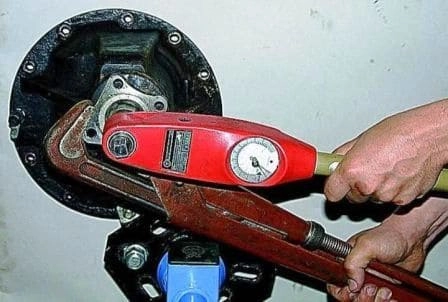
After installing the drive pinion in the final drive housing, we tighten the flange nut with a torque wrench to a torque of 160–200 N·m (16–20 kgf·m). During tightening, the pinion must be continuously rotated to ensure the correct seating of the rollers in the bearings.
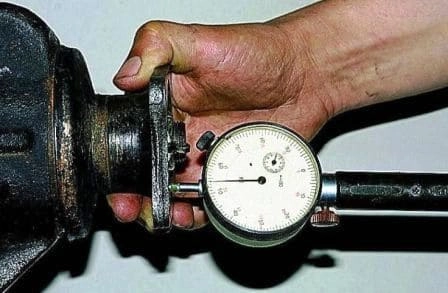
We mount a dial indicator with a graduation of no more than 0.01 mm on a stand, resting its plunger on the face of the flange. By moving the shaft via the flange, we measure the axial backlash of the drive pinion.
To eliminate the backlash, we remove the spacer ring installed on the pinion shaft and measure its thickness with a micrometer.
We select and install a new spacer ring. It must be thinner than the removed one by the measured backlash value, and additionally: by 0.05 mm if the drive pinion bearings are new, or by 0.01 mm if the old bearings are retained.
In the absence of axial backlash, we check the rotational resistance torque of the shaft using a special torque wrench (graduation up to 0.5 kgf·m).
With correct adjustment, the rotational resistance torque should be 15–20 kgf·cm for new bearings or 7–10 kgf·cm if the old bearings are retained.
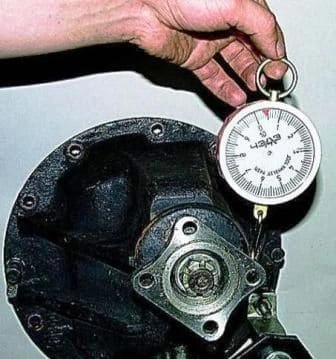
With sufficient practical accuracy, the rotational resistance torque can be measured with a household spring scale hooked into a flange hole. The required forces will then be lower: 3.8–5 kgf and 1.8–2.5 kgf respectively.
If the rotational resistance torque is higher than the norm, we replace the spacer ring with one that is 0.01–0.02 mm thicker. If it is lower, we accordingly select a thinner ring.
Important: Before assembly, the bolts securing the differential case halves and the ring gear, as well as their threaded holes, must be degreased and coated with anaerobic thread locker.
Special attention must be paid to the cleanliness of the mating surfaces of the gears and the differential case: the slightest contamination, burrs, or dents are unacceptable.
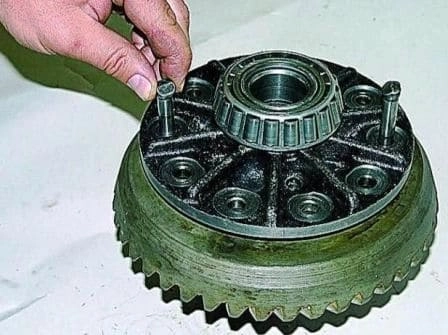
When installing the ring gear onto the differential case, we center it using long M10×1 bolts (suitable bolts from old connecting rods can be used).
We preload the differential bearings using the adjusting nuts with a slight tension. At the same time, we rotate the ring gear back and forth so that the bearing rollers assume their correct working position.
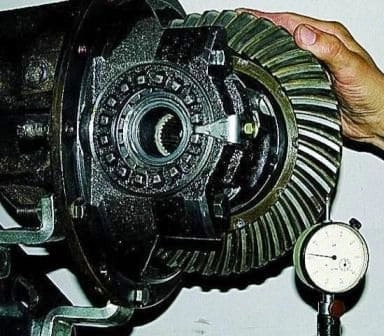
To measure the side clearance in the gear mesh, we fix a dial indicator to the rear axle housing, bringing its plunger to the tooth tip on the outer side of the ring gear.
The clearance should be 0.15–0.20 mm. Measurements should be repeated on at least six teeth in opposite zones of the gear ring.
To reduce the clearance, loosen the adjusting nut on the side opposite to the ring gear (using a screwdriver or a thin steel rod) and tighten the other nut.
Loosening one nut and tightening the other must be done by the same amount, guided by the notches (splines) of the adjusting nuts.
Note: each loosening of an adjusting nut must be completed by a slight tightening. For example, to loosen the nut by 5 notches, turn it out by 6 notches, then turn it back in by 1 notch. This ensures constant contact of the bearing outer ring with the nut, thereby guaranteeing its reliable fixation during operation.
To increase the clearance, repeat the entire procedure in the reverse order.
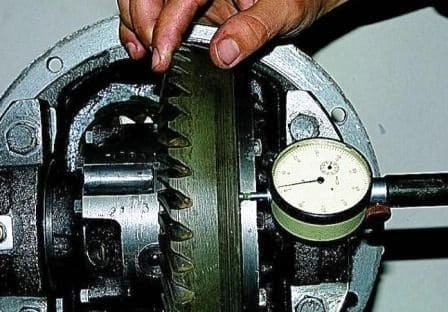
After adjusting the side clearance, we check the axial backlash in the differential bearings. To do this, we mount a dial indicator on a stand, resting its plunger on the face of the ring gear.
By rocking the ring gear in the axial direction, we measure the backlash in the differential bearings.
Using the adjusting nut located on the side opposite to the ring gear, we set the axial backlash to 0.035–0.055 mm.
Next, by tightening the nut, we set the bearing preload: 0.1 mm for bearings with less than 10,000 km of mileage; 0.05 mm for bearings with more than 10,000 km of mileage.
Turning the nut by one notch corresponds to a "compression" of the bearing by approximately 0.03 mm.
Having adjusted the preload, tighten the bearing cap bolts, install the locking plates, and check the side clearance once more.
Adjusting the final drive by the gear contact pattern
Before finally tightening the cap bolts, we unscrew them one by one and apply anaerobic sealant to the threaded part.
Adjusting the final drive by the gear contact pattern is the most effective method for verifying and correcting the gear mesh. It also allows verification of the quality of adjustments made by other methods.
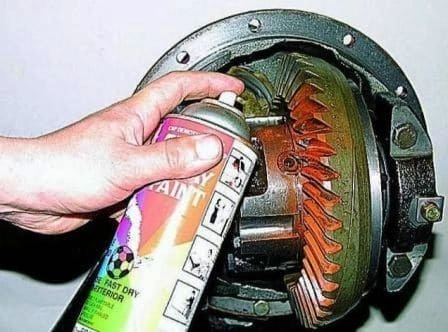
Apply marking compound (preferably bright and high-contrast) to the teeth of the ring gear.
Rotate the drive pinion flange several times in both directions, while slightly braking the ring gear until the compound is completely wiped off at the points of tooth contact.
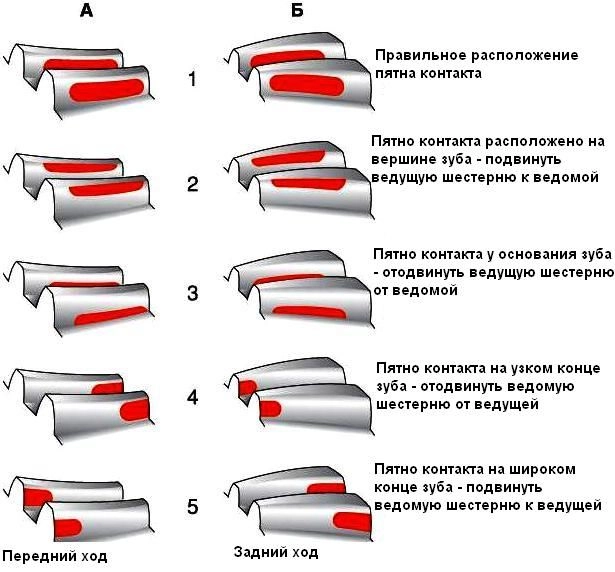
Examine the contact patterns on the teeth of the ring gear from both the convex and concave sides.
- If the contact pattern is located on the tooth tip, it is necessary to increase the thickness of the drive pinion shim.
- If the contact pattern is located at the tooth root, it is necessary to decrease the thickness of the shim.
- If the contact pattern is shifted towards the centre of the tooth (inwards), it is necessary to increase the side clearance between the ring gear and the drive pinion.
- If the contact pattern is shifted outwards (towards the edge), it is necessary to decrease the side clearance.
After successful adjustment, install the final drive into the rear axle. Apply a thin layer of oil-resistant sealant to the mounting bolts and the mating surface of the flange.
After assembling the rear axle and filling it with the recommended transmission oil, conduct a road test of the final drive.
To do this, drive at a speed of 60–70 km/h for 20–30 minutes.
The temperature of the housing neck should not exceed 95 °C (a drop of water applied to the housing should not boil instantly).
Otherwise, it is necessary to reduce the preload of the drive pinion bearings.