 ZH
 FR
 BE
 DE
 RU
 UK
 KK
 EN
 ES
UAZ vehicles are equipped with two types of rear axles: with a single main gear or with additional wheel reduction gears.
The axle with a single main gear consists of a cast iron housing divisible in the vertical plane and steel tubular half-shaft sleeves pressed into it, additionally fixed by welding.
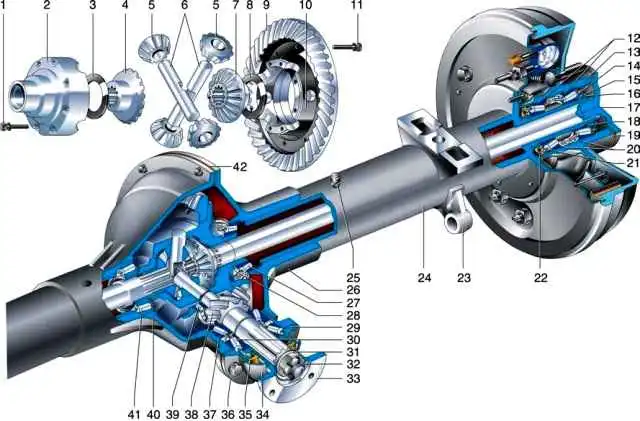
1 - satellite cage bolt; 2, 10 - satellite cage; 3, 8 - thrust washers; 4, 7 - side gears; 5 - satellites; 6 - satellite axes; 9 - ring gear; 11 - gear fixing bolt; 12 - hub bearings; 13 - hub; 14 - locking washer; 15 - adjusting nut; 16 - lock nut; 17 - half-shaft; 18 - locking washer; 19 - gasket; 20 - retaining rings; 21 - spacer ring; 22 - hub seal; 23 - shock absorber bracket; 24 - half-shaft sleeve; 25 - breather valve; 26 - differential housing; 27, 41 - roller bearings of the satellite cage; 40 - adjusting washers; 29 - gasket; 30 - ring; 31 - washer; 32 - nut; 33 - flange; 34 - mud deflectors; 35 - drive gear seal; 36 - cover; 37 - double-row roller bearing; 38 - drive gear; 39 - radial roller bearing; 42 - gasket.
The two parts of the housing are tightened by eight bolts through a gasket. The main gear with the differential is located in the right part of the housing and forms the axle reduction gear.
The drive gear of the main gear is mounted in the housing on a double-row tapered roller bearing and a radial roller bearing, located on both sides of its ring gear. The ring gear is bolted to the satellite cage. The gears are spiral bevel gears, the reduction gear ratio is 4.625.
The satellite cage consists of two parts connected by bolts. It is mounted in the housing on two tapered roller bearings. Two satellite axes, four satellites, and two side gears with thrust washers are installed in the cage. The splined ends of the half-shafts engage with the splined holes of the side gears.
Flanges are made at the outer ends of the half-shafts, which are connected to the wheel hubs by ten bolts. Each hub is mounted on the half-shaft sleeve on two identical tapered roller bearings. Five bolts are pressed into the hub, to which the stamped steel wheel with a seating diameter of 15 or 16 inches is attached by cone nuts.
The adjustment of the bearings and the engagement of the main gear gears is carried out by changing the thickness of the gaskets between the inner rings of the drive gear bearing and the number of washers at the inner rings of the satellite cage bearings. The hub bearings are adjusted by ring nuts installed on the threaded ends of the half-shaft sleeves.
The reduction gear is lubricated with transmission oil poured into the housing. Holes closed with plugs with a conical thread are used for filling and draining the oil. The hub bearings are lubricated with plastic grease placed in the internal cavities of the hubs.
To prevent the leakage of oil and grease, as well as the ingress of dust, the rear axle is equipped with seals installed on the tail of the drive gear and in the wheel hubs. To release excess pressure inside the axle, there is a breather valve on the half-shaft sleeve.
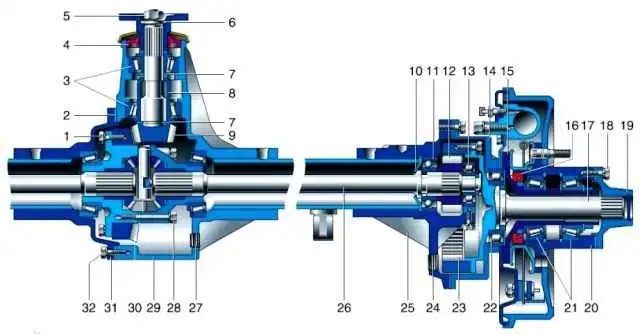
1 - ring gear fixing bolt; 2 - gasket; 3 - drive gear bearings; 4 - drive gear seal; 5 - flange nut; 6 - washer; 7 - adjusting rings; 8 - spacer sleeve; 9 - drive gear; 10 - oil deflector; 11 - half-shaft ball bearing; 12 - drive gear of the wheel reduction gear; 13 - half-shaft roller bearing; 14 - cover of the wheel reduction gear housing; 15 - journal; 16 - hub seal; 17 - driven shaft of the wheel reduction gear; 18 - bolt; 19 - drive flange; 20 - hub; 21 - hub bearings; 22 - driven shaft roller bearing; 23 - ring gear; 24 - oil drain plug of the wheel reduction gear; 25 - housing of the wheel reduction gear; 26 - half-shaft; 27 - oil drain plug of the main gear housing; 28 - satellite cage bolt; 29 - main gear housing; 30 - ring gear; 31 - housing cover; 32 - bolt.
The rear axle with wheel reduction gears is designed similarly to the one described, but has the following differences:
- The drive gear of the main gear is mounted cantilevered on two tapered roller bearings with a spacer sleeve between them.
- The gear ratio of the main gear is reduced to 2.77, and accordingly, the dimensions of the main gear housing are reduced.
- Wheel reduction gears with a straight-toothed cylindrical internal gear (gear ratio 1.94) are installed at the ends of the half-shaft sleeves.
In this case, the drive gear of the reduction gear is mounted on the splined end of the half-shaft, which rests on ball and roller bearings. The ring gear is made in one piece with the driven shaft. It is connected by splines to the drive flange of the wheel hub.
The housing of the wheel reduction gear consists of two parts connected by bolts through a gasket. The wheel reduction gear is lubricated with oil poured into its housing and has holes with plugs for filling and draining the oil, just like the central reduction gear.
Due to the use of wheel reduction gears, the vehicle's ground clearance increases by 80 mm, which improves its off-road capability.
Oil change in the rear axle reduction gear
It is desirable to change the lubrication after a trip, while the oil is still warm. Place the vehicle in an inspection pit or on a hoist. Clean the filling and draining plugs of the reduction gear and place a container for draining the oil.
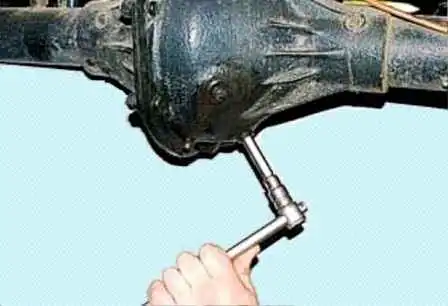
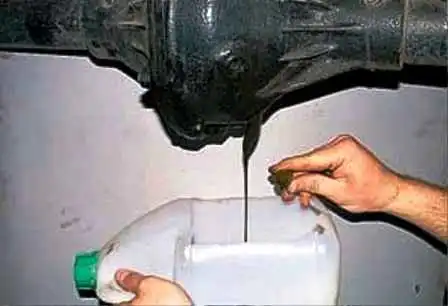
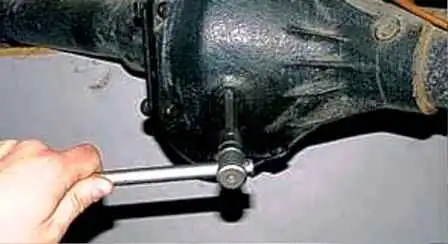
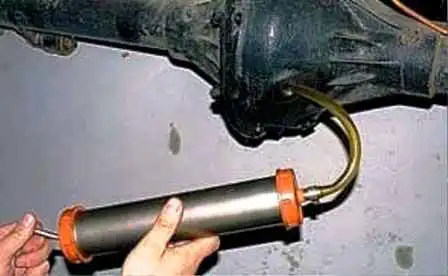
We screw the plug back in place and tighten it.
If the used oil is dark and metal particles are visible in it, we flush the reduction gear before pouring in fresh oil. To do this, after draining the old oil, we pour about 0.5 liters of a mixture of transmission or engine oil with 20–30% kerosene or diesel fuel into the reduction gear.
After screwing in the plug, we lift one side of the vehicle (until the wheels lift off the ground) and engage the front axle. We start the engine and engage first gear for 2-3 minutes, after which we completely drain the flushing fluid and pour fresh transmission oil into the reduction gear up to the lower edge of the filler hole.
We change the oil in the wheel reduction gears in the same way (for vehicles equipped with wheel reduction gears).
Possible malfunctions of the driving axles and methods of elimination
Increased noise while driving
- Increased side clearance in the engagement of the main gear gears due to tooth wear.
Elimination: Replace the worn gears. Adjusting the position of the gears to compensate for wear should not be done, as the required contact in the engagement is achieved only at a specific mutual position. - Wear of the bearings of the drive gear of the main gear.
Elimination: Adjust or replace the worn bearings. - Wear of the differential bearings.
Elimination: Replace the worn bearings. - Loosening of the bolts securing the ring gear to the differential.
Elimination: Tighten the bolts securing the ring gear. - Incorrect adjustment of the engagement of the main gear gears by contact.
Elimination: Perform engagement adjustment in the absence of tooth wear (for UAZ-3151 driving axles). - Damage to the differential parts (wear of the gear teeth, friction surfaces of the satellite cage, and related parts). In this case, noise appears when turning or when one of the wheels slips.
Elimination: Replace the worn parts. - Low oil level in the main gear housing.
Elimination: Top up the oil in the housing to the lower edge of the oil filler hole.
Oil leakage through the seal of the drive gear of the main gear
- Wear of the seal or the surface of the flange for attaching the propeller shaft to the drive gear of the main gear.
Elimination: Replace the seal together with the flange.