


If traces of oil leakage through the crankshaft oil seals are detected, first check whether the crankcase ventilation system is clogged and whether the hoses of this system are pinched.
If the oil leak does not stop, the oil seals must be replaced.
An indication that the front crankshaft oil seal needs replacing is an oil leak through its lip.
The oil is splashed by the rotating crankshaft pulley, as a result of which the parts of the front of the engine and the timing drive belt become oil-contaminated.
Oil contamination of the clutch plates may be a consequence of a leak from the gearbox input shaft oil seal or the rear crankshaft oil seal.
Engine oil and transmission oil differ in smell, so it is possible to determine which of the oil seals has leaked.
To replace the oil seals, the following tools are required: 10, 16, 17, 18 mm sockets, 11, 13 mm spanners, a flat-blade screwdriver, a Torx E14 socket, a TDC setting lock, a camshaft lock, pliers, a hammer.
Replacing the front crankshaft oil seal
We place the vehicle on a lift or an inspection pit.
We remove the timing drive belt (article — Checking and replacing the timing belt of the vehicle).
After removing the belt, the crankshaft and camshaft must not be turned.
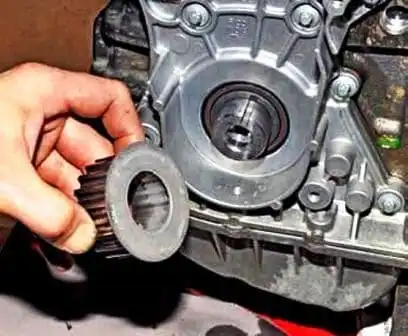
We remove the toothed pulley from the crankshaft nose.
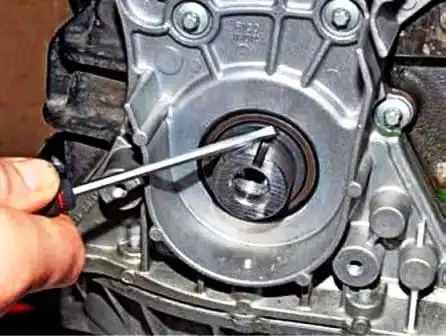
We prise out the oil seal with a screwdriver and withdraw it from the seat in the cylinder block cover.
We apply a thin layer of engine oil to the working lip of the new oil seal and press the oil seal into the seat using a socket of a suitable size.
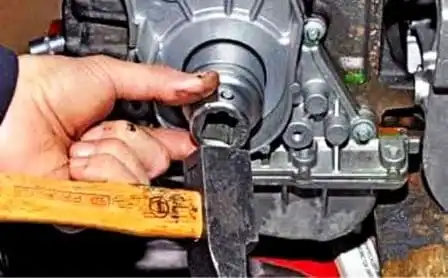
The oil seal must be pressed in to the same depth as the old oil seal was pressed in (the oil seal must be slightly sunk into the cover).
We carry out the assembly of the timing drive in the reverse order.
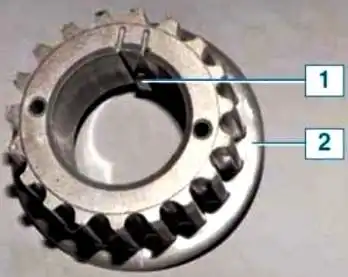
When fitting the toothed pulley, its projection 1 (acting as a key) must enter the groove on the crankshaft nose, and the flange 2 of the pulley must face the cylinder block cover.
Replacing the rear crankshaft oil seal
We place the vehicle on a lift or an inspection pit.
We remove the gearbox.
We remove the clutch plates.
The engine flywheel is secured to the crankshaft flange in only one position.
We mark with a marker the position of the flywheel relative to the shaft.
We lock the flywheel against turning by inserting the blade of a large flat-blade screwdriver between the teeth of the flywheel ring gear and resting on the cylinder block stud "А".
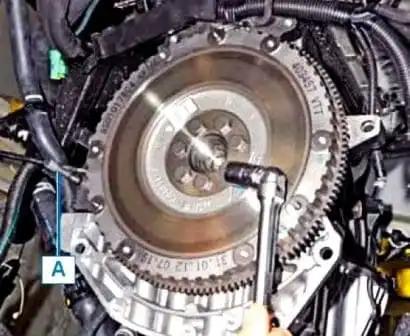
Using a 17 mm socket, we undo the seven flywheel securing bolts.
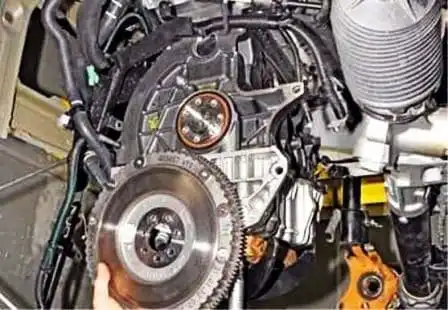
We remove the flywheel.
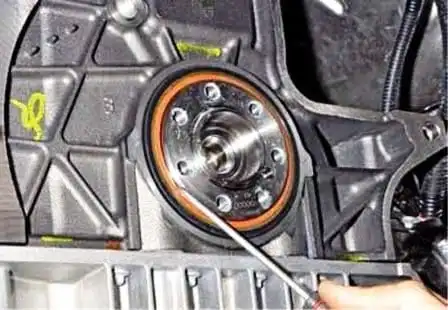
We prise out the rear crankshaft oil seal with a flat-blade screwdriver and withdraw it from the seat.
When fitting the oil seal, with a thin flat-blade screwdriver we guide the working lip of the oil seal onto the crankshaft flange.
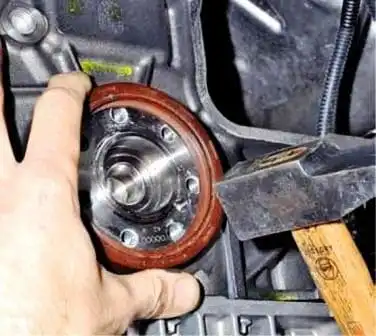
With the help of the old oil seal, we press the new oil seal into the seat of the cylinder block.
We fit the flywheel according to the marks made.
Before fitting the flywheel securing bolts, we apply sealant to their threaded part.
We screw in and evenly tighten the flywheel securing bolts to a torque of 55 Nm.
We carry out the further assembly in the reverse order.


