


The solenoid valve of the F4R engine and the high-voltage coil are secured by a single bolt.
At a crankshaft rotational frequency within 1500—4300 rpm, the electronic control unit applies voltage to the solenoid valve.
When 4300 rpm is exceeded, the supply to the solenoid valve is cut off.
In this case, the position of the phase regulator mechanism promotes the filling of the cylinders at a high crankshaft rotational frequency.
In this position, the locking plunger blocks the mechanism.
The diagram of the operation of the phase regulator and the solenoid valve is shown in Figure 1.
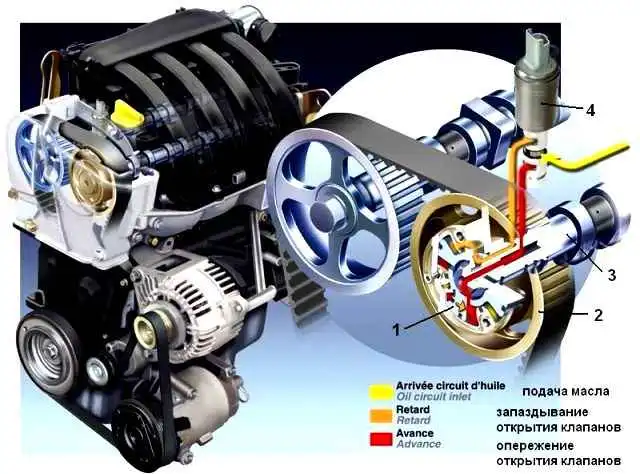
At a rotational frequency up to 1500 rpm, no voltage is applied to the solenoid valve.
The mechanism is blocked by the plunger.
From the moment power is applied to the solenoid valve, at a crankshaft rotational frequency of more than 1500 rpm, under the action of oil pressure, the locking plunger withdraws and releases the mechanism.
In the initial position, the solenoid valve is closed.
The valve opens the oil passage to control the phase regulator under the following conditions:
- the crankshaft rotational frequency sensor is serviceable;
- the camshaft position sensors are serviceable;
- the injection system is serviceable;
- after the engine starts;
- the engine is not running at idle;
- the battery voltage is more than 11.4 V;
- the coolant temperature is above 30 °C;
- the engine runs within 1500—4300 rpm;
- the load is more than 87% (approximately 900 mbar).
When the solenoid valve is blocked in the open position, the engine runs unsteadily at idle, the pressure in the intake pipe is increased.
In this case, a noisier operation of the engine is noted.
The engine may even stall (there have been cases of engine failure).
Removing the solenoid valve of the phase regulator of the F4R engine
We remove the valve for replacement, as well as for cleaning the valve or for replacing the seal in the cylinder head cover.
We disconnect the negative terminal of the battery.
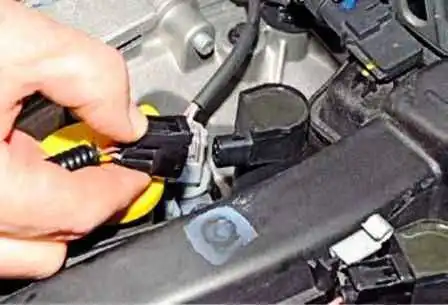
We press on the retainer of the wiring harness connector, disconnect the wire connector from the coil connector of the 4th cylinder.
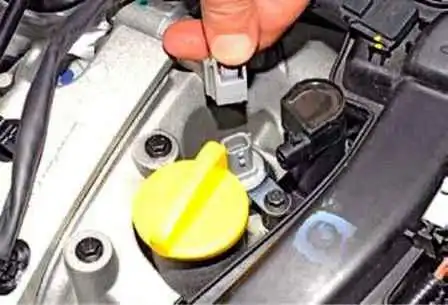
We press on the retainer and disconnect the connector from the valve connector.
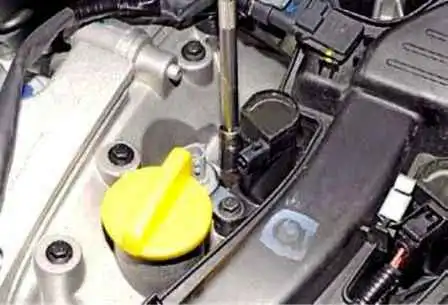
With an 8 mm socket we unscrew the bolt securing the valve bracket.
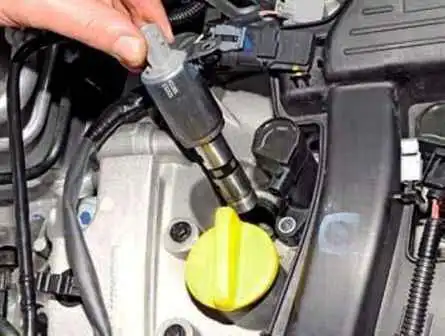
We take the valve out of the opening in the cylinder head cover.
The connection of the valve body with the cylinder head cover is sealed by an oil seal pressed into the cover seat.
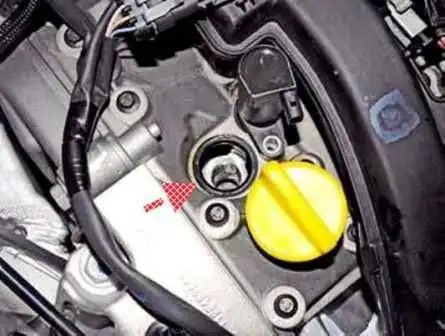
If the oil seal is damaged, we replace it.
We install the solenoid valve in the reverse order.


