

The engine oil pump is an ordinary gear pump.
Principle of operation of the pump: when the gears rotate, a vacuum is created on the inlet side, as a result of which the fluid fills the cavities between the teeth and is moved in them from the inlet side to the outlet side.
We remove the oil pump if the oil pressure does not correspond to the norm and during a major engine overhaul.
To remove the oil pump, the sump must be removed, as described in the article “How to dismantle the engine”.
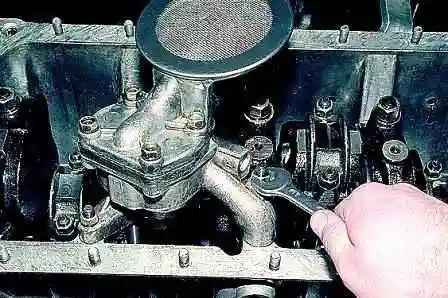
Using a 13 mm socket or spanner, we unscrew the two nuts securing the oil pump.
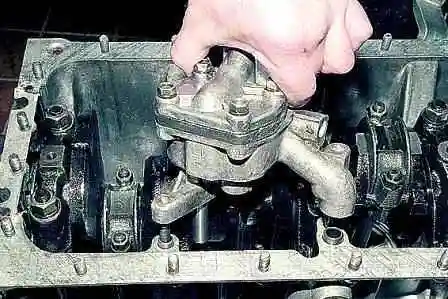
We remove the oil pump.
When we have removed the oil pump because of a defect (oil pressure not corresponding to the norm), attention must immediately be paid to the mesh of the oil pump intake.
It happens that the intake mesh is very heavily clogged and therefore the oil pressure is low.
The oil pump can be washed as an assembly by immersing it in a container of petrol and rotating the driving gear.
Dismantling of the oil pump
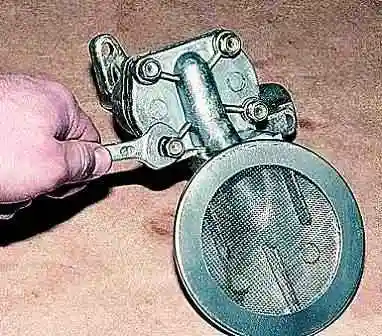
Using a 12 mm spanner, we unscrew the four screws securing the intake.
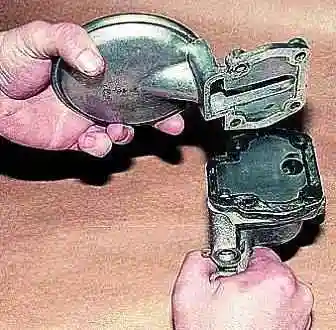
We remove the oil pump intake.
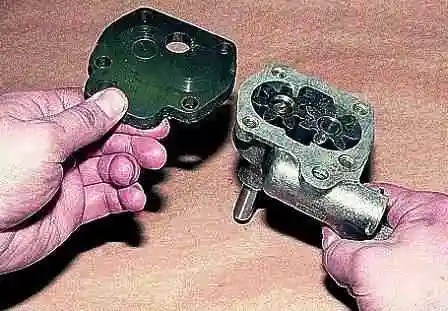
We remove the cover.
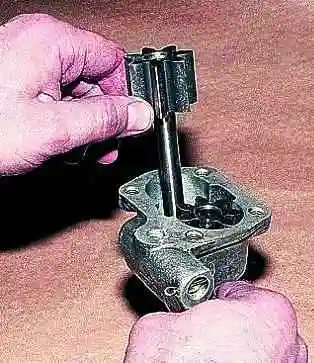
We extract the driving gear.
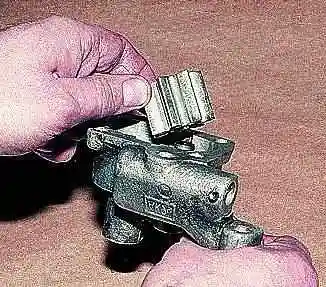
We extract the driven gear.
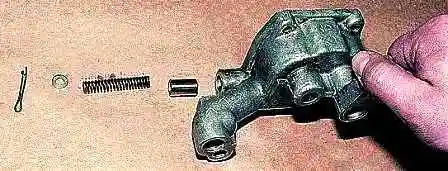
We remove the split pin from the relief valve fixing and extract its parts.
Inspection and fault diagnosis of the oil pump
- If there is wear from the gears on the partition (cover for mod. 402), it must be ground so that no traces of wear remain.
- Inspect the body. If it is heavily worn, the pump must be replaced.
- The gears in the pump body must rotate completely freely.
- The relief valve plunger must move in the body completely freely.
- Inspect the relief valve spring. If cracks are noticeable or the coils are broken — replace the spring.
The length and stiffness of the spring have been selected at the factory so that the operation of the relief valve is optimal; therefore the length and stiffness of the spring must not be changed in any way.
For the ZMZ-402 engine, to compress the spring to a length of 40 mm, a force of 43.5–48.5 N (4.35–4.85 kgf) must be applied.
If the spring does not meet at least one of these requirements, it must be replaced.
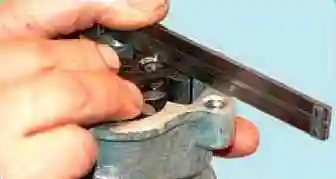
The clearance between the ends of the gears and the plane of the body must be 0.040–0.140 mm.
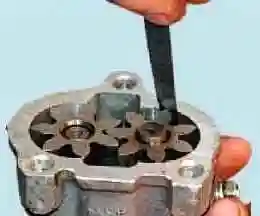
When measured with a flat feeler gauge, the clearance between the outside diameter of the gears and the body must be 0.120–0.215 mm.
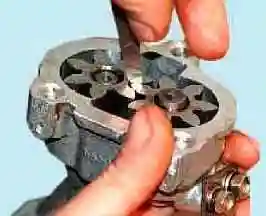
The clearance between the teeth of the gears must be no more than 0.15 mm.
If these values do not correspond, the pump parts must be replaced or the pump must be replaced.
Assembling the pump
We assemble the oil pump in the reverse order, having lubricated the friction parts with engine oil.
When assembling the pump of the mod. 402 engine, a cardboard gasket 0.3 mm thick must be fitted under the pump cover.
It is forbidden to fit a gasket of a different thickness or to use sealant, paint, etc. when fitting the gasket, as this will lead to a reduction in pump performance.
We fit the pump in the reverse order.
The oil pump mounting nuts are tightened to a torque of 18–25 N·m (1.8–2.5 kgf·m).


