


Repair of the connecting rod and piston assembly of the Cummins ISF2.8 engine
We carry out the repair of the connecting rod and piston assembly during a major or partial engine overhaul, when the components of the assembly need to be replaced.
Of course, if the engine has already been removed, it is advisable to carry out a major overhaul, since the engine will have to be removed anyway.
- we disconnect the battery cables;
- we drain the oil from the lubrication system;
- we remove the oil dipstick and the oil dipstick tube;
- we remove the sump and the gasket;
- we remove the piston cooling jets;
- we drain the coolant;
- we remove the cylinder head.
Turn the crankshaft so that the pistons are below the carbon deposit zone, which is located above the piston ring travel zone.
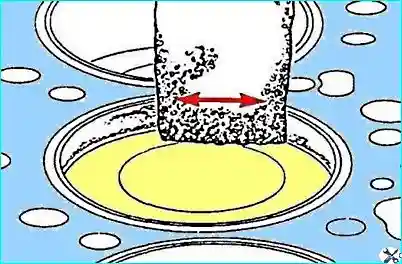
To remove carbon deposits, use a fine-grained abrasive stone with a fibrous structure and solvent.
Mark the cylinder number on the piston crown.
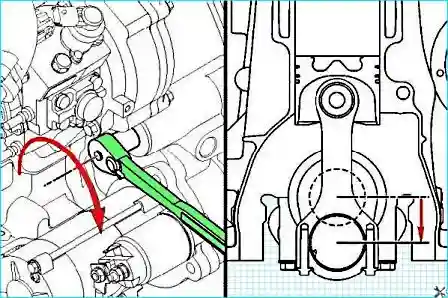
We turn the crankshaft so that the piston is at bottom dead centre in order to remove the connecting rod.
We slacken the connecting rod bolts but do not remove them.
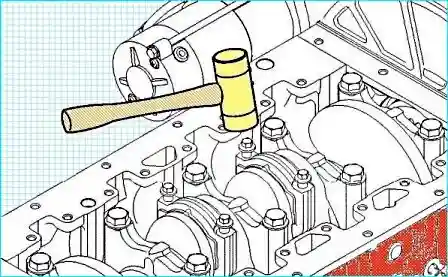
With a rubber-headed mallet, tap the connecting rod bolts to break the caps loose.
Important: if the engine is fitted with connecting rods having a fracture-split lower eye, take care when removing the cap to avoid damaging the contact surfaces of the rod or cap.
If the contact surfaces in the fracture zone are damaged, be sure to replace the connecting rod and its cap to reduce the likelihood of engine damage. Failure to follow the assembly rules may result in damage to the connecting rod.
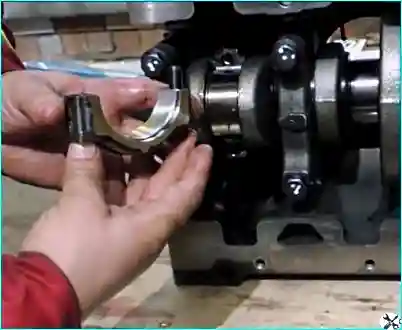
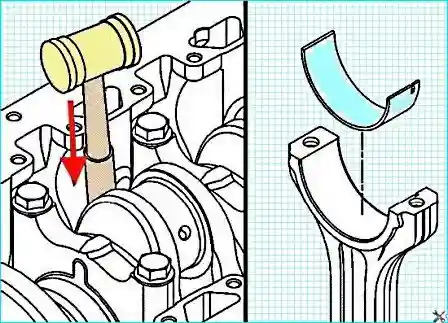
- we remove the connecting rod bolts;
- we remove the connecting rod cap;
- we remove the lower connecting rod bearing shell;
- we push the piston assembly with the connecting rod out of the cylinder;
- we remove the upper connecting rod bearing shell.
Important! Connecting rod bearing shells must not be reused.
The piston and connecting rod assembly should be installed in the cylinder from which they were removed, to ensure precise contact of the run-in surfaces if the parts are reused.
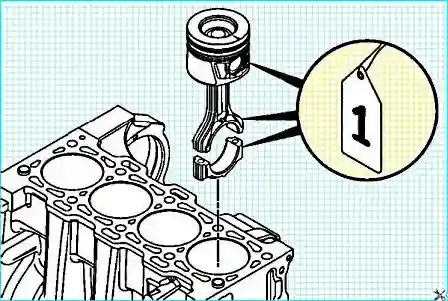
A tag bearing the cylinder number must be attached to each piston assembly.
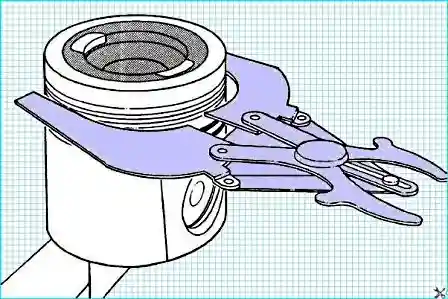
Using a piston ring expander (catalogue No. 3823137), remove the piston rings.
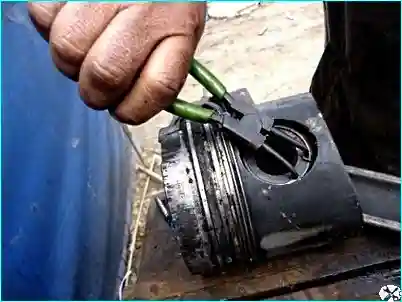
We extract the circlips from the grooves in the piston.
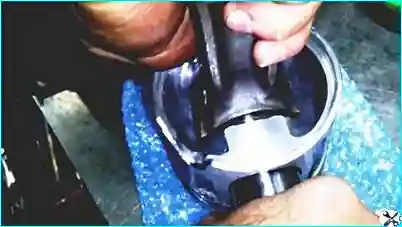
- we remove the piston pin and extract the connecting rod;
- we clean and check the pistons and piston pins.
We check the condition of the connecting rods.
Installation of the connecting rod and piston assembly
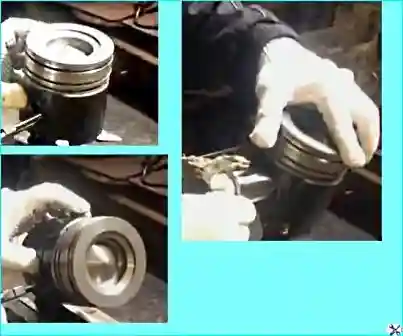
We install the spring ring in the piston pin groove on one side of the piston.
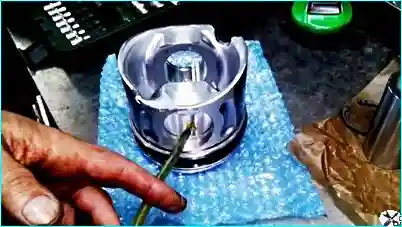
We lubricate the pin and the bores for it with clean engine oil.
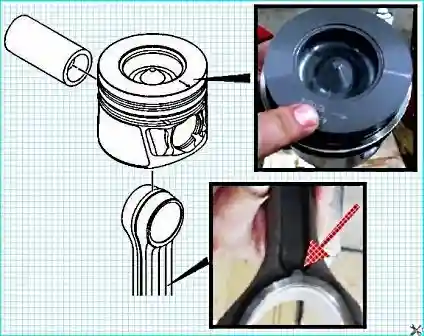
Important: when assembling the piston and connecting rod, the correct orientation must be observed.
On the surfaces of the connecting rods there are three notches which must face the front of the engine. On the pistons there is an arrow marked for this purpose.
We install the pistons on the connecting rods (there is no need to heat the pistons to install the pin).
Insert the pin into the piston and connecting rod.
We install the second circlip.
Installation of the piston rings
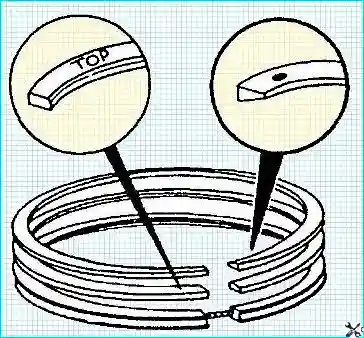
On the upper face of the compression rings there is the «ТОР» mark or the manufacturer's mark, for example a «dot». During assembly the marks must face upwards.
The oil control (lower) ring is installed with either side facing up.
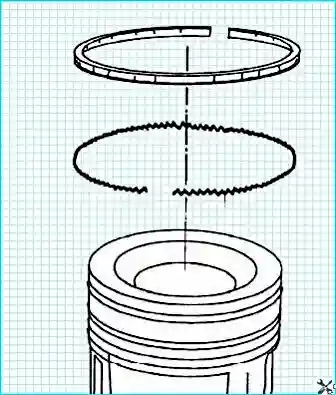
The oil control ring must be installed so that the gap of the spring expander is opposite the ring gap.
Using an expander (catalogue No. 3823137), we install the piston rings on the piston.
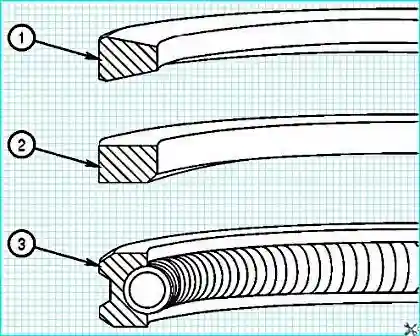
The type and installation position of the ring are determined by its profile.
Preparation for installing the pistons in the block
We clean the cylinder block and all parts before assembly.
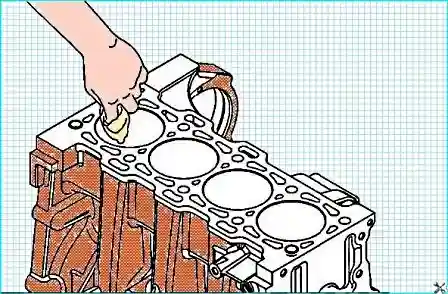
We check the cylinder block for defects.
Important: make sure there is no dirt or foreign particles on the connecting rods and the back of the bearing shells. Do not lubricate the back of the connecting rod bearings.
Install the upper bearing shell in the connecting rod. The locating tab of the bearing shell must engage in the groove of the connecting rod.
The edge of the bearing shell must be flush with the surface under the cap.
If the engine is fitted with connecting rods having a fracture-split lower eye, the lower and upper bearing shells are not interchangeable.
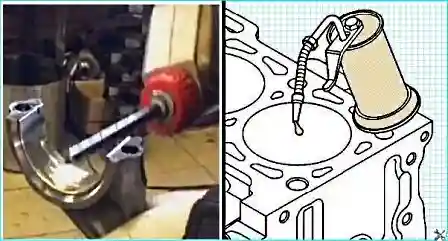
Using clean assembly oil (catalogue number 3163087) or its equivalent, lubricate the inner surface of the bearing shell.
We lubricate the cylinder wall with engine oil.
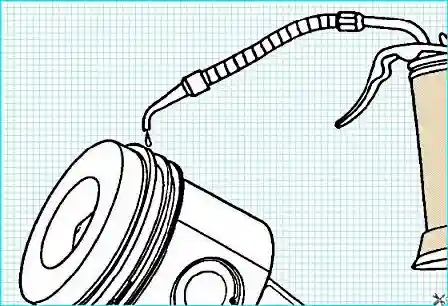
We lubricate the rings and piston skirts with clean engine oil.
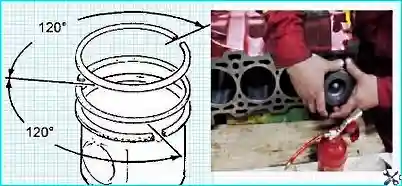
After turning the rings, we position their gaps as shown in the figure. The gap of each ring must not be opposite the piston pin or the gaps of the other rings.
Important! Incorrect positioning of the ring gaps will result in loss of cylinder sealing.
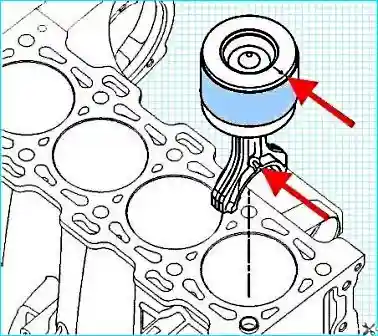
With a piston ring compressor (catalogue number 4919373) we compress the rings.
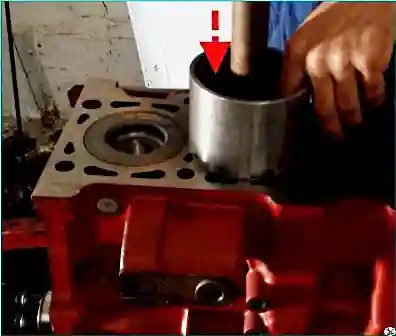
Installing the piston in the cylinder
We turn the crankshaft so that the connecting rod journal of the rod to be installed is at bottom dead centre.
Be sure to observe the orientation of the piston assembly with the connecting rod when installing it.
Having set the «Front» mark and/or the arrow on the upper face of the piston towards the front of the engine, insert the connecting rod into the cylinder until the piston ring compressor contacts the upper face of the cylinder block.
Press the piston ring compressor against the cylinder block.
Push the piston through the compressor into the cylinder.
Move the piston until the upper ring has fully entered the cylinder.
If the piston does not move freely, remove it and check for broken or damaged rings.
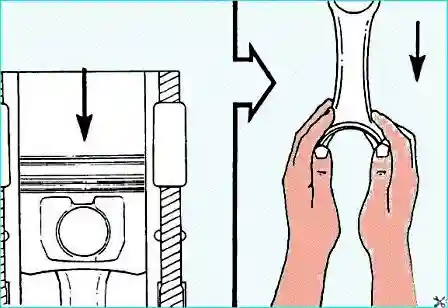
We carefully push the piston into the cylinder, guiding the connecting rod towards the connecting rod journal.
Important! Take care not to damage the crankshaft journal.
We install the bearing shell in the connecting rod cap.
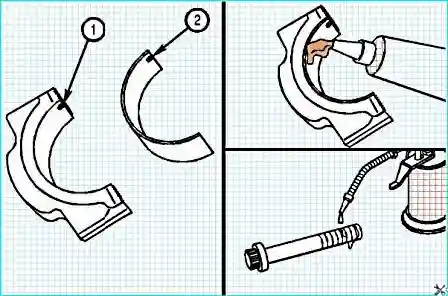
The tab «2» of the bearing shell must engage in the groove «1» of the cap. We lubricate the inner surface of the bearing shell with engine oil.
Important: the numbers on the connecting rod and the cap must be the same, and the piston must be installed in the corresponding cylinder.
The numbers on the connecting rod and the cap must be on the same side of the rod to reduce the likelihood of engine damage during operation.
Install the cap and the connecting rod bolts.
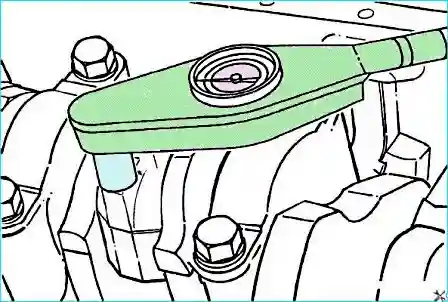
Using a torque wrench, we tighten the connecting rod cap bolts. Using the method of turning the bolt through a specified angle at the end of tightening, we alternately tighten the connecting rod bolts:
- first tightening stage — 34 N·m;
- second stage — turn 60° anticlockwise;
- third stage — tighten to a torque of 34 N·m;
- fourth stage — turn through an angle of 60° clockwise.
Post-assembly checks
We measure the side clearance between the connecting rod and the crankshaft crank.
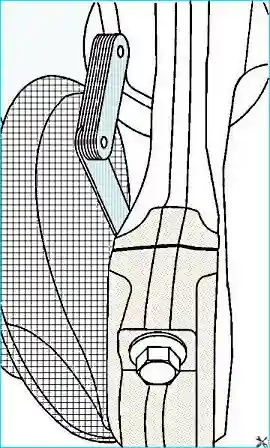
The side clearance must be 0.100–0.35 mm.
Note: we measure the piston protrusion above the upper face of the cylinder block. This operation is necessary only after repair or replacement of the piston, crankshaft, connecting rod or cylinder block.
We measure the protrusion using a depth gauge (catalogue No. 3823495).
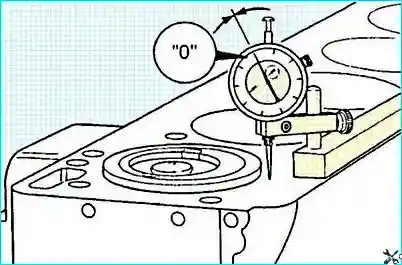
We mount the dial indicator on the upper face of the cylinder block and set it to zero.
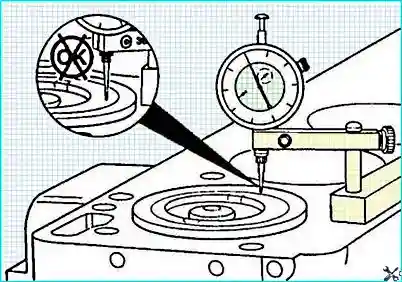
We move the indicator directly over the piston pin, preventing any transverse deflection.
Important: do not allow the indicator probe to touch a surface with a galvanic coating.
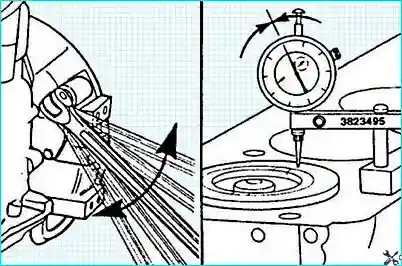
We turn the crankshaft so that the piston is at top dead centre.
By turning the crankshaft in different directions, we determine the maximum indicator reading. We record the measurement results.
The piston protrusion must be 0.034–0.260 mm.
If the piston protrusion does not meet the specification, the correct selection and machining of the parts must be checked.
We check the free rotation of the crankshaft after installing the connecting rod caps.
If the crankshaft does not rotate freely, we check how the connecting rod bearings are installed and their size.
After the operations performed, we assemble all parts in the reverse order in accordance with the technology.


