


The condenser (air conditioning radiator) of the multi-pass type is installed in front of the engine cooling system radiator.
The condenser is secured by four brackets to the tanks of the cooling system radiator.
The condenser fins consist of thin-walled flat aluminium tubes.
The tanks are made of aluminium, with flanges for connecting the pipelines.
In height, the tanks are divided into sections; therefore, as it passes through the condenser, the refrigerant flow changes direction several times.
In the condenser, the vapours of the refrigerant compressed by the compressor condense, and the heat released during this process is dissipated into the ambient air.
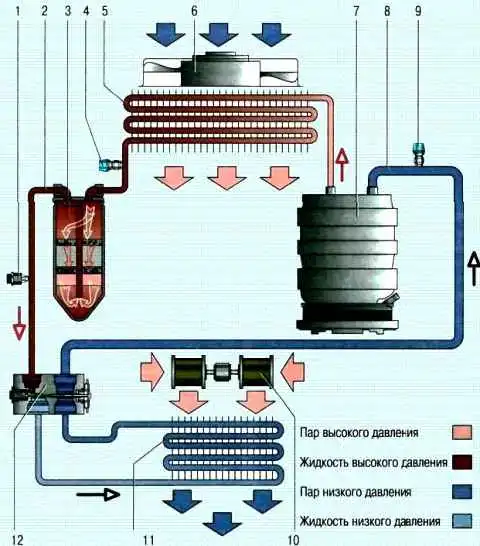
When the air conditioning is switched on, the engine control unit energises the power circuit of the electric fan of the engine cooling radiator, which improves heat exchange in the condenser and reduces the pressure in the air conditioning system.
At least once a year, preferably before the start of summer operation, wash the condenser fins to remove adhering dirt, dust and de-icing agents.
This will improve heat exchange, reduce the pressure in the system and extend the service life of the system components.
Do not use high-pressure water jet washers to wash the condenser.
This may damage the thin-walled fin plates.
Even with regular washing, the need to replace the condenser arises far more often than one would like.
The reason is that it is the first to take the flow of de-icing agents, dirt and road stones.
And the walls of its tubes are very thin.
In most cases, the condenser is damaged by corrosion in the third or fourth year of operation.
If corrosion compromises the tightness of the condenser, repairing it costs more than replacing it.
Even if an argon welder manages to patch the hole, a leak may soon appear elsewhere.
By the way, the pressure in the system on hot days can reach 25–28 bar.
In addition, the complex structure of the condenser tube should be taken into account: lengthwise it is divided by partitions into channels, so there is a high probability that after welding some of the channels will be blocked.
Accordingly, the dissipated power will drop and the operation of the air conditioning will deteriorate, especially in traffic jams and in hot weather.
After each attempt to patch the condenser, you will have to pay for removal and installation, welding of the condenser and recharging the system with refrigerant.
So it is better to install a new condenser straight away.
Instead of an expensive original one, you can quite well buy a cheaper condenser from authorised spare parts manufacturers.
Removal and installation of the condenser
To carry out the task you will need: a 7 mm spanner; Torx T30; a 10 mm socket; pliers; a flat-blade screwdriver; a container for the drained fluid.
We disconnect the negative terminal of the battery.
We remove the refrigerant from the air conditioning system as described in the article — Removal and installation of the Renault Duster heater.
We remove the front bumper (article — Removal and installation of the Renault Duster bumpers).
We remove the radiator deflector (article — Removal and installation of the Renault Duster cooling system radiator).
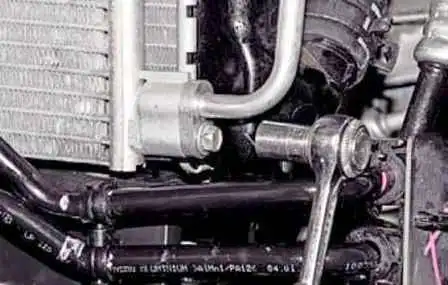
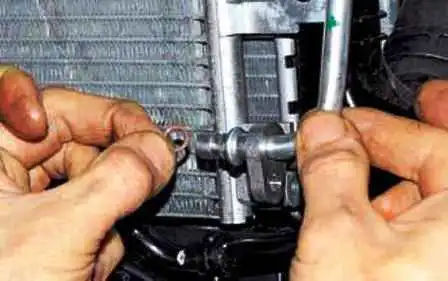
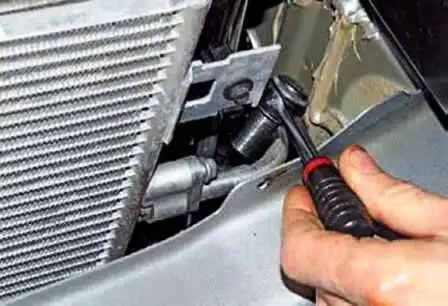
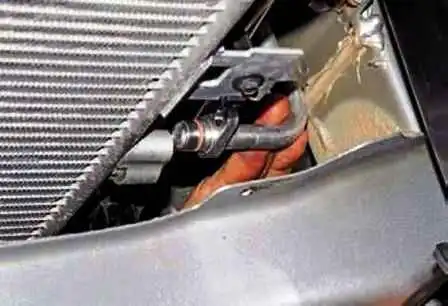
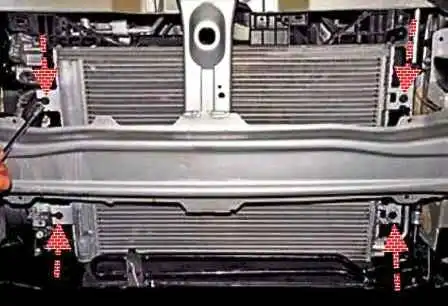
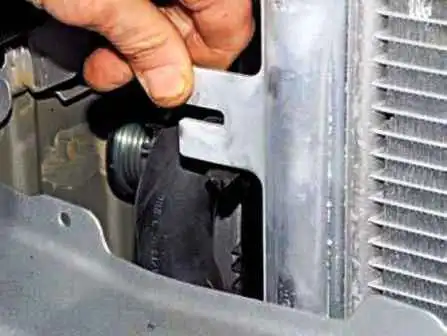
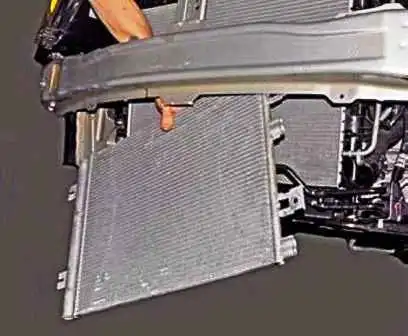
We remove the condenser.
We install the condenser in the reverse order.
We charge the air conditioning system.


