


GAZELLE NEXT
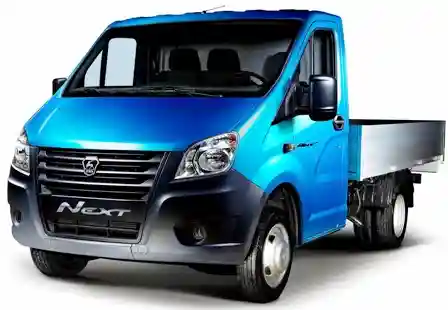
The GAZelle family of commercial and cargo-passenger vehicles in the LCV segment, manufactured by GAZ OJSC and also assembled using industrial assembly technology in Kazakhstan (Almaty), Lithuania (Rokiškis), and Iran (Tehran), was expanded in 2013 with the new NEXT model, a major upgrade of the previous GAZ-3302/2705 model.
The vehicle retains its frame structure, semi-bonneted cab, and longitudinal engine placement in the front of the cab.
Rear-wheel drive or, in the future (for all-wheel drive variants), dual-drive.
The main difference between the GAZelle NEXT and its predecessor is its independent front suspension and a completely new cabin with an anti-corrosion coating and plastic fenders.
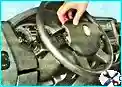
Removing the steering wheel
Remove the steering wheel when removing the steering column switches, ignition switch, instrument panel and when removing the steering column.
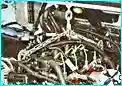
The engine on the Gazelle Next vehicle must be removed without the gearbox, extracting it forward from the engine compartment
You need to use a hoist or crane for this
- Design and verification of steering GAZelle Next
- Removal and installation of the instrument panel GAZelle Next
- Removal and installation of the starter of the car GAZelle Next
- Electrical diagrams of the car GAZelle Next
- Removal and installation of a turbocharger Cummins ISF2.8 Gazelle Next
- Removing and installing suspension arms Gazelle Next


